giving thanks
 The Gospel According to Matthew 14:19 (NABRE) records: “Taking the five loaves and the two fish, and looking up to heaven, he said the blessing, broke the loaves, and gave them to the disciples, who in turn gave them to the crowds.” A similar event in recorded in the Fourth Gospel.
In the Gospel According to John 6:1–15 (NABRE), Jesus multiplies some loaves and fish. The text presents this as a tremendous sign and provides a lot of detail around the setting, but it is rather more sparse when it comes to the details surrounding the working of the miracle itself. What we get in that category is the Gospel According to John 6:11 (NABRE): “Then Jesus took the loaves, gave thanks, and distributed them to those who were reclining, and also as much of the fish as they wanted.”
The only thing Jesus does here before distributing the food is give thanks, so it’s reasonable to conclude that act is essential to the miracle. The Greek word, εὐχαριστήσας (eucharistesas) means “give thanks” and is significant in Catholic contexts because it also is the root of the word “Eucharist.” In both the miracle from the Gospel According to John and the miracle of our celebration of the Eucharist, the act of giving thanks to God turns something that in itself is insufficient to meet our needs into a superabundance. Both miracles are achieved by the merit and power of Jesus Christ.
Consider in what other ways giving thanks to God for what we have can allow it to be sufficient or more than sufficient. What areas of your life might be an extension of the Eucharistic celebration?
related topics: thanksgiving, we give thanks
you also may like our study of Saul, David & Solomon (digital only)
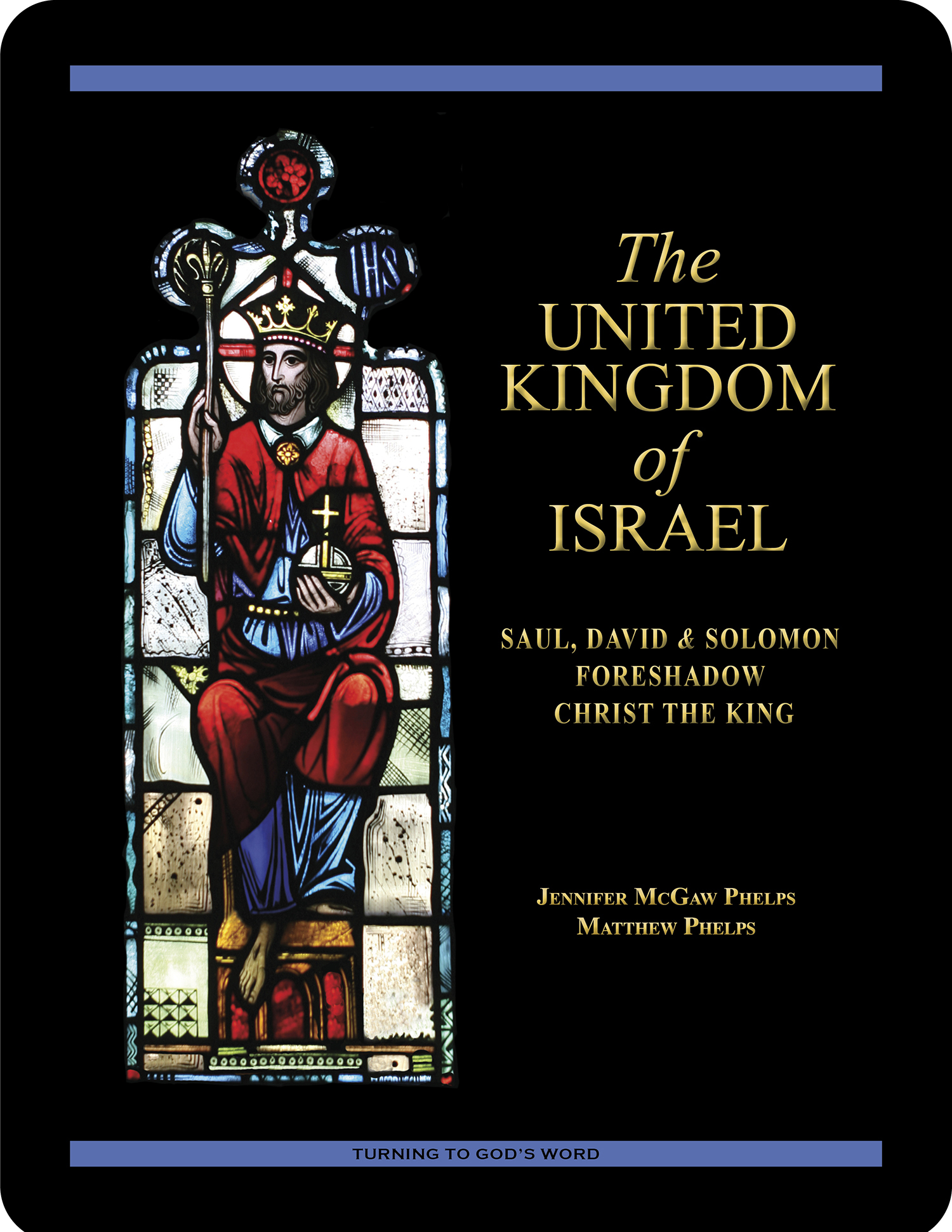 The United Kingdom of Israel: Saul, David & Solomon Foreshadow Christ the King, a 28-lesson Catholic Bible study with an imprimatur, provides an in-depth look at the First and Second Books of Samuel to learn how the lives of the monarchs Saul, David, and Solomon point ahead to the kingdom of heaven. The unified reign of King David is seen as a foreshadowing or type of the unity that is one of the four marks of the Church—the kingdom of God—established by Jesus Christ. Click here to view a sample of the first lesson.
 Click on the picture of the statue of Moses with horns (above) to learn more about Lost in Translation. A new entry is archived each Monday. Contact us to receive Lost in Translation by email every week. You may use any of the contact links on our website to ask Matthew a question.