
a man after God’s own heart
 Both the Revised Standard Version Catholic Editions (RSVCE) and the New American Bible Revised Edition (NABRE) translations of the First Book of Samuel 13:14 use a rather interesting phrase to describe David as a “man after [God’s] own heart.” This phrase easily can cause no small amount of confusion, most notably because something being after something else in a non-temporal context isn’t a common English idiom.
The original Hebrew text in this verse uses a preposition that means “like” or “as,” suggesting that God was seeking a man with a heart like his own. This raises the question of where we get the idea of “after” that we see in most translations. Ancient Greek, unlike ancient Hebrew, doesn’t have a preposition that exactly means “like.” In the Septuagint (the Greek translation of the Old Testament that was in common use at the time of Jesus) we see the preposition κατά (kata), which can in this context be translated as “after” in the sense of pursuit but can just as easily (and more so here, I think) mean “in accordance with” or “as.”
What the ancient author clearly means to say of David is that, as a result of Saul’s failure to live up to his responsibilities as king, God chose a man who shares his own view and feelings—a man with a heart like God’s own. This in no way suggests that David is equal to God or like God in every respect. Rabbi Abraham Heschel, in his seminal work on the prophets, defines prophecy as “sympathy with God” or the ability to feel things as God does. From the point of view of Heschel’s definition, David could be said to share in the gift of the prophets, and that’s what God was looking for in his king.
It’s through the line of David begun in the Old Testament that God establishes an eternal kingdom to be ruled over by the Messiah, or the Anointed One. David’s importance is attested to throughout the Gospels, which make many references to Jesus as the Son of David.
Paragraph 783 of the Catechism of the Catholic Church teaches that the whole people of God participate in the three offices to which Christ is anointed—priest, prophet, and king. How might we better share in that gift?
What might stand in the way of you having a heart like God’s?
related topics: prophecy; Septuagint
you also may like our study of the book of Genesis
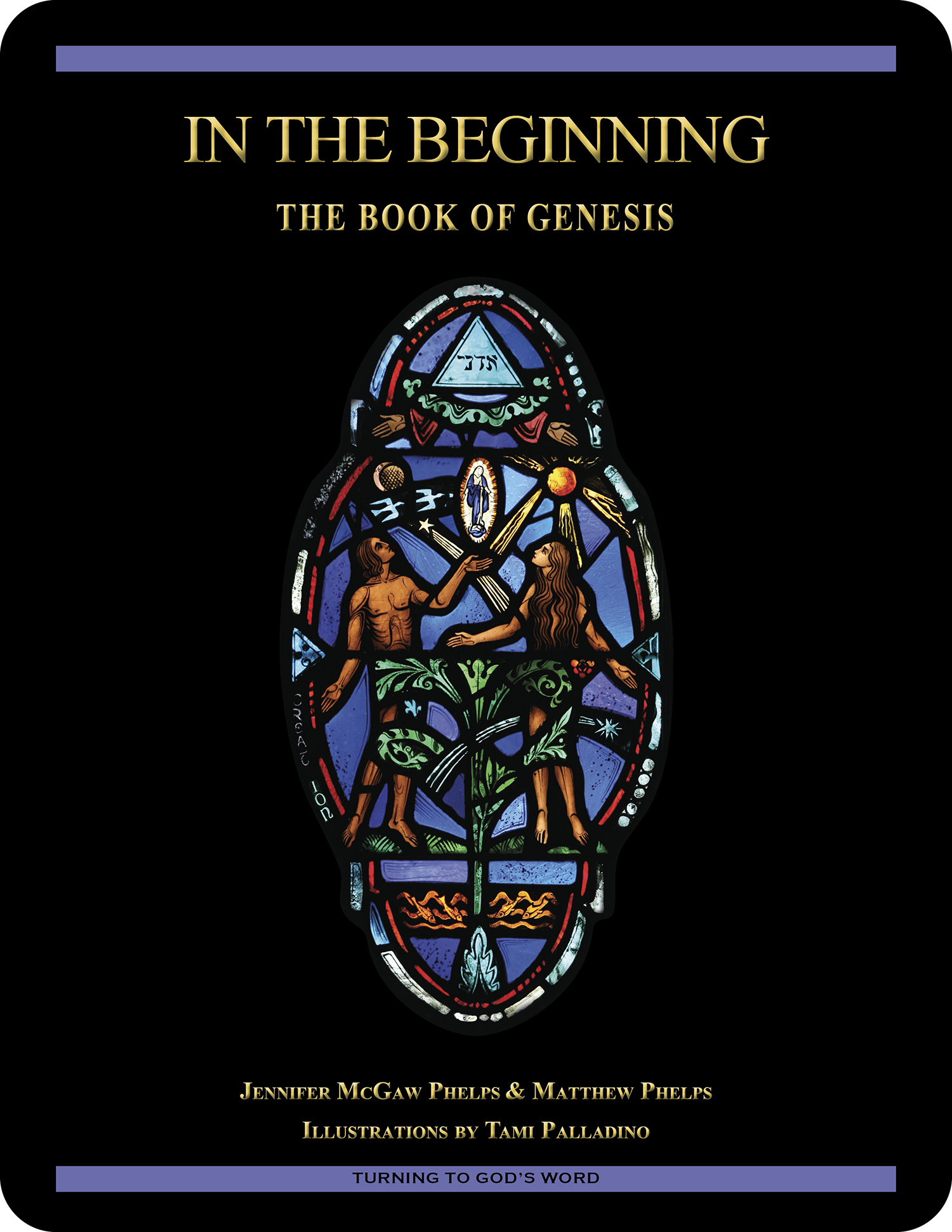 The first seven lessons of In the Beginning: The Book of Genesis, a 28-lesson Catholic Bible study with an imprimatur, provide an in-depth look at the very earliest biblical history—including the two accounts of Creation, events surrounding the Fall of Adam and Eve, the relationship between Cain and Abel, and the baptismal foreshadowing present in the account of Noah and the Flood. Remaining lessons look at lives of the patriarchs Abraham, Isaac, Jacob, and Joseph. Click here to view a sample of the first lesson.
 Click on the picture of the statue of Moses with horns (above) to learn more about Lost in Translation. A new entry is archived each Monday. Contact us to receive Lost in Translation by email every week. You may use any of the contact links on our website to ask Matthew a question.