The Gospel According to Mark:
A Look at the Son of God
Introduction What to Expect
Revised Standard Version Catholic Edition (RSVCE)*
New American Bible Revised Edition (NABRE)*
Catechism of the Catholic Church
ex libris (in our library)
Aperuit Illis (Instituting the Sunday of the Word of God)
Tami Palladino’s visual-meditation journal
glossary for the Gospel According to Mark
cross references in the Gospel According to Mark
first lesson: Jesus Christ: The Son of God
This material coordinates with the Introduction, “What to Expect,” on pages 4–7 in The Gospel According to Mark: A Look at the Son of God.
Now after John was arrested, Jesus came into Galilee, preaching the gospel of God, and saying,
“The time is fulfilled, and the kingdom of God is at hand; repent, and believe in the gospel.”
—the Gospel According to Mark 1:14–15
welcome to our in-depth study of the Gospel According to Mark
We invite interested groups and individuals to check out the sample introduction and first lesson from this 17- lesson Turning to
  God’s Word Catholic Bible study based on Scripture that is the source of most of the Sunday Gospel readings for liturgical Year B. These online study pages link to an online glossary and cross references in the biblical text. Other study aids include maps, additional commentary, and prayers based on the primary Scripture in each lesson. The Gospel According to Mark: A Look at the Son of God and the other two synoptic studies are being submitted for imprimaturs. This study will be available from our website shop about three months before the start of liturgical Year B in 2026. If you have a Bible-related question or comment, click on one of the “ask us your question” or “what do you think” buttons on any online study page.
every Turning to God’s Word Bible study carries an imprimatur
When finished, The Gospel According to Mark: A Look at the Son of God will be submitted for an imprimatur to the Most Reverend William M. Joensen, Ph.D. (left), bishop of the Diocese of Des Moines;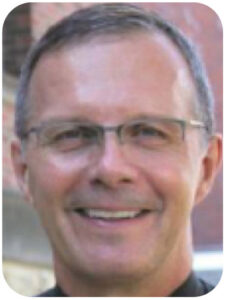 past studies have also been submitted for a nihil obstat to the Very Reverend Aquinas Nichols, censor librorum for the Diocese of Des Moines.
 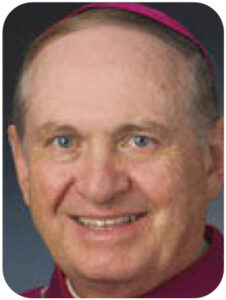 The imprimatur and nihil obstat are official declarations that a book or pamphlet is free of doctrinal or moral error. There’s no implication that those who’ve granted these declarations agree with the contents, opinions, or statements expressed in the work. All Turning to God’s Word Catholic Bible studies written after 2020 are being submitted to Bishop Joensen. Studies published before 2020 were granted an imprimatur by the Most Reverend Richard E. Pates, (right), bishop emeritus of the Diocese of Des Moines; Father Nichols granted the nihil obstat.
the popes inspire us—serious Catholics study the Word of God
In his apostolic letter Aperuit Illis (Instituting the Sunday of the Word of God) issued motu proprio (of his 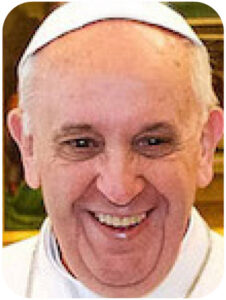 own accord), the late Pope Francis established the Third Sunday in Ordinary Time to be devoted to the celebration, study, and dissemination of the Word of God. His apostolic letter was published on September 30, 2019, the feast of St. Jerome and the 1600th anniversary of the saint’s death. St. Jerome, who translated the Latin
 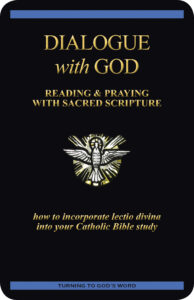 Vulgate Bible from Greek and Hebrew manuscripts, is famous for saying: “Ignorance of Scripture is ignorance of Christ.” In Aperuit Illis, Pope Francis calls attention to the sacramental nature of the Word of God, pointing to the unbreakable bond between Sacred Scripture and the Eucharist. In 2027, the Church will celebrate the Word of God on Sunday, January 24. We’ve posted a free digital version of Dialogue with God: Reading & Praying with Sacred Scripture, our guide to incorporating the Church’s traditional practice of lectio divina (sacred reading) into regular Bible study.
ex libris—read more Church documents
Find links to magisterial documents referred to in Turning to God’s Word Catholic Bible  studies, including Aperuit Illis (Instituting the Sunday of the Word of God), at ex libris—magisterial documents. The page lists significant recent encyclicals as well as a number of historical Church documents.
a few reminders about Turning to God’s Word Bible studies
The most distinguishing feature of our Bible studies is that they’re Catholic. Each one has been granted an imprimatur, which means that a bishop has read the work and found nothing contrary to Church teaching on morals or faith. Note that the imprimatur makes no claim that a work is equivalent to Church teaching, simply that it isn’t opposed to what the Church teaches. Practically speaking, this means that you don’t have to accept Turning to God’s Word interpretations of Scripture, only that choosing to do so doesn’t amount to heresy. Choosing not to accept conclusions of a work that’s been granted an imprimatur doesn’t immediately plunge you into heretical territory, but choosing not to accept Church teaching related to those conclusions does.
read the Catechism—how to avoid heresy
The imprimatur reinforces and validates the claim that Turning to God’s Word Bible studies are Catholic. All participants have a right to expect that discussions about our Bible studies will focus on Catholic teaching. That doesn’t mean that someone won’t occasionally have a question about Church teaching. Not knowing what the Church teaches about a particular issue isn’t heretical. Asking a question about Church teaching isn’t heretical. Failing to understand Church teaching isn’t heretical. Insisting that Church teaching is wrong is.
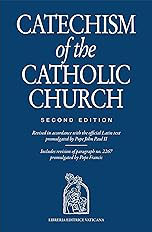 Most people who begin to study the Gospels are caught off guard by how many challenging theological ideas are found in Scripture. There are a surprising number of things many Catholics believe to be Church teaching that actually are not. In this study, we attempt to present Scripture and Church teaching related to the synoptic Gospels as unambiguously as possible. When in doubt, you can refer to the Catechism of the Catholic Church or talk with your parish priest about any doctrine that remains unclear.
If a Church teaching seems particularly unsettling even after studying the Catechism and speaking with someone who’s knowledgeable regarding Catholic doctrine, you might want to examine whether there’s be a personal or emotional reason why you’re having difficulty. Pray for God’s guidance and be open to receiving a different answer than you anticipated, possibly at a later time than you expected or hoped.
be respectful of the others in your group
Keep in mind that most people in your discussion group are there for a Catholic interpretation of Scripture. People from other faith backgrounds are welcome, but the focus of any Turning to God’s Word study always is going to be Catholic in nature. The following opening prayer emphasizes maintaining mutual respect amid differences of opinion:
Heavenly Father, send forth your Spirit to enlighten our minds
and dispose our hearts to accept your truth.
Help us to listen to one another with openness and honesty,
eager to learn from the talents and intuitions that you have given each of us.
Never let differences of opinion diminish our mutual esteem and love.
May we leave this meeting with more knowledge and love for you and your Son.
In the unity of the Holy Spirit. Amen.
You can find other opening prayers on our website. We especially like the following:
Lord Jesus, you promised to send your Holy Spirit to teach us all things.
As we read and study your word today,
allow it to touch our hearts and change our lives. Amen.
what do you think about interpreting Scripture?
 The Church encourages Catholics to read and interpret Scripture on our own as long as we follow these two rules:
1) Our interpretation can’t contradict anything else in Scripture.
2) Our interpretation can’t contradict Church teaching.
In order to comply, we need to know everything else that’s in the Bible as well as everything that the Church teaches. That’s a tall order, which is why each Turning to God’s Word Catholic Bible study is submitted to the Church for an imprimatur. The imprimatur for The Gospel According to Mark: A Look at the Son of God is a guarantee that the Church finds nothing objectionable in the work. You’re free to agree with interpretations in this Bible study, but it’s not essential that you do so. There are many different interpretations in other commentaries, but very few of them carry an imprimatur. This doesn’t mean that they necessarily pose any problems in regard to Catholic doctrine or moral teaching, but there’s no Church guarantee that they don’t.
When considering opinions that haven’t been granted an imprimatur, don’t be afraid to ask questions. Our Bible studies address some common interpretations, but there are innumerable opinions floating around about the meaning of different passages in the Bible—including in the synoptic Gospels.
? Here’s the first question to ask about an opinion expressed in any commentary: How closely does it adhere to what we can read in the biblical text?
? Do viewpoints about the meaning of the Bible passages contradict anything else you already know from Scripture?
? Do they contradict anything from Church teaching? The Catechism of the Catholic Church addresses a large number of questions related to common Scripture interpretations.
Lord & God—you could look it up in our archives
 God is addressed by several different names throughout the Bible. The reason has to do with the source manuscript that a translator is using. To learn about the distinctions between Lord, LORD, and God (Adonai, Yahweh [sometimes YHWH], and Elohim), read Lost in Translation, a weekly online column in which Turning to God’s Word author Matthew Phelps helps readers connect with ideas expressed in the original languages of the Scriptures. New Lost in Translation entries are posted on Mondays, and past entries are archived on our website. Contact us if you’d like to receive Lost in Translation by email every week.
the Gospel According to Mark is short & sweet
Many readers of Scripture appreciate that the Gospel According to Mark (Year B) is the shortest of the four Gospels. That also makes it the easiest biblical account of Jesus’ life to read in one sitting. For readers who have the time, it can be useful to read through the entire Gospel According to Mark before digging into the individual lessons. Because this study is part of an overall look at the three synoptic Gospels, familiarity with the Gospel According to Matthew (Year A) and the Gospel According to Luke (Year C) is helpful—as is an awareness of how the Gospel According to John differs from the other three Gospels.
None of this is strictly necessary, however; anyone can benefit from knowing the basic story covered in the Gospel According to Mark, which most scholars believe was the first written Gospel account of Jesus’ life. In this Catholic Bible study, Turning to God’s Word makes an effort to point out the main similarities and differences between the synoptic Gospels, which are featured in Sunday Mass readings for Years A, B, and C. (The first Turning to God’s Word synoptic study covers the Gospel According to Mark, which will be featured for Sunday Mass readings during Year B. That will be followed by a study of the Gospel According to Luke, which will be featured during Year C. The three-part synoptic study will end with a look at the Gospel According to Matthew, which will be featured during Year A.)
biblical vocabulary
Two words in the title the Gospel According to Mark jump out right away to most observant readers. The Revised Standard Version Catholic editions translate the titles of the four Gospels using the words “According to.” Turning to God’s Word follows the style adopted by translators of the Revised Standard Version Catholic Editions and refers to the Gospel According to Mark. This represents a slightly more authentic translation that’s in keeping with the title found on the oldest manuscripts, but the book also commonly is referred to as the “Gospel of Mark” and “Mark’s Gospel.”
It also can be beneficial to have a working idea of what the word Gospel means. Most scholars accept the definition that it means “good news.” When capitalized and italicized in Turning to God’s Word materials, Gospel refers to one of the first four books of the New Testament, all of which tell the story of Jesus’ life. You can learn more about how to think of these accounts, which are similar but not always identical, in the vocabulary boxes “Gospel” and “Synoptic,” on pages 5 and 7 respectively in the study book, The Gospel According to Mark: A Look at the Son of God. Readers may encounter the word “gospel” used outside a Christian context to mean “truth” and used to refer to a non-Christian doctrine or document.
translation changes
Attentive readers may notice a few slight variations between the Revised Standard Version Catholic Edition (RSVCE) and the Revised Standard Version Second Catholic Edition (RSV2CE). Turning to God’s Word reprints the RSV2CE, but because there is no free online version of that translation to which we can link, our website links to the RSVCE translation. There are very few changes between the two, and most are relatively insignificant—”beseech” has been dropped in favor of “beg,” “lo” now is “behold,” “girdle” and “mantle” have been replaced with “belt” and “coat” or “cloak.” In the synoptic Gospels the change that is perhaps most noticeable has to do with how God is spoken to and how he speaks. “You” replaces “thou” as a noun, and “are replaces “art” as a verb.
Jesus’ relative John
The person often referred to as John “the Baptist” in the other two synoptic Gospels originally was called John “the baptizer “in the Gospel According to Mark. That Gospel now refers to him as John “the Baptist.” In the Fourth Gospel (the Gospel According to John—the author isn’t the same John called “the Baptist” or “the baptizer” in the synoptic Gospels—Jesus’ relative never is referred to as “the Baptist” or “the baptizer.” Interestingly, the Fourth Gospel includes no account of John actually baptizing Jesus; instead, John’s primary role appears to be as a witness to Jesus.
what do you think should be the ultimate goal of Bible study?
The ultimate goal of this study is to increase our individual understanding about what God is communicating to us through the Gospels—particularly in the Sunday Mass readings, which emphasize the life and teachings of Jesus—and what we wish to communicate back to God. Because of this, many of the questions in The Gospel According to Mark: A Look at the Son of God direct participants to think about the meaning of the biblical text in the context of our own lives. It’s still important to focus on the facts presented in the text.
? Who is narrating the Scripture?
? Who is considered the ultimate author of Scripture?
? What is going on historically at the time the Gospel According to Mark was written?
? What do you know about the human author of the Gospel According to Mark? (The most prevalent theories are in the lead paragraphs to the Introduction in the study book. The Introduction and Lesson 1 from the study book make up the sample.)
? What might have been his primary purpose in writing the Gospel According to Mark?
? What expectations does this author have about God?
? What can you learn about God from this lesson?
? What effect do you expect studying the Gospels will have on your spiritual life?
? What are some ways that Christians can incorporate study of the Gospel According to Mark into regular prayer?
a video with potential to change the way you approach the Bible (40:44)
 Even if you’re a veteran of Catholic Bible studies, we encourage you to watch an explanation of the practical benefits of approaching The Bible as the Living Word of God. This 40-minute video is distilled from a talk that Turning to God’s Word author Matthew Phelps gave at a summer Bible study retreat at Conception Abbey in Conception, Missouri. In this video, Turning to God’s Word author Matthew Phelps looks at how viewing Scripture as a living document can help us to develop a more intimate relationship with Jesus Christ. There are benefits in setting aside what we think we know about Scripture to approach the Bible with the goal of learning what new things God is saying to us. Matthew examines the principles of lectio divina, the traditional Catholic approach to reading and praying with Scripture that’s foundational for all Turning to God’s Word Bible studies.
visual meditation is a form of prayer
 If you like to draw, you might want to
 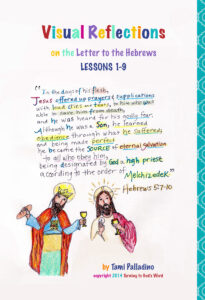 consider illustrating your prayers for The Gospel According to Mark: A Look at the Son of God. Check out drawings in this study and in the journal by Turning to God’s Word co-founder Tami Palladino to accompany The Letter to the Hebrews: An Explanation of the Mechanism of Our Salvation. Tami also illustrated The Revelation of Jesus Christ: The Faithful Witness, and some lessons in In the Beginning: The Book of Genesis and You Shall Have No Other Gods: The Book of Exodus.
the best Catholic commentary about Scripture
To find out more about how Church teaching is supported by passages in The Gospel According to Mark: A Look at the Son of God, check out the Index of Citations in the Catechism of the Catholic Church. Links to each lesson’s primary Scripture passages (from the Revised Standard Version Catholic Edition [RSVCE*]) that are cited in relevant paragraphs in the Catechism are provided on every online page. Not every passage in the Gospel According to Mark is referenced in a Catechism paragraph, however.
ways our glossary might prove helpful
In addition to providing extra information about geographical locations, our glossary also points out  persons or places mentioned in the biblical text under more than one name or more than one spelling. If you can remember a name but aren’t sure in which lesson it shows up, you can find it in the glossary, which lists every proper noun that appears in the biblical text for every lesson in The Gospel According to Mark: A Look at the Son of God. A few general terms also are included that may be unfamiliar or whose meaning may be unclear to readers.
to learn more, read more Scripture
If you’re having difficulty with a passage of Scripture, it can be helpful to read the relevant  cross references—but looking these up can take time. To make that easier, we’ve compiled the cross references from the Revised Standard Version Second Catholic Edition (RSV2CE)—the translation that we reprint in our study books. That list can be found at the top of every online study page accompanying this study, and it includes links to each of the cross references in the primary biblical text for The Gospel According to Mark: A Look at the Son of God.
don’t forget about our indexes & extra online material
If you’re trying to locate information about a specific Scripture passage, you can look it up in the index at the back of the study book. If you want to find a particular commentary, you can look up its title in the topics index. To learn more about another book of the Bible for which there’s a Turning to God’s Word study, visit the online study directories to read the commentaries and watch any accompanying videos. Finally, if you have a question or would like to make a comment about any of our studies, you can use one of the “ask us your question” or “what do you think” buttons to email our authors.
ex libris—Church documents & books about religious topics
Link to magisterial documents referred to in our Bible studies at ex libris—magisterial documents. This listing includes significant recent encyclicals as well as a number of historical Church documents. Recommended books related to Scripture study can be found at ex libris—main bookshelf.
wondering how to pronounce some words?
Each online page provides links to readings from the New International Version (NIV) Bible. To listen, open one of the links and click on the audio icon above the printed text. Although not taken from the translations used in our study materials, the NIV readings provide an audio guide to pronunciation of many words in this lesson’s primary biblical texts. A close online version of the translation of the Bible currently used in Catholic liturgy in the United States as well as an audio guide for daily Mass readings for the current month can be found on the website of the United States Conference of Catholic Bishops (USCCB).
 close with Bible-based prayer related to this lesson
Many of our Catholic study groups like to conclude their discussions with a prayer based on the scriptural focus of their lesson, and some participants include Scripture-specific prayer in their individual study. If you’re uncomfortable composing your own Bible-based prayers, you can follow our four easy steps. If you prefer, you can use the following prayer based on general themes in the Gospel According to Mark.
O God, you sent your own Son Jesus into the world
to demonstrate your great love for humanity.
Help us to see how best we can serve you
as the Evangelist Mark did when he determined
that he was called to write a clear account of Jesus’ life.
Grant that we may benefit from his labors
and from this Catholic Bible study
and allow us to join all the saints in eternal life. Amen.
Lesson 1 Jesus Christ: The Son of God—the Gospel According to Mark 1:1–45
you also may like Volume II of our psalms study
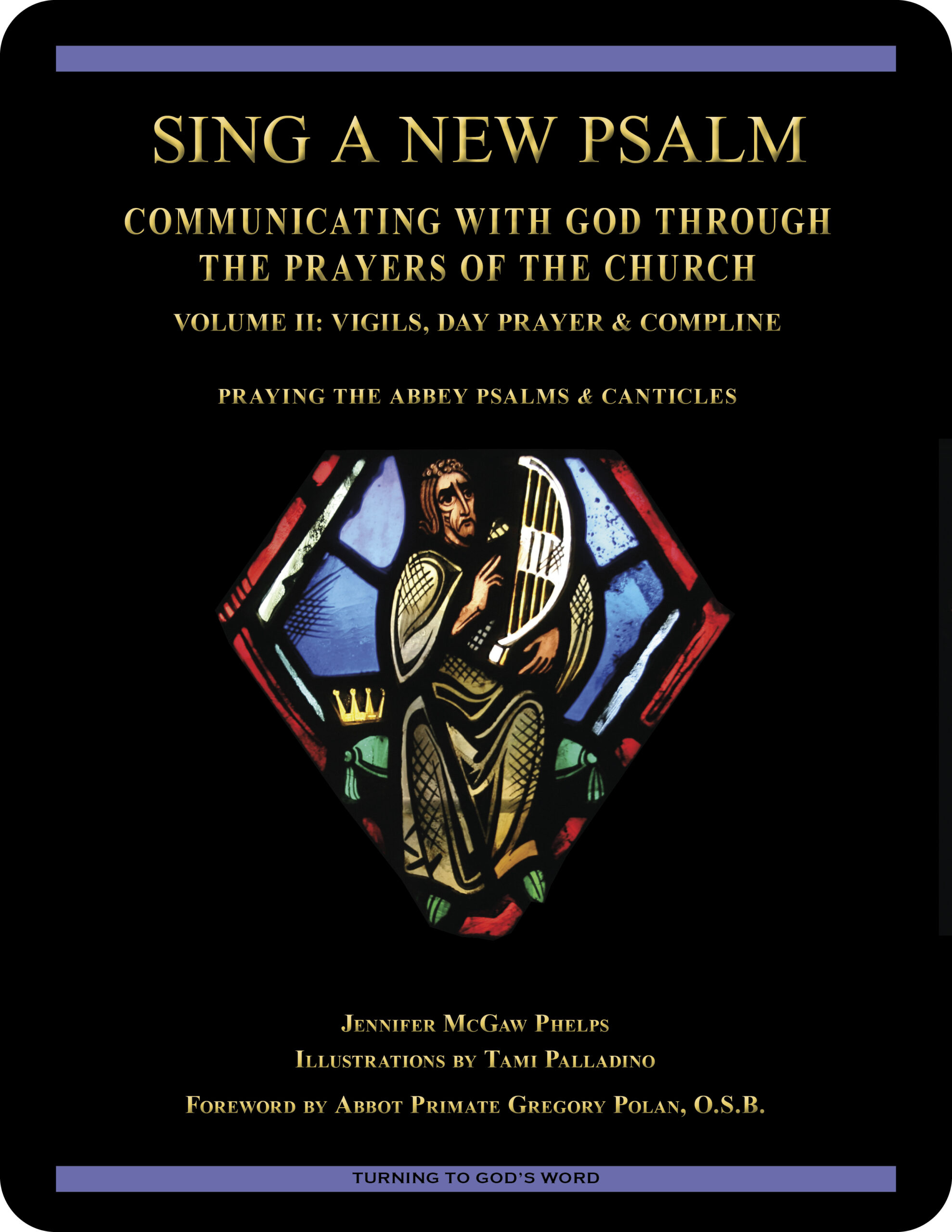 Sing a New Psalm: Communicating with God Through the Prayers of the Church—Volume II: Vigils, Day Prayer & Compline provides an in-depth look at psalms prayed by Catholics in early morning, mid-day, and evening liturgies. Volume II includes 29 lessons based on The Abbey Psalms and Canticles, a translation prepared by the Benedictine monks of Conception Abbey and endorsed by the United States Conference of Catholic Bishops (USCCB) for liturgical use. Click here to view a sample of the Introduction and Lesson 1.
start a Turning to God’s Word Bible study
 Thank you for your interest in our three-part study of the synoptic Gospels.
  More information about beginning a Turning to God’s Word Bible study can be found at start a Bible study, and Tami, Matthew, and I are available to answer questions or discuss concerns. Contact us to start this or one of our other studies or to have your schedule listed with other TtGW study groups on our website. —Jennifer
*There are seven deuterocanonical books in the Old Testament—Baruch, Judith, Sirach, Tobit, Wisdom, and First and Second Maccabees—and there are some deuterocanonical passages in the Books of Daniel and Esther. Protestants usually refer to these works as “apocryphal,” a word that means “outside the (Protestant) canon” because they’re excluded from most Protestant Bibles. Deuterocanonical means “second canon”; Catholics use that word to refer to any section of the Catholic Old Testament for which there are no extant, or existing, Hebrew manuscripts. All of the deuterocanonical books appear in the Septuagint, the earliest remaining versions of which date to the 1st century B.C. This Greek translation of the Old Testament was in common use by Jews at the time of Jesus. Learn more by reading How Do Catholic & Protestant Bibles Differ?
Turning to God’s Word printed Bible studies use the 2006 Revised Standard Version Second Catholic Edition (RSV2CE) translation for all Scripture references except those to the psalms, which are taken from The Abbey Psalms and Canticles, prepared by the Benedictine monks of Conception Abbey and published in 2020 by the United States Conference of Catholic Bishops (USCCB). All Scripture links for the online study pages for The Gospel According to Mark: A Look at the Son of God are to the 1966 Revised Standard Version Catholic Edition (RSVCE) translation. The New International Version (NIV) audio recordings follow the same chapter and verse numbering as the RSV Catholic translations.
The 1966 RSVCE uses archaic pronouns and verb forms such as “thee,” “thou,” and “didst” in the psalms and in direct quotations attributed to God. The 2006 RSV2CE replaces these with more accessible English. The few significant translation changes in the RSV2CE include rendering almah as “virgin” in the Book of Isaiah 7:14 and restoring the term “begotten” in the Gospel According to John 3:16.
Numbering varies for some passages in this Bible study. Turning to God’s Word studies (print and digital) follow the numbering in the Revised Standard Version Catholic translations (RSV2CE and RSVCE). Discrepancies in the New American Bible Revised Edition (NABRE) are noted in the Index of Scripture Citations in the study book.
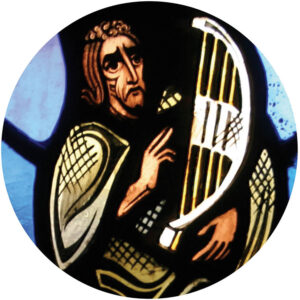 You can learn more about the psalms by viewing a sample lesson from the Turning to God’s Word Catholic Bible study Sing a New Psalm: Communicating with God Through the Prayers of the Church. The first volume covers psalms prayed at Lauds and Vespers; the second volume covers psalms prayed at Vigils, Day Prayer, and Compline. Numbering of psalms and verses may vary in different translations.