
The Gospel According to Mark:
A Look at the Son of God
Lesson 2 The Son of Man Has Divine Authority
the Gospel According to Mark 2:1–28
Revised Standard Version Catholic Edition (RSVCE)*
New American Bible Revised Edition (NABRE)*
Catechism of the Catholic Church
ex libris (in our library)
glossary for the Gospel According to Mark
cross references in the Gospel According to Mark
next lesson: Is Jesus Possessed?
This material coordinates with Lesson 2, “The Son of Man Has Divine Authority,” on pages 13–16 in The Gospel According to Mark: A Look at the Son of God.
Now after John was arrested, Jesus came into Galilee, preaching the gospel of God, and saying,
“The time is fulfilled, and the kingdom of God is at hand; repent, and believe in the gospel.”
—the Gospel According to Mark 1:14–15
welcome to our in-depth study of the Gospel According to Mark
We invite interested groups and individuals to check out the sample introduction and first lesson from this 17- lesson Turning to
  God’s Word Catholic Bible study based on Scripture that is the source of most of the Sunday Gospel readings for Liturgical Year B. These online study pages link to an online glossary and cross references in the biblical text. Other study aids include maps, additional commentary, and prayers based on the primary Scripture in each lesson. The Gospel According to Mark: A Look at the Son of God and the other two synoptic studies are being submitted for imprimaturs. This study will be available from our website shop about three months before the start of liturgical Year B in 2026. If you have a Bible-related question or comment, click on one of the “ask us your question” or “what do you think” buttons on any online study page.
open with prayer
It’s always wise to begin any Bible study with prayer, whether reading the Scriptures alone or meeting with others in a discussion study group. You can pray using your own words or use one of the opening prayers on our website. We especially like the following:
Lord Jesus, you promised to send your Holy Spirit to teach us all things.
As we read and study your word today,
allow it to touch our hearts and change our lives. Amen.
let’s review—the Gospel According to Mark 1:1–45
Lesson 1 Jesus Christ: The Son of God introduces Jesus at the start of his adult ministry. The author opens with Jesus’ baptism in the Jordan River by John the Baptist, quickly followed by Jesus’ 40 days of temptation by Satan in the wilderness. This Gospel, which most scholars think was the first biblical account written about Jesus’ life, describes Jesus beginning to preach after John’s arrest. Jesus calls Simon (later renamed Peter), Andrew, James, and John and his first disciples, and he also begins his healing ministry. Jesus’ fame quickly spreads throughout the region of Galilee.
authority—you could look it up in our archives
 The Evangelist Mark identifies Jesus’ teaching with authority as a key way of differentiating between what Jesus teaches and what the scribes teach. The word translated as authority in Scripture also can mean “power.” To learn more, read Lost in Translation, a weekly online column in which Turning to God’s Word author Matthew Phelps helps readers connect with ideas expressed in the original languages of the Scriptures. New Lost in Translation entries are posted on Mondays, and past entries are archived on our website. Contact us if you’d like to receive Lost in Translation by email every week.
Christian Connection: performative words
That Jesus exhibits power to cast out an unclean spirit indicates that his speech is performative, a divine attribute that humans do not share with God, except when a priest acts in persona Christi when performing the sacraments of the Church.
 ? How does Jesus’ performative speech change reality in the Gospel According to Mark 2:1–12?
? Why might Jesus choose to demonstrate his authority in this way?
? How do the sacraments of the Church display Jesus’ power at work in the world today?
? What role, if any, do you think our responses to Jesus’ teaching have in how much authority we perceive them as having?
Jesus calls another disciple
Although Levi seems an unlikely choice as a disciple, his willingness to respond to Jesus immediately  and with generosity demonstrates that anyone can act in a way that is pleasing to God—despite past sinful behavior. The Gospel According to Mark 2:14 describes the call of Levi, but the Evangelist fails to mention that this same person also goes by the name of Matthew, something that present-day scholars agree about. The Gospel According to Matthew doesn’t include anything about a tax-collector named Levi; instead, in all references in that Gospel he is called Matthew. Some scholars speculate that Levi may have taken the name Matthew at the time he became a follower of Jesus, and there also is speculation that Jesus may have been responsible for renaming this disciple.
Jesus is not alone describing himself as a bridegroom
In the Gospel According to Mark 2:19–20 Jesus says: “Can the wedding guests fast while the bridegroom is with them? As long as they have the bridegroom with them, they cannot fast. The days will come, when the bridegroom is taken away from them, and then they will fast in that day.” Jesus’ self-identification with a bridegroom reinforces what his relative John says about Jesus in the Gospel According to John 3:29: “He who has the bride is the bridegroom; the friend of the bridegroom, who stands and hears him, rejoices greatly at the bridegroom’s voice; therefore this joy of mine is now full.”
? What other passages in Scripture of you know of that also refer to a bridegroom, a bride, or a wedding?
? What point might Jesus have been trying to make by using this image?
? How is the idea of Jesus as a bridegroom relevant to Christians?
Jesus follows David’s example
When questioned about his disciples’ actions on the sabbath, Jesus responds by citing a story well-known at the time about David eating showbread in the temple at Nob. (This event occurred prior to the building of the Temple in Jerusalem.) The account of David’s actions can be found in the First Book of Samuel 21:1–6. Scholars are uncertain why Jesus refers to Abiathar instead of Ahimelech, but one theory is that Abiathar was the son of Ahimelech and shared the duties of high priest with his father. Another theory is that the Evangelist Mark was confused about the name of the man who was high priest when the event occurred.
map notes—where was Nob?
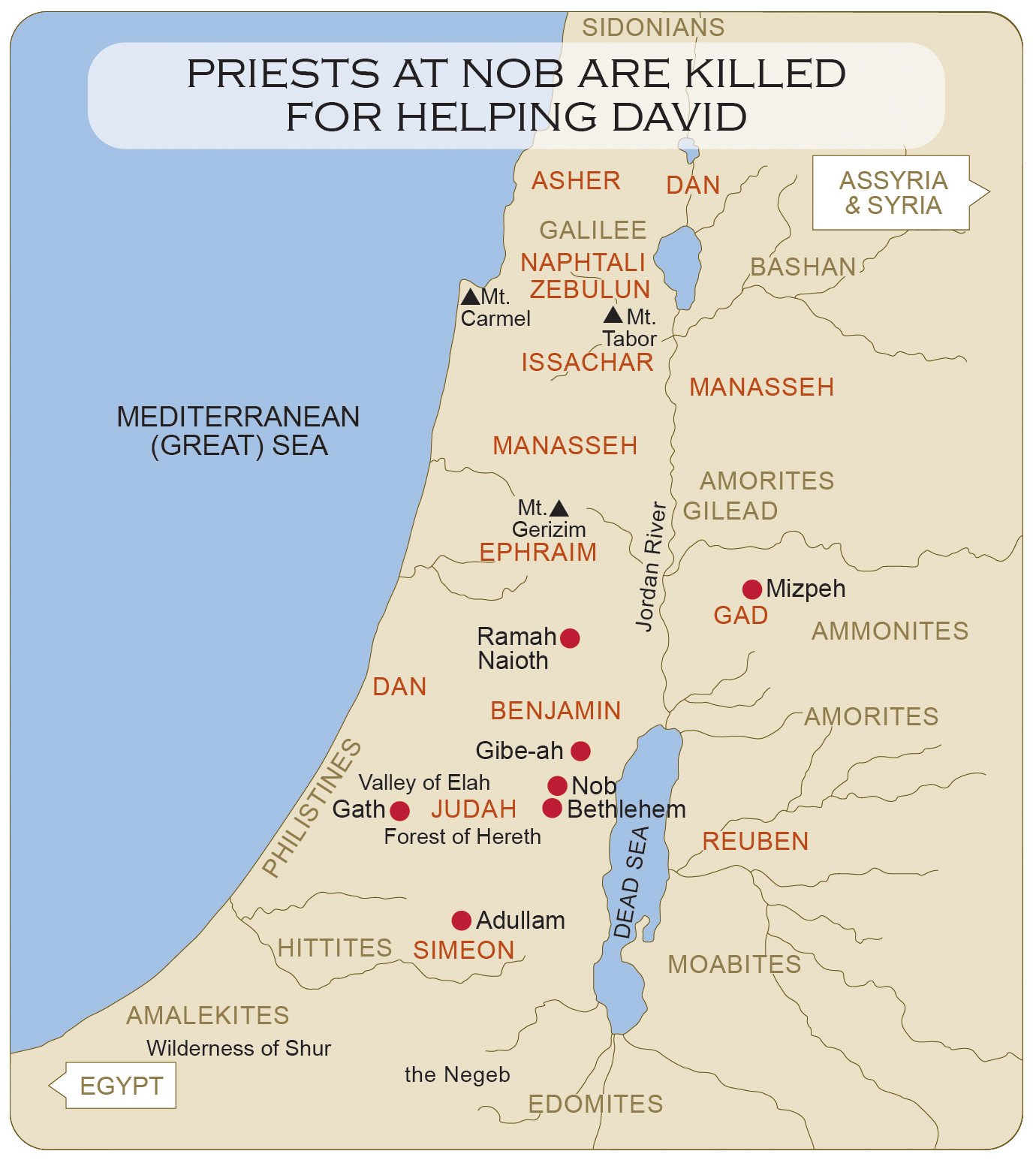 Nob is located just north of Bethlehem. Before David conquered Jerusalem and his son Solomon built the Temple
  there, Nob was a city of priests. It’s easy to mistake it as one of the 48 cities allotted to the Levites in lieu of other real estate in the land of Canaan. The book of Numbers 35:1–8 specifies that these cities are to be taken from the tribes receiving land. The Levites were dispersed in order to instruct all of the people regarding law and worship. Levites also lived in places that weren’t designated as Levitical cities, and they appear to have been regarded as attached to the tribe with which they resided. Click on the map to enlarge it. The same map also is printed on page 48 in The United Kingdom of Israel: Saul, David & Solomon Foreshadow Christ the King.
the Pharisees express concern about keeping the sabbath
In the Gospel According to Mark 2:24, the Pharisees are upset because Jesus’ disciples are ignoring Jewish religious law by plucking and eating grain on the sabbath. Jesus’ response, in the Gospel According to Mark 2:27–28, is to announce: “The sabbath was made for man, not man for the sabbath; so the Son of man is lord even of the sabbath.”
read the Catechism—the importance of the sabbath in the Old Testament
Judaism is a religion that developed during the Babylonian Exile, when the descendants of Jacob didn’t have access to God’s Temple in Jerusalem because it had been destroyed by the Babylonians. Many of the inhabitants of the southern kingdom of Judah were taken captive to Babylon. The religion that grew 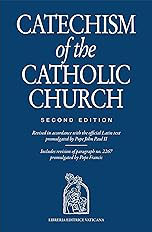 out of the people’s experience was law-based; although it was built around the Ten Commandments, a number of other laws (613) had been added that weren’t expressly ordained by God. Paragraph 348 in the Catechism of the Catholic Church teaches about the place the sabbath held in Jewish life.
348 The sabbath is at the heart of Israel’s law. To keep the commandments is to correspond to the wisdom and the will of God as expressed in his work of creation.
the best Catholic commentary about Scripture
To find out more about how Church teaching is supported by passages in The Gospel According to Mark: A Look at the Son of God, check out the Index of Citations in the Catechism of the Catholic Church. Links to each lesson’s primary Scripture passages (from the Revised Standard Version Catholic Edition [RSVCE*]) that are cited in relevant paragraphs in the Catechism are provided here. Not every passage in the Gospel According to Mark is referenced in a Catechism paragraph.
the Gospel According to Mark 2:1–12—paragraph 1421
the Gospel According to Mark 2:5—paragraphs 1441, 1484, 2616
the Gospel According to Mark 2:5–12—paragraphs 1502 and 1503
the Gospel According to Mark 2:7—paragraphs 430, 574, 589, 1441
the Gospel According to Mark 2:8—paragraph 473
the Gospel According to Mark 2:10—paragraph 1441
the Gospel According to Mark 2:14–17—paragraph 574
the Gospel According to Mark 2:17—paragraphs 545, 1484, 1503
the Gospel According to Mark 2:19—paragraph 796
the Gospel According to Mark 2:23–26—paragraph 544
the Gospel According to Mark 2:23–27—paragraph 581
the Gospel According to Mark 2:25–27—paragraph 582
the Gospel According to Mark 2:27—paragraph 2173
the Gospel According to Mark 2:27–28—paragraph 2167
the Gospel According to Mark 2:28—paragraph 2173
ways our glossary might prove helpful
In addition to providing extra information about geographical locations, our glossary also points out persons or places mentioned in the biblical text under more than one name or more than one spelling. If you can remember a name but aren’t sure in which lesson it shows up, you can find it in the glossary, which lists every proper noun that appears in the biblical text for every lesson in The Gospel According to Mark: A Look at the Son of God. A few general terms also are included that may be unfamiliar or whose meaning may be unclear to readers.
to learn more, read more Scripture
If you’re having difficulty with a particular passage of Scripture, it can be helpful to read the relevant  cross references—but looking these up can take time. To make that easier, we’ve compiled the cross references from the Revised Standard Version Second Catholic Edition (RSV2CE)—the translation that we reprint in our study books. A link to that list can be found at the top of every online study page; the list features links to cross references in the primary biblical text in the study book The Gospel According to Mark: A Look at the Son of God.
don’t forget about our indexes & extra online material
If you’re trying to locate information about a specific Scripture passage, you can look it up in the index at the back of the study book. If you want to find a particular commentary, you can look up its title in the topics index. To learn more about another book of the Bible for which there’s a Turning to God’s Word study, visit the online study directories to read the commentaries and watch any accompanying videos. Finally, if you have a question or would like to make a comment about any of our studies, you can use one of the “ask us your question” or “what do you think” buttons to email our authors.
ex libris—Church documents & books about religious topics
Link to magisterial documents referred to in our Bible studies at ex libris—magisterial documents.  This listing includes significant recent encyclicals as well as a number of historical Church documents. Recommended books related to Scripture study can be found at ex libris—main bookshelf.
wondering how to pronounce some of these words?
The following link is to a reading from the New International Version (NIV) Bible. To listen, open the link and click on the audio icon above the printed text. Although not taken from the translations used in our study materials, the NIV reading provides an audio guide to pronunciation of words in this lesson’s primary biblical text. A close online version of the translation of the Bible used in Catholic liturgy in the United States as well as an audio guide for daily Mass readings for the current month can be found on the website of the United States Conference of Catholic Bishops (USCCB).
the Gospel According to Mark 2:1—28 (NIV)
 close with Bible-based prayer related to this lesson
Many of our Catholic study groups like to conclude their discussions with a prayer based on the scriptural focus of their lesson, and some participants include Scripture-specific prayer in their individual study. If you’re uncomfortable composing your own Bible-based prayers, you can follow our four easy steps. If you prefer, you can use the following prayer based on this lesson’s text from the Gospel According to Mark.
O God, help us to willingly cede authority to you.
Teach us the wisdom involved in making the only choice available to us—
the choice to serve you or to serve Satan.
Grant that we may understand that choosing self-interest
amounts to the sin associated with choosing evil.
We ask this in the name of your Son Jesus,
who always chose to do your will. Amen.
Lesson 3 Is Jesus Possessed?—the Gospel According to Mark 3:1—35
Lesson 1 Jesus Christ: The Son of God—the Gospel According to Mark 1:1–45
you also may like our study of the book of Exodus
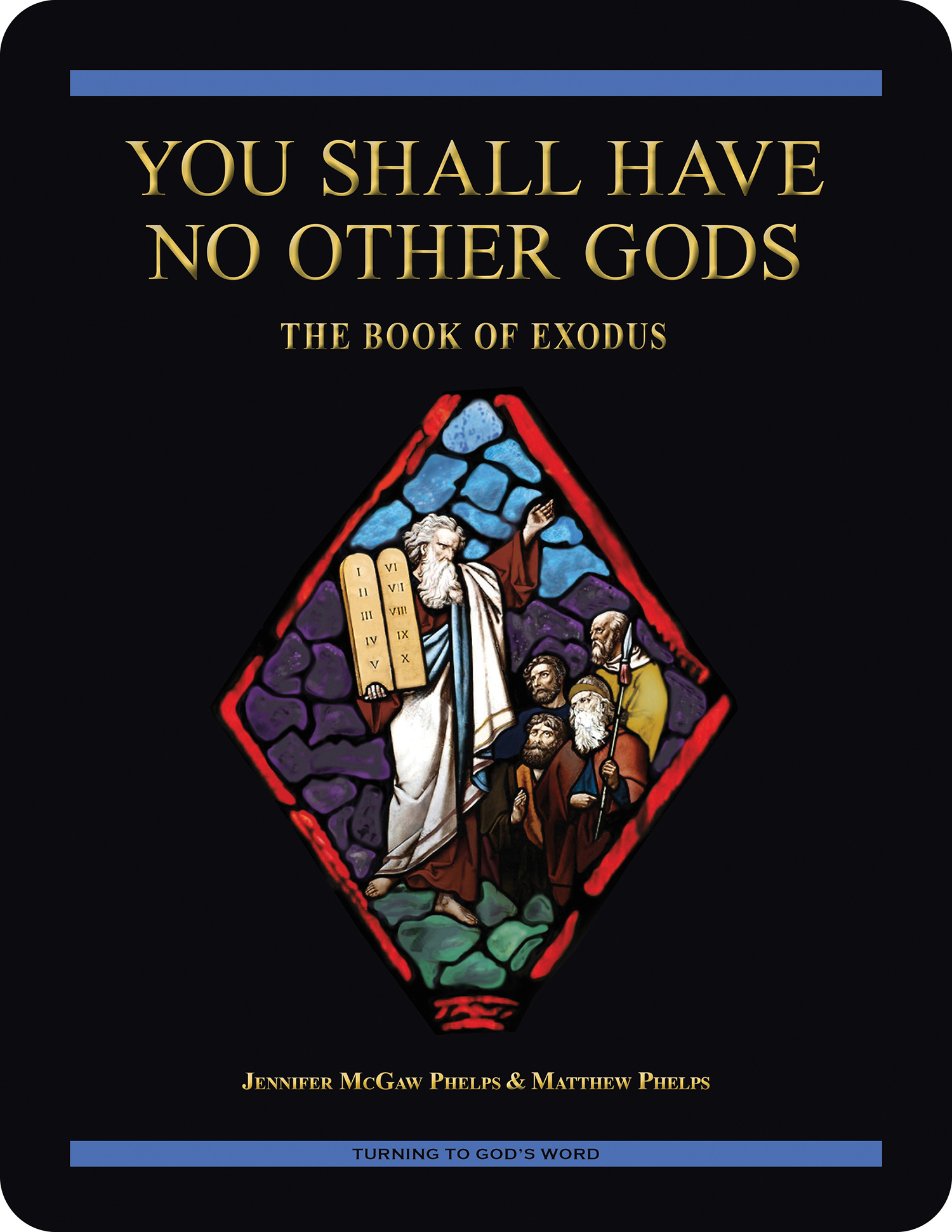 You Shall Have No Other Gods: The Book of Exodus, a 28-lesson Catholic Bible study with an imprimatur, provides an in-depth look at how significant events in biblical history that occurred thousands of years ago to descendants of Jacob remain relevant and even critical for present-day Christians to understand. The deliverance of the Hebrews from slavery in Egypt and the giving of Ten Commandments are examined along with the development of Moses’ relationship to God. Click here to view a sample of the first lesson.
start a Turning to God’s Word Bible study
 Thank you for your interest in our three-part study of the synoptic Gospels.
  More information about beginning a Turning to God’s Word Bible study can be found at start a Bible study, and Tami, Matthew, and I are available to answer questions or discuss concerns. Contact us to start this or one of our other studies or to have your schedule listed with other TtGW study groups on our website. —Jennifer
*There are seven deuterocanonical books in the Old Testament—Baruch, Judith, Sirach, Tobit, Wisdom, and First and Second Maccabees—and there are some deuterocanonical passages in the Books of Daniel and Esther. Protestants usually refer to these works as “apocryphal,” a word that means “outside the (Protestant) canon” because they’re excluded from most Protestant Bibles. Deuterocanonical means “second canon”; Catholics use that word to refer to any section of the Catholic Old Testament for which there are no extant, or existing, Hebrew manuscripts. All of the deuterocanonical books appear in the Septuagint, the earliest remaining versions of which date to the 1st century B.C. This Greek translation of the Old Testament was in common use by Jews at the time of Jesus. Learn more by reading How Do Catholic & Protestant Bibles Differ?
Turning to God’s Word printed Bible studies use the 2006 Revised Standard Version Second Catholic Edition (RSV2CE) translation for all Scripture references except those to the psalms, which are taken from The Abbey Psalms and Canticles, prepared by the Benedictine monks of Conception Abbey and published in 2020 by the United States Conference of Catholic Bishops (USCCB). All Scripture links for the online study pages for The Gospel According to Mark: A Look at the Son of God are to the 1966 Revised Standard Version Catholic Edition (RSVCE) translation. The New International Version (NIV) audio recordings follow the same chapter and verse numbering as the RSV Catholic translations.
The 1966 RSVCE uses archaic pronouns and verb forms such as “thee,” “thou,” and “didst” in the psalms and in direct quotations attributed to God. The 2006 RSV2CE replaces these with more accessible English. The few significant translation changes in the RSV2CE include rendering almah as “virgin” in the Book of Isaiah 7:14 and restoring the term “begotten” in the Gospel According to John 3:16.
Numbering varies for some passages in this Bible study. Turning to God’s Word studies (print and digital) follow the numbering in the Revised Standard Version Catholic translations (RSV2CE and RSVCE). Discrepancies in the New American Bible Revised Edition (NABRE) are noted in the Index of Scripture Citations in the study book.
 You can learn more about the psalms by viewing a sample lesson from the Turning to God’s Word Catholic Bible study Sing a New Psalm: Communicating with God Through the Prayers of the Church. The first volume covers psalms prayed at Lauds and Vespers; the second volume covers psalms prayed at Vigils, Day Prayer, and Compline. Numbering of psalms and verses may vary in different translations.