
The Gospel According to Mark:
A Look at the Son of God
Lesson 5 Demons Are Legion
the Gospel According to Mark 5:1–43
Revised Standard Version Catholic Edition (RSVCE)*
New American Bible Revised Edition (NABRE)*
Catechism of the Catholic Church
ex libris (in our library)
glossary for the Gospel According to Mark
cross references in the Gospel According to Mark
next lesson: The Death of John the Baptist
This material coordinates with Lesson 5, “Demons Are Legion,” on pages 25–28 in The Gospel According to Mark: A Look at the Son of God.
Now after John was arrested, Jesus came into Galilee, preaching the gospel of God, and saying,
“The time is fulfilled, and the kingdom of God is at hand; repent, and believe in the gospel.”
—the Gospel According to Mark 1:14–15
welcome to our in-depth study of the Gospel According to Mark
We invite interested groups and individuals to check out the sample introduction and first lesson from this 17- lesson Turning to
  God’s Word Catholic Bible study based on Scripture that is the source of most of the Sunday Gospel readings for Liturgical Year B. These online study pages link to an online glossary and cross references in the biblical text. Other study aids include maps, additional commentary, and prayers based on the primary Scripture in each lesson. The Gospel According to Mark: A Look at the Son of God and the other two synoptic studies are being submitted for imprimaturs. This study will be available from our website shop about three months before the start of liturgical Year B in 2026. If you have a Bible-related question or comment, click on one of the “ask us your question” or “what do you think” buttons on any online study page.
open with prayer
It’s always wise to begin any Bible study with prayer, whether reading the Scriptures alone or meeting with others in a discussion study group. You can pray using your own words or use one of the opening prayers on our website. We especially like the following:
Lord Jesus, you promised to send your Holy Spirit to teach us all things.
As we read and study your word today,
allow it to touch our hearts and change our lives. Amen.
let’s review—the Gospel According to Mark 4:1–41
Lesson 4 ‘Do You Understand This Parable?’ focuses on the importance of understanding Jesus’ parables. The Gospel According to Mark 4:11–13 records some of Jesus’ more disturbing words to his disciples: “To you has been given the secret of the kingdom of God, but for those outside everything is in parables; so that they may indeed see but not perceive, and may indeed hear but not understand; lest they should turn again, and be forgiven.” And he said to them, “Do you not understand this parable? How then will you understand all the parables?” The Evangelist pairs these private comments of Jesus with parables in which he describes the kingdom of God, and the fourth chapter closes with the story about Jesus calming a storm on the Sea of Galilee. Consider whether Jesus’ disciples were able to understand that Jesus is the Son of God—even with private explanations about the meaning of Jesus’ parables.
demonic possession—you could look it up in our archives
 In the fourth chapter of the Gospel According to Mark, a man possessed by demons is said to be inhabited by “unclean spirits,” but the man later is called a demoniac. To learn more why demoniac possession is difficult for men and women to understand, read Lost in Translation, a weekly online column in which Turning to God’s Word author Matthew Phelps helps readers connect with ideas expressed in the original languages of the Scriptures. New Lost in Translation entries are posted on Mondays, and past entries are archived on our website. Contact us if you’d like to receive Lost in Translation by email every week.
a problem with the ancient understanding of demons
The Greek word for “demon” is δαίμων (daimon). Many Greek lexicons define daimon as a god or goddess, though in Greek mythology such daimones (the plural of daimon) are incorporeal—nature spirits that are not perceived either as evil or as good. This is not unlike the way we view ghosts in our culture. Even in the Septuagint, daimones are less-than-divine natural spirits, though many of these contexts tend to suggest idolatry and foreign gods.
New Testament use of the word daimon forever changed its meaning and is responsible for how we view demons in our Christian world today. In the New Testament, daimones are unambiguously evil spirits that possess people, a view consistent with the Judeo-Christian worldview.
 ? How do you think demons are present in our world today?
? In the Greek view, possession often was considered to be a sign of deification, or being made into a god. Why do you think it is that Christianity and Judaism tend to take a less favorable view of such possession?
? What problem might this Greek view of demonic possession have posed for Jesus?
Jesus ups the ante from synagogue to synagogue official
In the fifth chapter in the Gospel According to Mark, Jesus continues to perform healing miracles. Of significance is the story of Jesus healing the daughter of a synagogue official, presumably in the same synagogue at Caperna-um where he began his ministry. Many of the religious leaders in the area (around the Sea Galilee) have been openly criticizing Jesus because his healing take place on the sabbath and this appears to be in contradiction to religious law of the time. That one of the local religious leaders is willing to ask Jesus to heal his daughter—who presumably dies while Jesus is on his way to her—indicates that the synagogue official Jairus is willing to take his chances with the religious leaders. Jairus exhibits great faith when he turns to Jesus, because it means that Jairus is going against his own assumed religious interests.
? How do you think that the Pharisees and scribes who have been criticizing Jesus feel about Jairus after he asks Jesus to heal his daughter?
? What impact might the Pharisees’ and scribes’ opinion have on Jairus’ future?
? What reason might Jesus have for limiting the number of witnesses who observe him healing the girl?
? Why might Jesus strictly charge no one to talk about what he has just done?
Christian Connection: what does it mean to be possessed?
The people in Jesus’ time regularly blamed unusual behavior on demonic possession, but that label is far less commonly applied in the present day.
? What are some of the labels currently applied to people who exhibit behavior that falls outside of what most people experience?
? Consider whether demonic possession still is a valid label for such behavior in some instances
? What might those instances be?
? How can religious faith help people who are experiencing such difficulties, and how can it prove harmful?
no one knows for sure where the healing of the demoniac took place
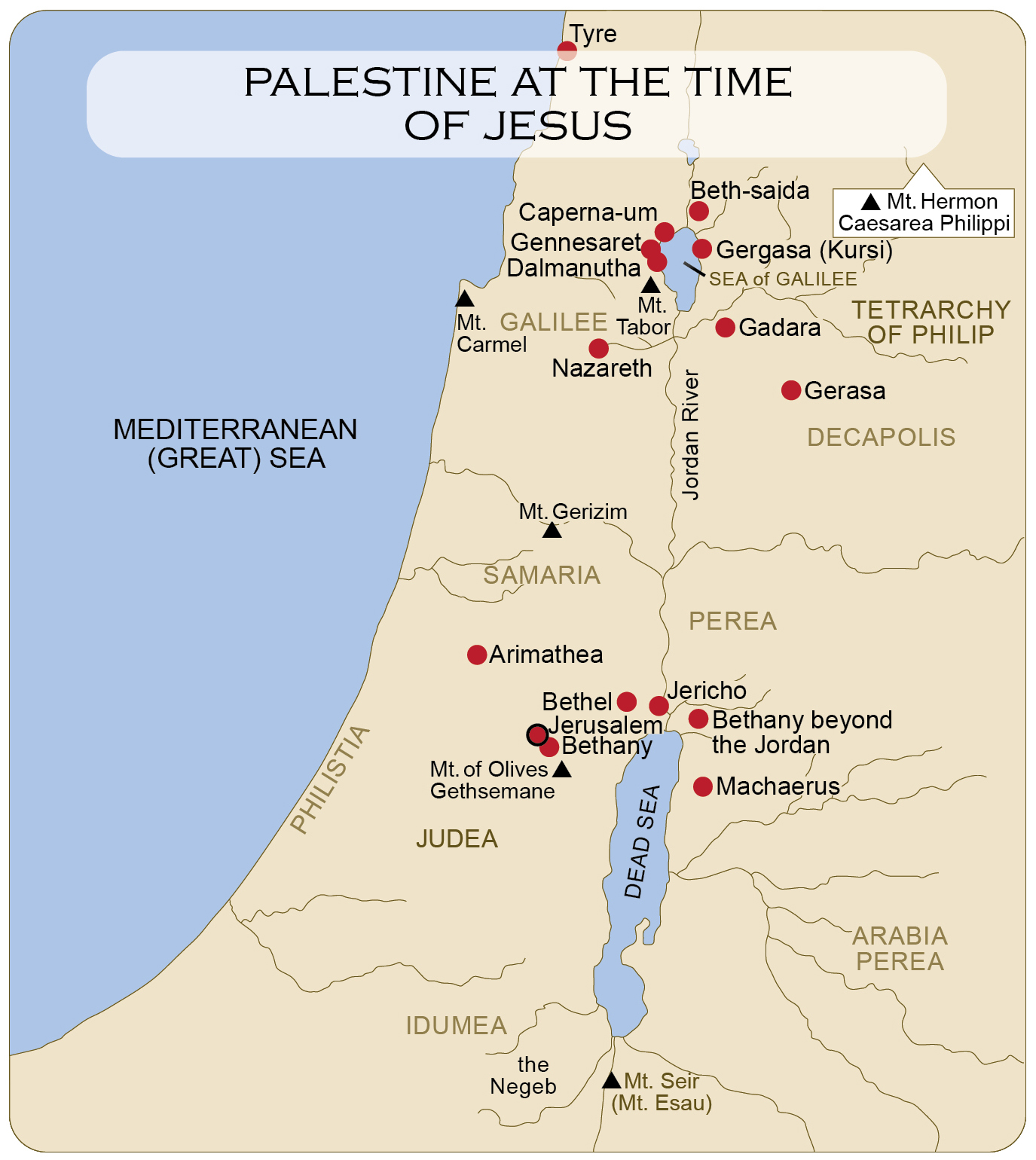 Most people are familiar with the story of Jesus healing the demoniac by allowing a large number of unclean spirits to enter a herd of pigs and send them rushing into the Sea of Galilee, but no one knows the precise place where this occurred. The Gerasenes mentioned in the Gospel According to Mark 5:1–20 are referred to as Gadarenes or Geresenes in other synoptic Gospels or other translations. Scholars have come up with three possible ancient sites—Gergasa (also sometimes called Kursi), Gerasa, and Gadara. Two of these locations—Gerasa and Gadara—were in the region known as the Decapolis; the other location scholars favor was near a town known as Gergasa on the eastern shore of the Sea of Galilee. The meaning of names of the potential locations remains uncertain. The event could have happened in any of these three places—or somewhere else. The map, which shows all three locations, is found on page 7 in the Introduction What to Expect in The Gospel According to Mark: A Look at the Son of God.
where to find the story in the other synoptic Gospels
The story of Jesus healing the Gerasene demoniac can be found in the Gospel According to Matthew 8:28–34 and in the Gospel According to Luke 8:26–39.
the best Catholic commentary about Scripture
To find out more about how Church teaching is supported by passages in The Gospel According to Mark: A Look at the Son of God, check out the Index of Citations in the Catechism of the Catholic Church. Links to each lesson’s primary Scripture passages (from the Revised Standard Version Catholic Edition [RSVCE*]) that are cited in relevant paragraphs in the Catechism are provided here. Not every passage in the Gospel According to Mark is referenced in a Catechism paragraph.
the Gospel According to Mark 5:21–42—paragraph 994
the Gospel According to Mark 5:25–34—paragraph 548
the Gospel According to Mark 5:28—paragraph 2616
the Gospel According to Mark 5:34—paragraph 1504
the Gospel According to Mark 5:36—paragraphs 1504 and 2616
ways our glossary might prove helpful
In addition to providing extra information about geographical locations, our glossary also points out  persons or places mentioned in the biblical text under more than one name or more than one spelling. If you can remember a name but aren’t sure in which lesson it shows up, you can find it in the glossary, which lists every proper noun that appears in the biblical text for every lesson in The Gospel According to Mark: A Look at the Son of God. A few general terms also are included that may be unfamiliar or whose meaning may be unclear to readers.
to learn more, read more Scripture
If you’re having difficulty with a particular passage of Scripture, it can be helpful to read the relevant  cross references—but looking these up can take time. To make that easier, we’ve compiled the cross references from the Revised Standard Version Second Catholic Edition (RSV2CE)—the translation that we reprint in our study books. A link to that list can be found at the top of every online study page; the list features links to cross references in the primary biblical text in the study book The Gospel According to Mark: A Look at the Son of God.
don’t forget about our indexes & extra online material
If you’re trying to locate information about a specific Scripture passage, you can look it up in the index at the back of the study book. If you want to find a particular commentary, you can look up its title in the topics index. To learn more about another book of the Bible for which there’s a Turning to God’s Word study, visit the online study directories to read the commentaries and watch any accompanying videos. Finally, if you have a question or would like to make a comment about any of our studies, you can use one of the “ask us your question” or “what do you think” buttons to email our authors.
ex libris—Church documents & books about religious topics
Link to magisterial documents referred to in our Bible studies at ex libris—magisterial documents.  This listing includes significant recent encyclicals as well as a number of historical Church documents. Recommended books related to Scripture study can be found at ex libris—main bookshelf.
wondering how to pronounce some of these words?
The following link is to a reading from the New International Version (NIV) Bible. To listen, open the link and click on the audio icon above the printed text. Although not taken from the translations used in our study materials, the NIV reading provides an audio guide to pronunciation of words in this lesson’s primary biblical text. A close online version of the translation of the Bible used in Catholic liturgy in the United States as well as an audio guide for daily Mass readings for the current month can be found on the website of the United States Conference of Catholic Bishops (USCCB).
the Gospel According to Mark 5:1—43 (NIV)
 close with Bible-based prayer related to this lesson
Many of our Catholic study groups like to conclude their discussions with a prayer based on the scriptural focus of their lesson, and some participants include Scripture-specific prayer in their individual study. If you’re uncomfortable composing your own Bible-based prayers, you can follow our four easy steps. If you prefer, you can use the following prayer based on this lesson’s text from the Gospel According to Mark.
O God, even though Jesus’ primary reason for being on earth
was not to provide physical healing for everyone who asked,
he nevertheless healed many people of serious ailments.
Grant that we may constantly remember to thank Jesus,
for the spiritual healing he already has given us.
Teach us to trust that God loves us
and desires that we love him in return,
even when our lives seem full of difficulties. Amen.
Lesson 6 The Death of John the Baptist—the Gospel According to Mark 6:1—56
Lesson 4 ‘Do You Understand This Parable?’—the Gospel According to Mark 4:1–41
you also may like our two-part study of the psalms
 Sing a New Psalm: Communicating with God Through the Prayers of the Church provides an in-depth look at all 150 psalms based on The Abbey Psalms and Canticles, a translation prepared by the Benedictine monks of Conception Abbey and endorsed by the United States Conference of Catholic Bishops (USCCB). This translation is being included in new Liturgy of the Hours books. Volume I currently is available only in a digital format. Click on these links to view a sample first lesson from Volume I and another from Volume II.
start a Turning to God’s Word Bible study
 Thank you for your interest in our three-part study of the synoptic Gospels.
  More information about beginning a Turning to God’s Word Bible study can be found at start a Bible study, and Tami, Matthew, and I are available to answer questions or discuss concerns. Contact us to start this or one of our other studies or to have your schedule listed with other TtGW study groups on our website. —Jennifer
*There are seven deuterocanonical books in the Old Testament—Baruch, Judith, Sirach, Tobit, Wisdom, and First and Second Maccabees—and there are some deuterocanonical passages in the Books of Daniel and Esther. Protestants usually refer to these works as “apocryphal,” a word that means “outside the (Protestant) canon” because they’re excluded from most Protestant Bibles. Deuterocanonical means “second canon”; Catholics use that word to refer to any section of the Catholic Old Testament for which there are no extant, or existing, Hebrew manuscripts. All of the deuterocanonical books appear in the Septuagint, the earliest remaining versions of which date to the 1st century B.C. This Greek translation of the Old Testament was in common use by Jews at the time of Jesus. Learn more by reading How Do Catholic & Protestant Bibles Differ?
Turning to God’s Word printed Bible studies use the 2006 Revised Standard Version Second Catholic Edition (RSV2CE) translation for all Scripture references except those to the psalms, which are taken from The Abbey Psalms and Canticles, prepared by the Benedictine monks of Conception Abbey and published in 2020 by the United States Conference of Catholic Bishops (USCCB). All Scripture links for the online study pages for The Gospel According to Mark: A Look at the Son of God are to the 1966 Revised Standard Version Catholic Edition (RSVCE) translation. The New International Version (NIV) audio recordings follow the same chapter and verse numbering as the RSV Catholic translations.
The 1966 RSVCE uses archaic pronouns and verb forms such as “thee,” “thou,” and “didst” in the psalms and in direct quotations attributed to God. The 2006 RSV2CE replaces these with more accessible English. The few significant translation changes in the RSV2CE include rendering almah as “virgin” in the Book of Isaiah 7:14 and restoring the term “begotten” in the Gospel According to John 3:16.
Numbering varies for some passages in this Bible study. Turning to God’s Word studies (print and digital) follow the numbering in the Revised Standard Version Catholic translations (RSV2CE and RSVCE). Discrepancies in the New American Bible Revised Edition (NABRE) are noted in the Index of Scripture Citations in the study book.
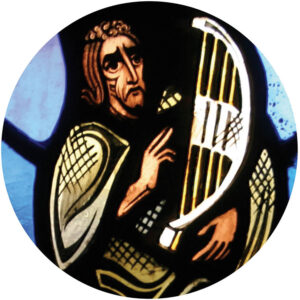 You can learn more about the psalms by viewing a sample lesson from the Turning to God’s Word Catholic Bible study Sing a New Psalm: Communicating with God Through the Prayers of the Church. The first volume covers psalms prayed at Lauds and Vespers; the second volume covers psalms prayed at Vigils, Day Prayer, and Compline. Numbering of psalms and verses may vary in different translations.