
The Gospel According to Mark:
A Look at the Son of God
Lesson 7 ‘What Defiles Comes from Within’
the Gospel According to Mark 7:1–37
Revised Standard Version Catholic Edition (RSVCE)*
New American Bible Revised Edition (NABRE)*
Catechism of the Catholic Church
ex libris (in our library)
glossary for the Gospel According to Mark
cross references in the Gospel According to Mark
next lesson: ‘But Who Do You Say That I Am?’
This material coordinates with Lesson 7, “’What Defiles Comes from Within’,” on pages 34–37 in The Gospel According to Mark: A Look at the Son of God.
Now after John was arrested, Jesus came into Galilee, preaching the gospel of God, and saying,
“The time is fulfilled, and the kingdom of God is at hand; repent, and believe in the gospel.”
—the Gospel According to Mark 1:14–15
welcome to our in-depth study of the Gospel According to Mark
We invite interested groups and individuals to check out the sample introduction and first lesson from this 17- lesson Turning to
  God’s Word Catholic Bible study based on Scripture that is the source of most of the Sunday Gospel readings for Liturgical Year B. These online study pages link to an online glossary and cross references in the biblical text. Other study aids include maps, additional commentary, and prayers based on the primary Scripture in each lesson. The Gospel According to Mark: A Look at the Son of God and the other two synoptic studies are being submitted for imprimaturs. This study will be available from our website shop about three months before the start of liturgical Year B in 2026. If you have a Bible-related question or comment, click on one of the “ask us your question” or “what do you think” buttons on any online study page.
open with prayer
It’s always wise to begin any Bible study with prayer, whether reading the Scriptures alone or meeting with others in a discussion study group. You can pray using your own words or use one of the opening prayers on our website. We especially like the following:
Lord Jesus, you promised to send your Holy Spirit to teach us all things.
As we read and study your word today,
allow it to touch our hearts and change our lives. Amen.
let’s review—the Gospel According to Mark 6:1–56
Lesson 6 The Death of John the Baptist begins with Jesus unable to perform many healing miracles in the vicinity of Nazareth because the inhabitants there have little faith. At this point in his ministry, Jesus sends out his Twelve disciples in groups of two to preach repentance. Herod Antipas, whom Rome had appointed ruler of Galilee and Perea, hears about Jesus and assumes that Jesus is John the Baptist risen from the dead. The sixth chapter contains a lengthy description of how Herod Antipas previously had John beheaded at the behest of his step-daughter. Jesus’ apostles return from their missions, and Jesus takes them away to a lonely place, but crowds of people also go there. This causes Jesus to miraculously feed 5,000 men as well as women and children. Jesus sends his disciples away in a boat, but later they are frightened when they see him walking on the Sea of Galilee. Jesus calms their fears and gets into the boat with them. They land at Gennesaret, where Jesus is once again mobbed by crowds of people seeking healing.
Jesus again cites the prophet Isaiah
When Jesus chastises the Jewish religious leaders who have come from Jerusalem to Galilee to see  him, he cites the Book of Isaiah 29:13—“Because this people draw near with their mouth and honor me with their lips, while their hearts are far from me, and their fear of me is a commandment of men learned by rote…” It probably is significant that Jesus doesn’t include the rest of citation (the Book of Isaiah 29:14): “… therefore, behold, I will again do marvelous things with this people, wonderful and marvelous; and the wisdom of their wise men shall perish, and the discernment of their discerning men shall be hid.”
? Why might Jesus have chosen to cite this particular verse?
? Under what circumstances have words of the prophet Isaiah previously appeared in the Gospel According to Mark?
? What does the truncated biblical quotation suggest?
hypocrites—you could look it up in our archives
 The Greek root of the word hypocrites, which literally means “an answer,” comes up fairly regularly in the Gospels, including in the Gospel According to Mark 7:6. To learn more about what Jesus is accusing the Jewish religious leaders of doing, read Lost in Translation, a weekly online column in which Turning to God’s Word author Matthew Phelps helps readers connect with ideas expressed in the original languages of the Scriptures. New Lost in Translation entries are posted on Mondays, and past entries are archived on our website. Contact us if you’d like to receive Lost in Translation by email every week.
The Greek root ὑπόκρισις (hypocrisis) literally means “an answer.” In a slightly different form, ὑποκριτής (hyocrites), the word means “the one who answers,” or “an interpreter or expounder.” Over time, this word also took on a technical definition of “one who plays a part, an actor.” One of the meanings of hypocrisis—and the one relevant to our modern concept of hypocrisy—is that of acting or playing a part on the stage. The call to examine whether we are hypocrites, then, is the call to evaluate where we act like someone other than ourselves for the sake of achieving some goal.
The word “pretender” may better describe this Greek concept because it’s easier to understand than “hypocrite.” A pretender, like an actor, is one who is faking it or doing something disingenuous. Why do you think Jesus is so offended by hypocrisy?
Christian Connection: two views of tradition
Because of a reliance on Tradition (with a capital ‘T’), Catholics sometimes are accused of the same sort of hypocrisy a Jesus accuses the Jewish religious leaders in the Gospel According to Mark 7:8.
? The Catholic Church uses a capital ‘T’ to refer to its 2,000-year Tradition. What is the difference between Tradition and the tradition that Jesus talks about in the Gospel According to Mark 7:8?
? How do you think that confusion about the Tradition of the Church and tradition of men arose?
? How does the Church define Tradition in paragraphs 81 through 83 of the Catechism of the Catholic Church?
a missing verse
The Gospel According to Mark 7:16—“Anyone who has ears to hear ought to hear” (which is not in Revised Standard Version translations)—is missing from the main text of most modern Bible translations because it is not found in the earliest and most reliable Greek manuscripts. Older versions, like the King James Version (KJV), include it because it was present in the later manuscripts used at the time of their translation. Scholars suspect the verse is omitted from many translations because it is lacking in some of the best Greek manuscripts; many believe it probably was transferred by scribes from the Gospel According to Mark 4:9 and 4:23.
 Jesus travels outside of Galilee
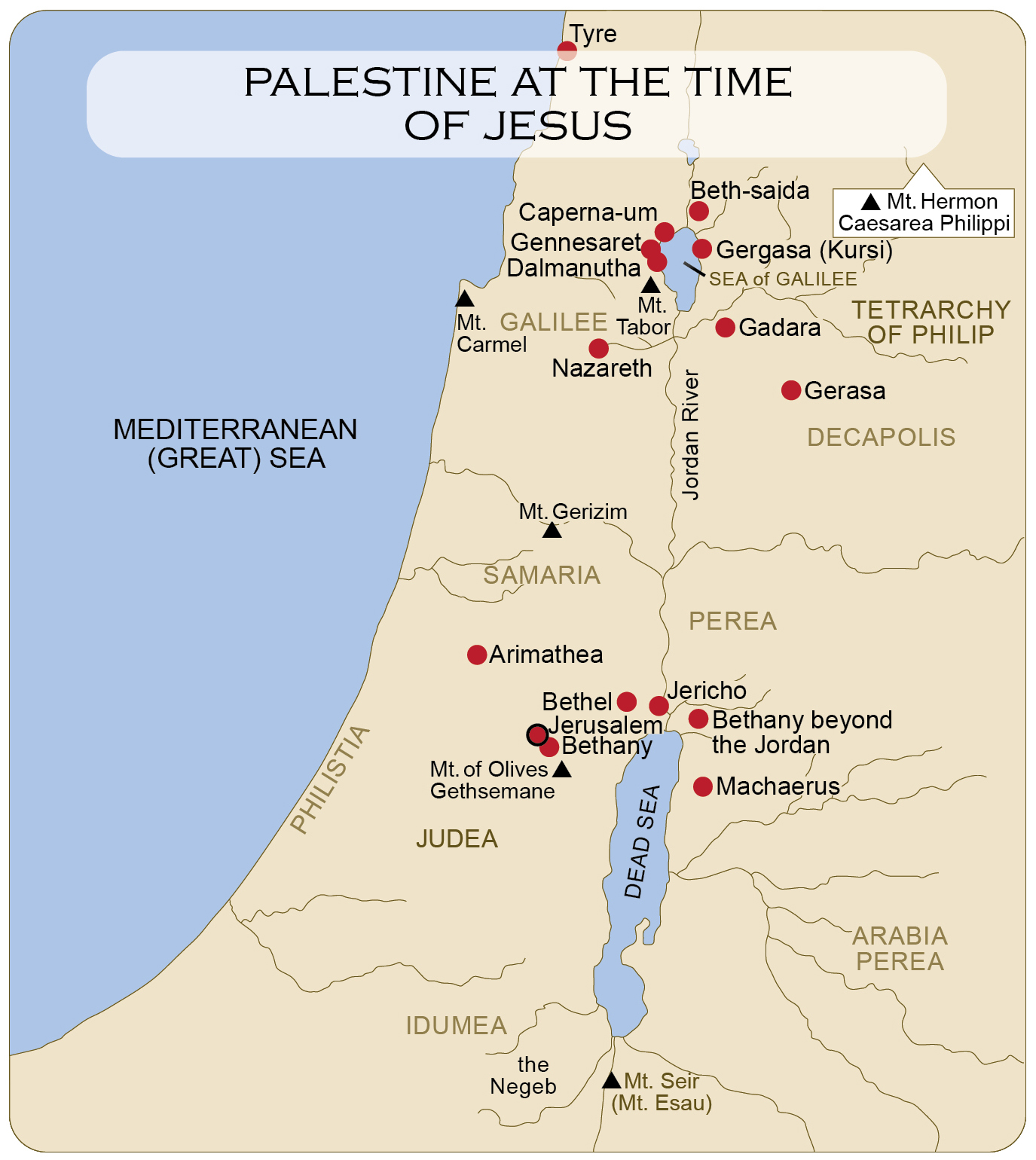
The seventh chapter of the Gospel According to Mark opens with Jesus in the region of Gennesaret in Galilee. As an indication of the extent of knowledge about Jesus, the Evangelist Mark writes that scribes have come there from Jerusalem, a distance that would have taken them three to four days to walk. Scholars estimate the total distance that Jesus travels on foot in the seventh chapter of the Gospel According to Mark from Gennesaret to Tyre and Sidon, then on through the Decapolis to the Sea of Galilee to be at least 100 miles. Most of the locations are shown on the map (left). Click on it to enlarge it. The map also can be seen on page 7 in The Gospel According to Mark: A Look at the Son of God.
two more miracles
The Evangelist describes two more instances of healing in the seventh chapter of the Gospel According to Mark. In the first, recorded in the Gospel According to Mark 7:24–30, Jesus travel to the region of Tyre and Sidon, where a Syrophoenician woman (a non-Jew) pleads with Jesus to heal her daughter, who has been possessed by a demon. Although Jesus at first refuses, the woman’s faith persuades him to heal her child. In the Gospel According to Mark 7:31–37, Jesus heals a deaf man with a speech impediment, and urges those present not to speak of this. The more Jesus urges them not to speak about him, the more they ignore Jesus’ instructions.
the best Catholic commentary about Scripture
To find out more about how Church teaching is supported by passages in The Gospel According to Mark: A Look at the Son of God, check out the Index of Citations in the Catechism of the Catholic Church. Links to each lesson’s primary Scripture passages (from the Revised Standard Version Catholic Edition [RSVCE*]) that are cited in relevant paragraphs in the Catechism are provided here. Not every passage in the Gospel According to Mark is referenced in a Catechism paragraph.
the Gospel According to Mark 7:8–13—paragraph 2196
the Gospel According to Mark 7:10—paragraph 2247
the Gospel According to Mark 7:10–12—paragraph 2218
the Gospel According to Mark 7:13—paragraph 581
the Gospel According to Mark 7:14–23—paragraph 574
the Gospel According to Mark 7:18–21—paragraph 582
the Gospel According to Mark 7:21—paragraph 1764
the Gospel According to Mark 7:29—paragraph 2616
the Gospel According to Mark 7:32–36—paragraph 1504
the Gospel According to Mark 7:33–35—paragraph 1151
ways our glossary might prove helpful
In addition to providing extra information about geographical locations, our glossary also points out  persons or places mentioned in the biblical text under more than one name or more than one spelling. If you can remember a name but aren’t sure in which lesson it shows up, you can find it in the glossary, which lists every proper noun that appears in the biblical text for every lesson in The Gospel According to Mark: A Look at the Son of God. A few general terms also are included that may be unfamiliar or whose meaning may be unclear to readers.
to learn more, read more Scripture
If you’re having difficulty with a particular passage of Scripture, it can be helpful to read the relevant  cross references—but looking these up can take time. To make that easier, we’ve compiled the cross references from the Revised Standard Version Second Catholic Edition (RSV2CE)—the translation that we reprint in our study books. A link to that list can be found at the top of every online study page; the list features links to cross references in the primary biblical text in the study book The Gospel According to Mark: A Look at the Son of God.
don’t forget about our indexes & extra online material
If you’re trying to locate information about a specific Scripture passage, you can look it up in the index at the back of the study book. If you want to find a particular commentary, you can look up its title in the topics index. To learn more about another book of the Bible for which there’s a Turning to God’s Word study, visit the online study directories to read the commentaries and watch any accompanying videos. Finally, if you have a question or would like to make a comment about any of our studies, you can use one of the “ask us your question” or “what do you think” buttons to email our authors.
ex libris—Church documents & books about religious topics
Link to magisterial documents referred to in our Bible studies at ex libris—magisterial documents.  This listing includes significant recent encyclicals as well as a number of historical Church documents. Recommended books related to Scripture study can be found at ex libris—main bookshelf.
wondering how to pronounce some of these words?
The following link is to a reading from the New International Version (NIV) Bible. To listen, open the link and click on the audio icon above the printed text. Although not taken from the translations used in our study materials, the NIV reading provides an audio guide to pronunciation of words in this lesson’s primary biblical text. A close online version of the translation of the Bible used in Catholic liturgy in the United States as well as an audio guide for daily Mass readings for the current month can be found on the website of the United States Conference of Catholic Bishops (USCCB).
the Gospel According to Mark 7:1—37 (NIV)
 close with Bible-based prayer related to this lesson
Many of our Catholic study groups like to conclude their discussions with a prayer based on the scriptural focus of their lesson, and some participants include Scripture-specific prayer in their individual study. If you’re uncomfortable composing your own Bible-based prayers, you can follow our four easy steps. If you prefer, you can use the following prayer based on this lesson’s text from the Gospel According to Mark.
O God, Jesus frequently labeled the Jewish religious leaders
of his day as hypocrites because of the way
they interacted falsely with him.
Grant that we may eliminate any trace of hypocrisy
from our prayers and religious practices,
and teach us the meaning of true love.
We ask this through your Son, Jesus,
who never acted falsely. Amen.
Lesson 8 ‘But Who Do You Say That I Am?’—the Gospel According to Mark 8:1—38
Lesson 6 The Death of John the Baptist—the Gospel According to Mark 6:1–56
you also may like our study of the Letter to the Hebrews (digital only)
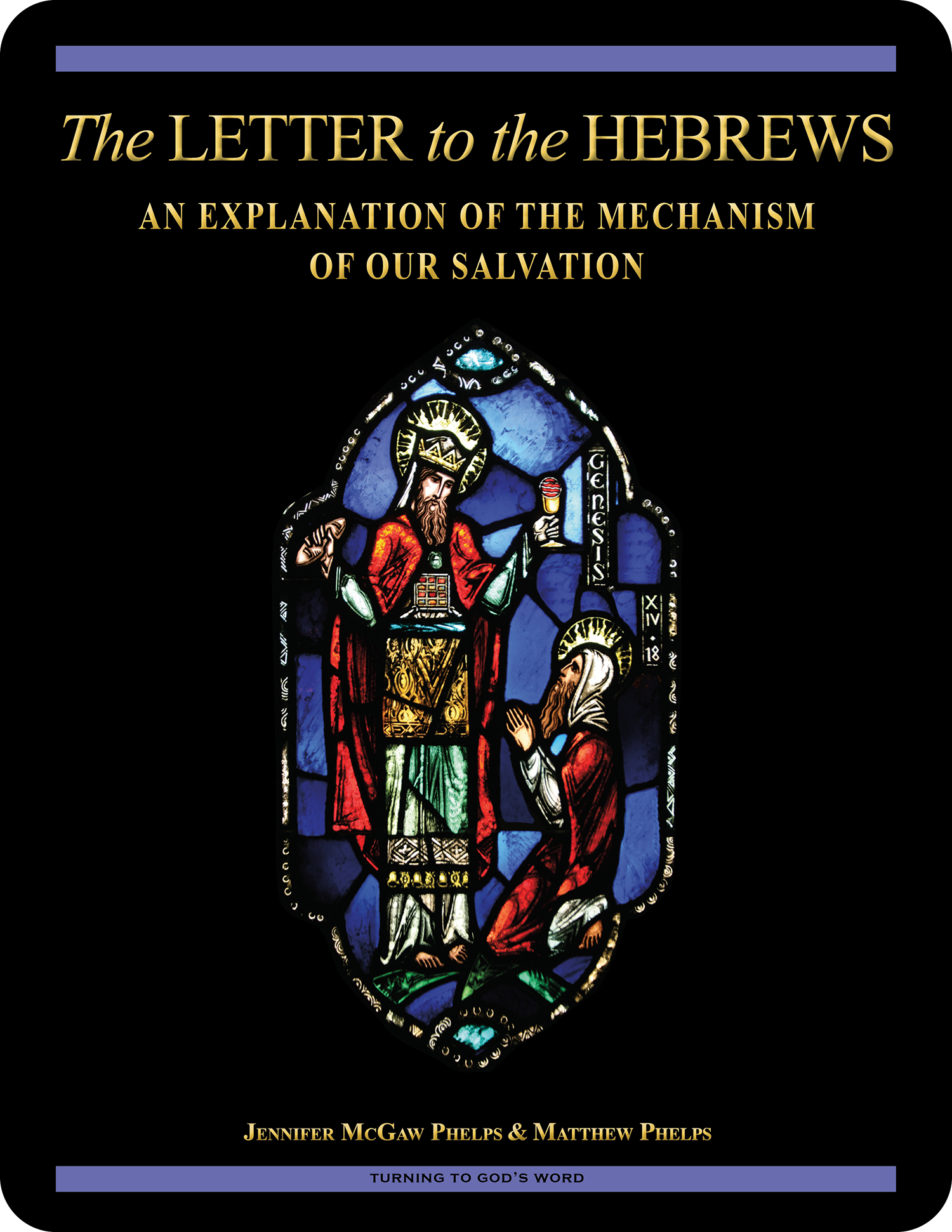 Many Christians struggle to understand one of the central mysteries of our faith: how Jesus can be both human and divine at the same time. The Letter to the Hebrews: An Explanation of the Mechanism of Our Salvation, an 18-lesson Catholic Bible study with an imprimatur, offers an in-depth look at the way in which Jesus’ dual nature allows for the salvation of humanity. The Letter to the Hebrews is designed to provide information that will encourage Christians to remain faithful. Click here to view a sample of the first lesson.
start a Turning to God’s Word Bible study
 Thank you for your interest in our three-part study of the synoptic Gospels.
  More information about beginning a Turning to God’s Word Bible study can be found at start a Bible study, and Tami, Matthew, and I are available to answer questions or discuss concerns. Contact us to start this or one of our other studies or to have your schedule listed with other TtGW study groups on our website. —Jennifer
*There are seven deuterocanonical books in the Old Testament—Baruch, Judith, Sirach, Tobit, Wisdom, and First and Second Maccabees—and there are some deuterocanonical passages in the Books of Daniel and Esther. Protestants usually refer to these works as “apocryphal,” a word that means “outside the (Protestant) canon” because they’re excluded from most Protestant Bibles. Deuterocanonical means “second canon”; Catholics use that word to refer to any section of the Catholic Old Testament for which there are no extant, or existing, Hebrew manuscripts. All of the deuterocanonical books appear in the Septuagint, the earliest remaining versions of which date to the 1st century B.C. This Greek translation of the Old Testament was in common use by Jews at the time of Jesus. Learn more by reading How Do Catholic & Protestant Bibles Differ?
Turning to God’s Word printed Bible studies use the 2006 Revised Standard Version Second Catholic Edition (RSV2CE) translation for all Scripture references except those to the psalms, which are taken from The Abbey Psalms and Canticles, prepared by the Benedictine monks of Conception Abbey and published in 2020 by the United States Conference of Catholic Bishops (USCCB). All Scripture links for the online study pages for The Gospel According to Mark: A Look at the Son of God are to the 1966 Revised Standard Version Catholic Edition (RSVCE) translation. The New International Version (NIV) audio recordings follow the same chapter and verse numbering as the RSV Catholic translations.
The 1966 RSVCE uses archaic pronouns and verb forms such as “thee,” “thou,” and “didst” in the psalms and in direct quotations attributed to God. The 2006 RSV2CE replaces these with more accessible English. The few significant translation changes in the RSV2CE include rendering almah as “virgin” in the Book of Isaiah 7:14 and restoring the term “begotten” in the Gospel According to John 3:16.
Numbering varies for some passages in this Bible study. Turning to God’s Word studies (print and digital) follow the numbering in the Revised Standard Version Catholic translations (RSV2CE and RSVCE). Discrepancies in the New American Bible Revised Edition (NABRE) are noted in the Index of Scripture Citations in the study book.
 You can learn more about the psalms by viewing a sample lesson from the Turning to God’s Word Catholic Bible study Sing a New Psalm: Communicating with God Through the Prayers of the Church. The first volume covers psalms prayed at Lauds and Vespers; the second volume covers psalms prayed at Vigils, Day Prayer, and Compline. Numbering of psalms and verses may vary in different translations.