
 Sing a New Psalm:
Communicating with God Through
the Prayers of the Church
Volume II: Vigils, Day Prayer & Compline
Lesson 11 The Suffering Servant
Invitatory: Psalm 67 (RSVCE)
Psalm 22 (RSVCE) and Psalm 69 (RSVCE)
Friday Vigils (Week I)
Revised Standard Version Catholic Edition*
New American Bible Revised Edition (NABRE)*
Catechism of the Catholic Church
ex libris (in our library)
glossary for Volume II of Sing a New Psalm
next lesson: Awaiting the Appointed Time
This material coordinates with Lesson 11, “The Suffering Servant,” on pages 43–46 in Sing a New Psalm: Communicating with God Through the Prayers of the Church—Volume II: Vigils, Day Prayer & Compline. Our Catholic Bible study is based on The Abbey Psalms and Canticles, a translation of the psalms prepared by the monks at Conception Abbey in 2010 and first published as The Revised Grail Psalms. The Abbey Psalms and Canticles is a revision of that work, finished in 2020 and published by the United States Conference of Catholic Bishops (USCCB). Wording and numbering of some psalms and verses in other translations may differ. The Abbey Psalms and Canticles is being added to Liturgy of the Hours books used in the United States. While the Turning to God’s Word study book is based on The Abbey Psalms and Canticles translation, all online links to the psalms are to the Revised Standard Version Catholic Edition (RSVCE) translation. A separate copy of The Abbey Psalms and Canticles is needed to read the translation on which the psalms in this study are based.
“Unlike other prayers in sacred Scripture, the prayers contained in the psalms are not inserted into a narrative story that specifies their meaning and function. Instead, the psalms are given to the believer precisely as a text of prayer. Since they are the Word of God, the believer who prays the psalms speaks to God using the very words that God himself has given to us. Thus, in praying the psalms we learn to pray. The psalms are a school of prayer.”—Pope Benedict XVI
welcome to our continuing in-depth study of the psalms
We invite groups and individuals to check out the sample Introduction and Lesson 1 from this 29- lesson Turning to
  God’s Word Catholic Bible study. Our online study pages include additional questions, commentary, and prayers based on the psalm texts, plus an online glossary. Both Volume I and Volume II of Sing a New Psalm: Communicating with God Through the Prayers of the Church have been granted imprimaturs. A digital version of Volume I: Lauds & Vespers can be purchased from our website shop. Volume II: Vigils, Day Prayer & Compline is available in hard copy. If you have a Bible-related question or comment, click on one of the “ask us your question” or “what do you think” buttons on any online study page.
open with prayer
It’s always wise to begin any Bible study with prayer, whether reading the Scriptures alone or meeting with others in a discussion study group. You can pray using your own words, pray one of the psalms in this lesson, or use one of the opening prayers on our website. We especially like the following:
Lord Jesus, you promised to send your Holy Spirit
to teach us all things.
As we read and study your word today,
allow it to touch our hearts and change our lives. Amen.
think about praying Compline every night
In addition to the sample for this Bible study, Turning to God’s Word is providing a copy of Lesson 29 In Peace I Will Lie Down, which addresses the nightly Compline prayers based on Psalm 91, Psalm 4, and Psalm 134. The monks at Conception Abbey pray these short psalms each evening—Psalm 91 on Sunday, Tuesday, Wednesday, and Friday; Psalm 4 and Psalm 134 on Monday, Thursday, and Saturday.
 about the psalms in this lesson**
Two of the three psalms prayed for Friday Vigils Week I at Conception Abbey—Psalm 22 and Psalm 69—are individual or personal laments attributed to David; both frequently are associated with Jesus’ Passion. The third—Psalm 67 (the Invitatory)—is a hymn of communal thanksgiving written by an unidentified composer.
classifying the psalms
The classification of the psalms, though somewhat standardized, retains an arbitrary nature. Some psalms are classified according to form or type; such forms include the hymn, the lament, and the song of thanksgiving. Psalms also may be classified according to subject matter—royal psalms, for instance, portray the political king of the descendants of Jacob as both the representative of God to the community and the representative of the community to God—or they may be classified according to their use; scholars generally think that hymns exalting Zion were part of a ritual reenactment of the great deeds of God in maintaining Mount Zion and Jerusalem as a home base. Turning to God’s Word is indebted to Fr. Felix Just, a Jesuit priest and biblical scholar, for his organized listing of the psalms by classification and author.
Psalm 67 (the Invitatory) is classified as a psalm of thanksgiving
Eight psalms, including Psalm 67 (the Invitatory) in this lesson, express communal gratitude to God. The other seven psalms of communal thanksgiving are Psalm 65, Psalm 66, Psalm 68, Psalm 75, Psalm 107, Psalm 118, and Psalm 124. An additional nine—Psalm 9, Psalm 10, Psalm 30, Psalm 32, Psalm 34, Psalm 41, Psalm 92, Psalm 116, and Psalm 138—are classified as individual psalms of thanksgiving.
the largest number of psalms are laments
Forty-three of the psalms, including Psalm 22 and Psalm 69 in this lesson, are classified as individual laments. The word “lament” means “a passionate expression of regret.” An additional 18 psalms are classified as communal laments, which means they were written to be used by an entire community. Refer to the above-mentioned work of Fr. Felix Just for a complete online listing of psalms classified as individual or communal laments.
what is a lament?
Because the word “lament” as a verb means to wail, moan, or sob in sorrow, when the same word “lament” is used as a noun it means an expression of mourning. It is this meaning that it holds in Psalm 22 and Psalm 69. In addition to the laments in the psalms, Scripture also includes a book called Lamentations (sometimes referred to as the Lamentations of Jeremiah, although many scholars contest the prophet Jeremiah’s authorship of that work). A lament frequently refers to a funeral dirge, elegy, or burial hymn.
a passage omitted from Liturgy of the Hours books
A difficulty for Christians who wish to incorporate the psalms into their prayers is that in some of these  ancient hymns the Psalmists blatantly curse their enemies and ask the LORD to deal harshly with them. This is disturbing enough that the editors compiling the four-week Liturgy of the Hours books chose to leave out a few problematic verses. Omitted from psalms for this lesson (Friday Vigils Week I prayed by the monks at Conception Abbey) is Psalm 69:23–29 (Psalm 69:22–28 in Revised Standard Version Catholic Editions). Consider why the editors of Liturgy of the Hours books might have felt that these verses should be excluded.
all omissions are noted in this study
Omissions in the four-week Liturgy of the Hours books are addressed in Volume I and Volume II. For a complete list, click on this link, which includes a comparison of the two-week cursus (schedule) used at Conception Abbey and in both volumes of our study with the four-week Roman cursus followed by current Liturgy of the Hours books.
what is there to be thankful for?
Considering the negative tone taken by most of the verses in Psalm 22 and Psalm 69, what do you think makes Psalm 67, a hymn whose anonymous composer chose to focus on thanking God for the many blessings shown to humanity, an appropriate choice as an Invitatory for Friday Vigils Week I as prayed at Conception Abbey? What lesson can Christians learn from this pairing? Altogether, counting Psalm 67—plus Psalm 9 and Psalm 10 taken together as a single psalm—there are 17 psalms classified as songs of thanksgiving and gratitude. These include Psalm 30, Psalm 32, Psalm 34, Psalm 41, Psalm 65, Psalm 66, Psalm 68, Psalm 75, Psalm 92, Psalm 107, Psalm 115, Psalm 118, Psalm 124, and Psalm 138.
the suffering servant predates Deutero- (Second) Isaiah
Although Deutero- (Second) Isaiah is known for describing the suffering servant in the chapters 40 through 55 in the Book of Isaiah, the idea shows up in Psalm 22, a lament that records David’s  vision of the Messiah’s Passion. It’s worthwhile to consider why David was chosen to receive such a vision a thousand years before the time of Jesus. You can learn more about the connection between suffering and the Messiah in Lesson 16 There They Crucified Him in the Turning to God’s Word Catholic Bible study Scripture & the Rosary: New Testament Mysteries, Old Testament Parallels. Lesson 16 in that study is only available during Lent, when it’s posted free on our website.
? What passages in Psalm 22 appear to specifically describe Jesus’ Passion?
? Compare David’s vision in Psalm 22 with Deutero- (Second) Isaiah’s description of the suffering servant in the Book of Isaiah 52:13–53:12. What things are the same?
? What details differ?
? Why do you think that the passage from the Book of Isaiah always is read on Good Friday?
what Matthew thinks—don’t confuse forsaken & forgotten
 Turning to God’s word author Matthew Phelps points out that Psalm 22:2 (Psalm 22:1 in Revised Standard Version Catholic Editions), an oft-quoted verse, frequently is misquoted, leading to some weird theological conclusions. What do you think is the difference between being forgotten and being forsaken? Christians frequently associate Psalm 22 with Jesus’ Crucifixion. Explain how Psalm 22 suggests that David—and in a Christian interpretation, Jesus—doesn’t really feel either forgotten or forsaken by God.
zeal—you could look it up in our archives
 Psalm 69:10 (Psalm 69:9 in Revised Standard Version Catholic Editions) is often cited in connection with Jesus’ act of driving money changers from the Temple in Jerusalem. The disciples specifically recall the zeal mentioned in Psalm 69. To learn more about zeal, read Lost in Translation, an online column in which Turning to God’s Word author Matthew Phelps helps readers connect with ideas expressed in the original languages of the Scriptures. New Lost in Translation entries are posted on Mondays, and past entries are archived on our website. Contact us if you’d like to receive Lost in Translation by email every week.
being zealous is synonymous with being jealous
The concept of zeal or zealotry in our society has come to be associated with religious extremism, but the Greek word ζῆλος (zelos) and the Hebrew word קִנְאָה (qinah) both have the same root meaning—jealousy. In its root sense, having zeal means being jealous. Jesus’ behavior driving out the money changers shows his jealousy for the true purpose of the Temple, worship of God.
do you know what’s important about Bashan?
If not, you can refer to our online glossary. Bashan, a country frequently cited in the Old Testament and  later important in the Roman Empire, was located in what is now Syria. Bashan was the northernmost of the three ancient divisions of eastern Palestine, and in the Old Testament it was known for rich pastures and thick forests. Along with Carmel, Bashan stood for the fruitfulness of the land (the Book of Isaiah 33:9); when the land associated with Bashan and Carmel languished, the ancients saw that as a mark of God’s displeasure (the Book of Nahum 1:4). The bulls of Bashan in Psalm 22:12 represent brutal, animal strength. Bashan also is mentioned in Psalm 68, which is covered in Lesson 13 Praise the LORD Who Rides on the Heavens.
read the Catechism—only one place where Church teaching has changed
Do you know what the Church’s position is regarding capital punishment? Paragraph 2267 in the  Catechism of the Catholic Church has changed since the Catechism was printed, and some Catholics—especially in the United States—remain unaware that the Church now is completely opposed to the death penalty. The quotation in the final paragraph is by Pope Francis. Had there been no legal recourse to the death penalty at the time of Jesus, his Crucifixion would have been considered illegal—not to mention a serious sin against life.
2267 Recourse to the death penalty on the part of legitimate authority, following a fair trial, was long considered an appropriate response to the gravity of certain crimes and an acceptable, albeit extreme, means of safeguarding the common good.
Today, however, there is an increasing awareness that the dignity of the person is not lost even after the commission of very serious crimes. In addition, a new understanding has emerged of the significance of penal sanctions imposed by the state. Lastly, more effective systems of detention have been developed, which ensure the due protection of citizens but, at the same time, do not definitively deprive the guilty of the possibility of redemption.
Consequently, the Church teaches, in the light of the Gospel, that “the death penalty is inadmissible because it is an attack on the inviolability and dignity of the person,” and she works with determination for its abolition worldwide.”
two translation differences in one verse
The Abbey Psalms and Canticles translates Psalm 67:2 (Psalm 67:1 in Revised Standard Version Catholic Editions): “May God be gracious and bless us and let his face shed its light upon us.” The Revised Grail Psalms translates the same passage: “O God be gracious and bless us and let your face shed its light upon us.” Consider whether you prefer a prayer that describes behavior desired by God or one that directly addresses God and asks for divine favor. (Note that it is not possible to link to either The Abbey Psalms and Canticles or The Revised Grail Psalms; all links on the online pages are to the Revised Standard Version Catholic Edition [RSVCE].)
a word deletion
The Abbey Psalms and Canticles translates the first sentence in Psalm 22:16 (Psalm 22:15 in Revised Standard Version Catholic Editions): “Parched as burnt clay is my throat, my tongue cleaves fast to my jaws.” The Revised Grail Psalms translates the same passage: “Parched as burnt clay is my throat, my tongue cleaves to my jaws.” Think about whether this deletion is likely to be noticeable to many people praying Psalm 22.
a translation difference that appears significant
The Abbey Psalms and Canticles translates Psalm 22:30 (Psalm 22:29 in Revised Standard Version Catholic Editions): “They have eaten and adore him, all who sleep in the earth; before him shall bow all who go down to the dust.” The Revised Grail Psalms translates the same passage: “They shall worship him, all the mighty of the earth; before him shall bow all who go down to the dust.” What do you consider the difference between “they have eaten and adore him, all who sleep in the earth” and “they shall worship him, all the mighty of the earth”? Which translation seems to make the most sense?
two more translation differences in the same verse
The Abbey Psalms and Canticles translates Psalm 69:14 (Psalm 69:13 in Revised Standard Version Catholic Editions): “But I pray to you, O LORD, at an acceptable time. In your great mercy, answer me, O God, with your faithful salvation.” The Revised Grail Psalms translates the same passage: “But I pray to you, O LORD, for a time of your favor. In your great mercy, answer me, O God, with your salvation that never fails.” Which translation do you prefer?
a translation difference: mire vs. mud
The Abbey Psalms and Canticles translates Psalm 69:15 (Psalm 69:14 in Revised Standard Version Catholic Editions): “Rescue me from the mire, lest I begin to sink.
From those who hate me, deliver me.” The Revised Grail Psalms translates the same passage: “Rescue me from sinking in the mud; from those who hate me, deliver me.” Which translation do you prefer? The primary difference here appears to be that one translation uses the word “mire” and the other the word “mud.” Which translation do you think is more accessible to most readers?
a translation difference that’s primarily about regional grammar
The Abbey Psalms and Canticles translates Psalm 69:17 (Psalm 69:16 in Revised Standard Version Catholic Editions): “LORD, answer, for your mercy is kind; in your great compassion, turn towards me.” The Revised Grail Psalms translates the same passage: “LORD, answer, for your mercy is kind; in your great compassion, turn toward me.” Although toward is the preferred spelling in the United States, towards is preferred in England. It’s difficult to guess why the editors at the United States Conference of Catholic Bishops (USCCB) wanted this change made.
a translation difference: upright vs. just
The Abbey Psalms and Canticles translates Psalm 69:29 (Psalm 69:28 in Revised Standard Version Catholic Editions): “Blot them out from the book of the living;
do not enroll them among the upright.” The Revised Grail Psalms translates the same passage: “Blot them out from the book of the living; do not enroll them among the just.” Once again the USCCB editors indicate a decided preference for the word “upright” instead of the word “just.” Which translation do you think is more accessible to most readers?
a translation difference: the LORD vs. God
The Abbey Psalms and Canticles translates Psalm 69:32 (Psalm 69:31 in Revised Standard Version Catholic Editions): “…a gift pleasing the LORD more than oxen,
more than a bull with horns and hooves.” The Revised Grail Psalms translates the same passage: “…a gift pleasing God more than oxen, more than a bull with horns and hooves.” Although most Christians fail to distinguish between “the LORD” and “God,” ancient manuscripts used these terms to indicate differences in the attributes of God. To learn more about the words behind “the LORD” and “God,” read Lord & God in the Lost in Translation archives.
the best Catholic commentary about Scripture
To find out more about how Church teaching is supported by passages in Sing a New Psalm: Communicating with God Through the Prayers of the Church—Volume II: Vigils, Day Prayer & Compline, check out the Index of Citations in the Catechism of the Catholic Church. Links to the primary Scripture passages in the lesson (Revised Standard Version Catholic Edition [RSVCE*]) and relevant paragraphs in the Catechism are provided here. Not every passage in the biblical text for this study is referenced in a Catechism paragraph, however, including Psalm 67 (the Invitatory) in this lesson.
Psalm 22:1—paragraph 603
Psalm 22:2—paragraph 2605
Psalm 22:10–11—paragraph 2270
Psalm 22:15—paragraph 112
Psalm 22:27—paragraph 716
Psalm 69:10—paragraph 584
ways our glossary might prove helpful
In addition to providing extra information about geographical locations, our glossary also points out persons or places mentioned in the biblical text under more than one name or more than one spelling. If you can remember a name but aren’t sure in which lesson it shows up, you can find it in the glossary, which lists every proper noun that appears in the biblical text for every lesson in Sing a New Psalm: Communicating with God Through the Prayers of the Church—Volume II: Vigils, Day Prayer & Compline.
don’t forget about our indexes & extra online material
If you’re trying to locate information about a passage in Scripture, you can look it up in the index at the back of the study book. If you want to revisit a particular commentary, you can look that up by title in the topics index. If you want to learn more about another book of the Bible for which there’s a Turning to God’s Word study, you can read the online commentaries and watch any accompanying videos by going to the online study directories. Finally, if you have a question or would like to make a comment about any of our studies, you can use one of the “ask us your question” or “what do you think” buttons to email our authors.
ex libris—Church documents & books about religious topics
You can find links to magisterial documents referred to in Turning to God’s Word Catholic Bible studies  at ex libris—magisterial documents. This page includes a listing of significant recent encyclicals as well as a number of historical Church documents. Recommended books related to Scripture study can be found at ex libris—main bookshelf.
wondering how to pronounce some of these words?
The following links are to readings from the New International Version (NIV) Bible. To listen, open one of the links and click on the audio icon above the printed text. Although not taken from the translations used in our study materials, the NIV readings provide an audio guide to pronunciation of words in this lesson’s primary biblical texts. An online version of the translation of the Bible used in Catholic liturgy in the United States as well as an audio guide for daily Mass readings for the current three months can be found on the website of the United States Conference of Catholic Bishops (USCCB).
Psalm 67, the Invitatory (NIV)
Psalm 22 (NIV)
Psalm 69 (NIV)
 close with a psalms-based prayer for Friday Vigils (Week I)
Many of our Catholic study groups like to conclude their discussions with a prayer based on the scriptural focus of their lesson. If you’re uncomfortable composing your own Bible-based prayers, you can follow our four easy steps. If you prefer, you can pray any of the psalms in this lesson, or you can use the following short prayer.
O God, you sent your own Son to suffer and die
to give humanity an opportunity for eternal life.
Teach us to value our suffering.
and to recognize that it plays a crucial part
on the Christian path to heaven.
We ask this in the name of Jesus Christ,
who was willing to suffer and die for our sake. Amen.
Lesson 12 Awaiting the Appointed Time, Friday Day Prayer (Week I)—Psalm 70, Psalm 75, and Psalm 82
Lesson 10 In the Shelter of God’s Wings, Thursday Day Prayer (Week I)—Psalm 58, Psalm 61, and Psalm 64
you also may like our study of Saul, David & Solomon (digital only)
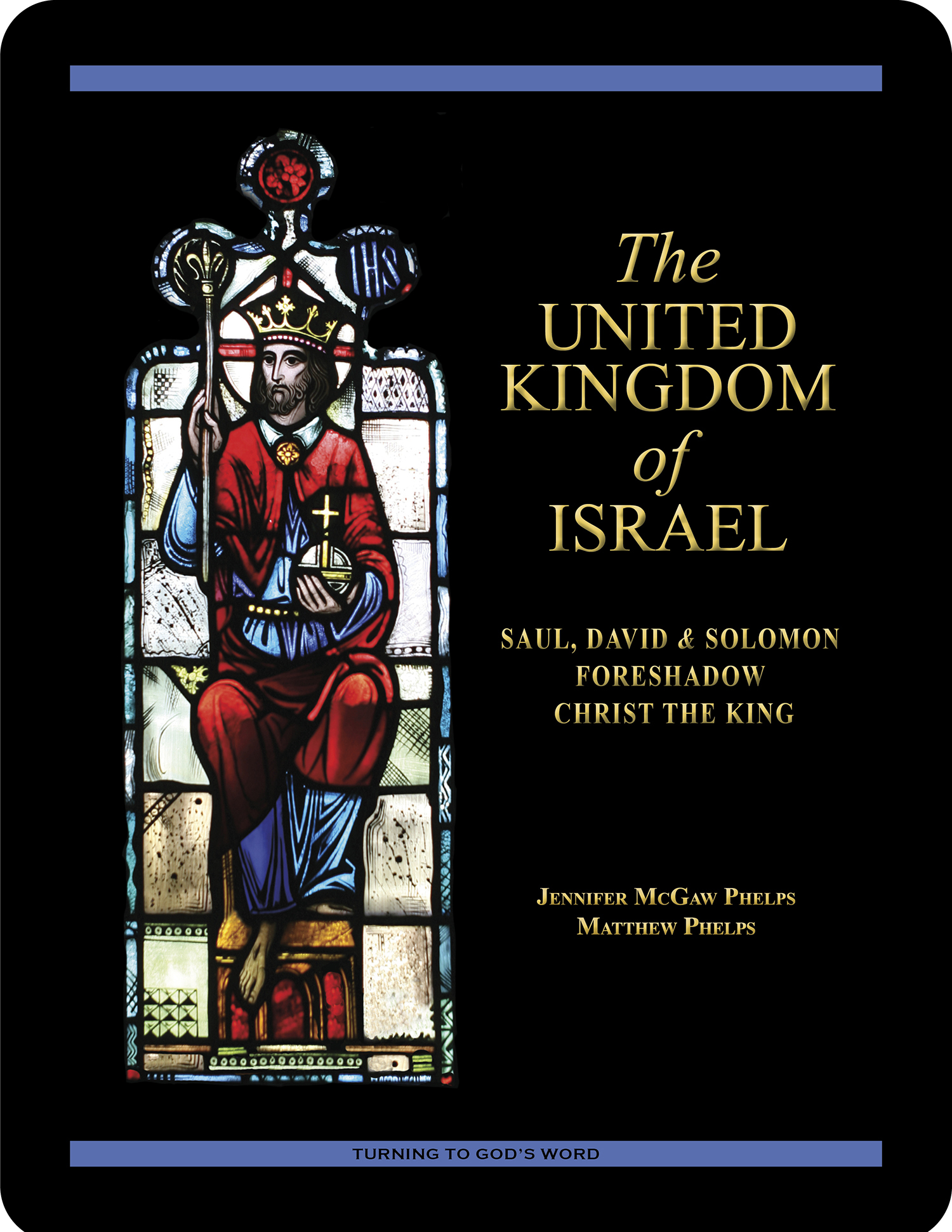 The United Kingdom of Israel: Saul, David & Solomon Foreshadow Christ the King, a 28-lesson Catholic Bible study with an imprimatur, provides an in-depth look at the First and Second Books of Samuel to learn how the lives of the monarchs Saul, David, and Solomon point ahead to the kingdom of heaven. The unified reign of King David is seen as a foreshadowing or type of the unity that is one of the four marks of the Church—the kingdom of God—established by Jesus Christ. Click here to view a sample of the first lesson.
start a Turning to God’s Word Bible study
 Thank you for your interest in Sing a New Psalm: Communicating with God Through the Prayers of the Church—Volume II.
  Information about beginning a Turning to God’s Word Bible study can be found at start a Bible study. Tami, Matthew, and I are available to answer questions. Contact us if you’d like to start one of our studies or have your schedule listed with other TtGW study groups on our website. —Jennifer
*There are seven deuterocanonical books in the Old Testament—Baruch, Judith, Sirach, Tobit, Wisdom, and First and Second Maccabees—and there are some deuterocanonical passages in the Books of Daniel and Esther. Protestants usually refer to these works as “apocryphal,” a word that means “outside the (Protestant) canon” because they’re excluded from most Protestant Bibles. Deuterocanonical means “second canon”; Catholics use that word to refer to any section of the Catholic Old Testament for which there are no extant, or existing, Hebrew manuscripts. All of the deuterocanonical books appear in the Septuagint, the earliest remaining versions of which date to the 1st century B.C. This Greek translation of the Old Testament was in common use by Jews at the time of Jesus. Learn more by reading How Do Catholic & Protestant Bibles Differ?
**You can learn more about the psalms by viewing a sample lesson from the Turning to God’s Word Catholic Bible study Sing a New Psalm: Communicating with God Through the Prayers of the Church. The first volume covers psalms prayed at Lauds and Vespers; the second covers psalms prayed at Vigils, Day Prayer, and Compline. Numbering of psalms and verses may vary in other translations.
Turning to God’s Word printed Bible studies use the 2006 Revised Standard Version Second Catholic Edition (RSV2CE) translation for all Scripture references except those to the psalms, which are taken from The Abbey Psalms and Canticles, prepared by the Benedictine monks of Conception Abbey and published in 2020 by the United States Conference of Catholic Bishops (USCCB). All Scripture links for the online study pages for Sing a New Psalm: Communicating with God Through the Prayers of the Church—Volume II: Vigils, Day Prayer & Compline are to the 1966 Revised Standard Version Catholic Edition (RSVCE) translation. The New International Version (NIV) audio recordings follow the same chapter and verse numbering as the RSV Catholic translations, but the NIV translation doesn’t include the deuterocanonical books and passages.
The 1966 RSVCE uses archaic pronouns and verb forms such as “thee,” “thou,” and “didst” in the psalms and in direct quotations attributed to God. The 2006 RSV2CE replaces these with more accessible English. The few significant translation changes in the RSV2CE include rendering almah as “virgin” in the Book of Isaiah 7:14 and restoring the term “begotten” in the Gospel According to John 3:16.
Numbering for some passages in this Bible study will vary. Turning to God’s Word studies (print and digital) follow the numbering in the Revised Standard Version Catholic translations (RSV2CE and RSVCE). Discrepancies in the New American Bible Revised Edition (NABRE) are noted in the Index of Scripture Citations in the study book.