 Sing a New Psalm:
Communicating with God Through
the Prayers of the Church
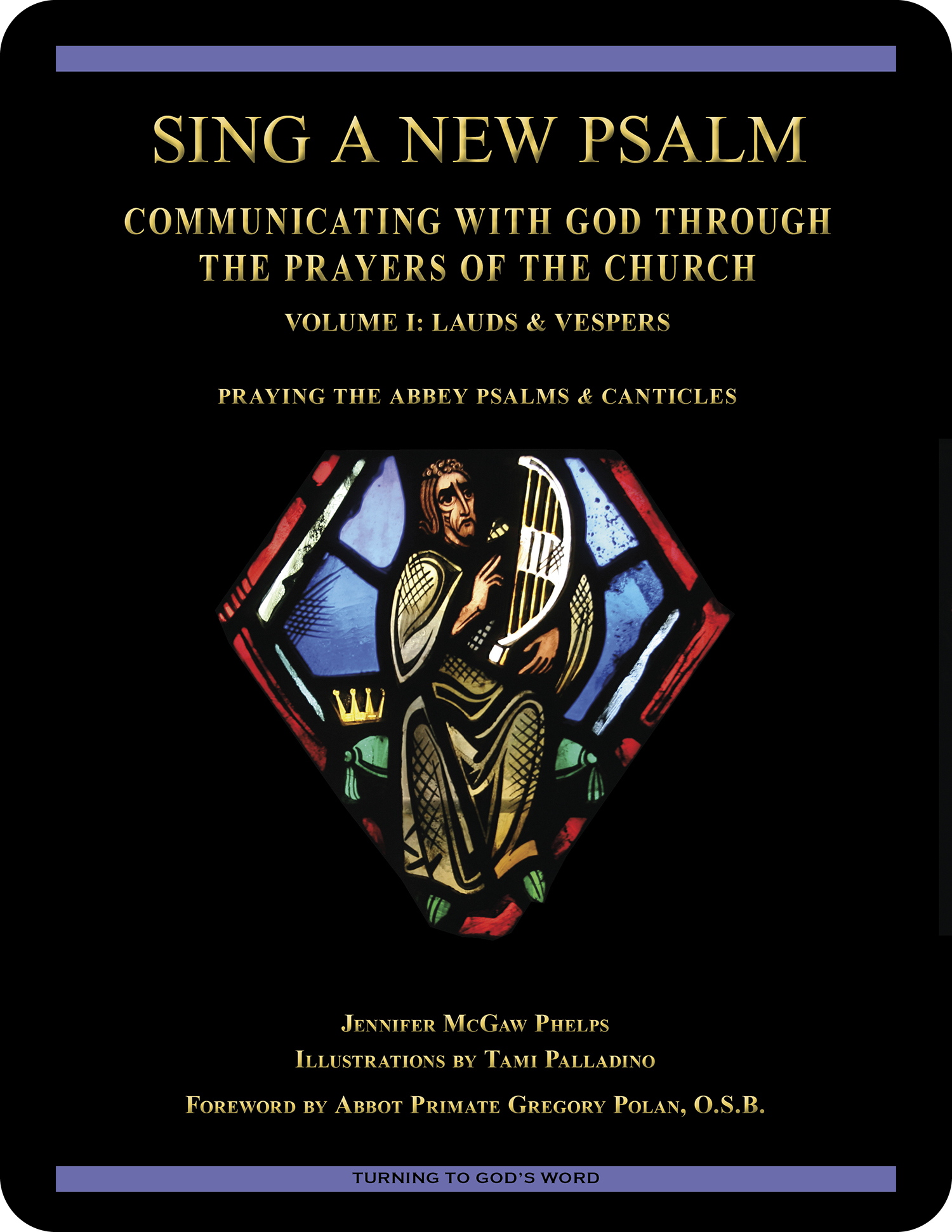
Volume I: Lauds & Vespers
Introduction Psalms Study Basics
Revised Standard Version Catholic Edition*
The New American Bible
Catechism of the Catholic Church
ex libris (in our library)
Aperuit Illis (Instituting the Sunday of the Word of God)
first lesson: Set a Guard on My Mouth
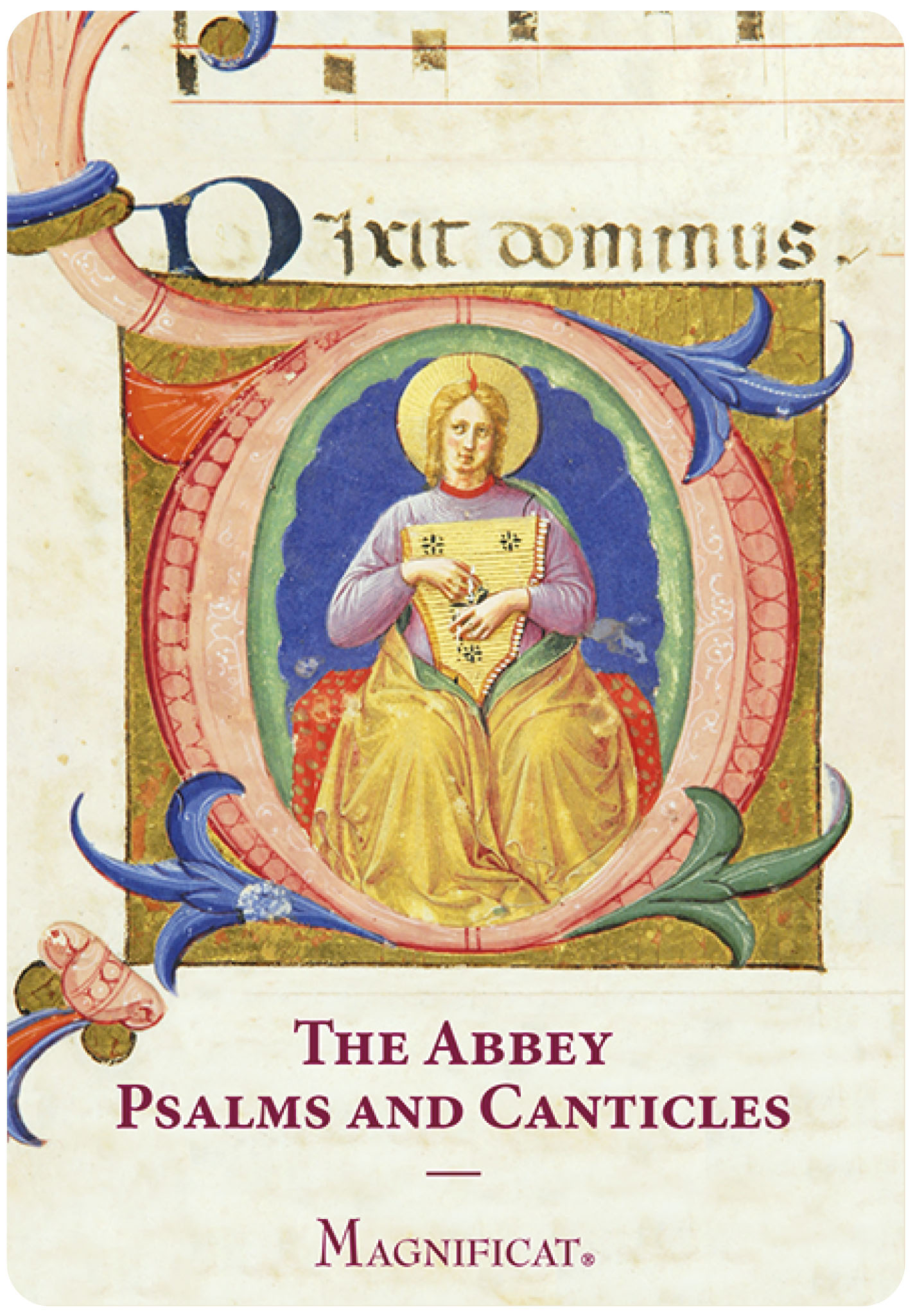 Sing a New Psalm: Communicating with God Through the Prayers of the Church—Volume I: Lauds & Vespers is a Catholic Bible study based on The Abbey Psalms and Canticles, a psalms translation prepared by the monks at Conception Abbey in 2010 and first published as The Revised Grail Psalms. The Abbey Psalms and Canticles is a revision of that work, finished in 2020 and now owned by the United States Conference of Catholic Bishops (USCCB). Wording and numbering of some psalms in other translations may differ. This translation is being added to all English-language Liturgy of the Hours books used in the United States.
This material coordinates with the Introduction on pages 6–7 in the study book Sing a New Psalm: Communicating with God Through the Prayers of the Church—Volume I: Lauds & Vespers.
“Unlike other prayers in sacred Scripture, the prayers contained in the psalms are not inserted into a narrative story that specifies their meaning and function. Instead, the psalms are given to the believer precisely as a text of prayer. Since they are the Word of God, the believer who prays the psalms speaks to God using the very words that God himself has given to us. Thus, in praying the psalms we learn to pray. The psalms are a school of prayer.”—Pope Benedict XVI
welcome to our in-depth study of the psalms
We invite groups and individuals to check out the sample Introduction and Lesson 1 from this 28- lesson Turning to
  God’s Word Catholic Bible study. Our online study pages include additional questions, commentary, and prayers based on the psalm texts. Sing a New Psalm: Communicating with God Through the Prayers of the Church—Volume I: Lauds & Vespers has been granted an imprimatur. A digital version of can be purchased from our website shop. Volume II covers psalms prayed at Vigils, Day Prayer, and Compline. If you have a Bible-related question or comment, click on one of the “ask us your question” or “what do you think” buttons on any online study page.
every Turning to God’s Word Bible study carries an imprimatur
 Sing a New Psalm: Communicating with God Through the Prayers of the Church—Volume I: Lauds & Vespers
 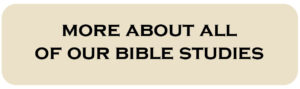 was granted an imprimatur by the Most Reverend Richard E. Pates, (left), bishop emeritus of the Diocese of Des Moines, on July 1, 2015; the censor librorum for
 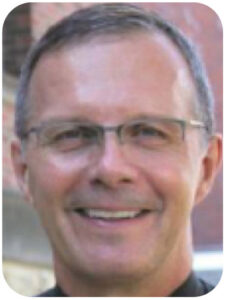 the Diocese of Des Moines, the Very Reverend Aquinas Nichols, granted the nihil obstat. The Most Reverend William M. Joensen, Ph.D. (right), current bishop of the Diocese of Des Moines, granted an imprimatur for Volume II: Vigils, Day Prayer & Compline on July 18, 2025; Father Nichols granted the nihil obstat, These are official declarations that a book or pamphlet is free of doctrinal or moral error. There’s no implication that those who’ve granted the imprimatur or nihil obstat agree with the contents, opinions, or statements expressed in the work. All Turning to God’s Word Catholic Bible studies are submitted to the Church before publication; studies written after 2020 are being submitted to Bishop Joensen. Visit the archives of Lost in Translation to read more about the Latin terms imprimatur & nihil obstat.
the popes inspire us—serious Catholics study the Word of God
In his apostolic letter Aperuit Illis (Instituting the Sunday of the Word of God) issued motu proprio (of his  own accord), the late Pope Francis established the Third Sunday in Ordinary Time to be devoted to the celebration, study, and dissemination of the Word of God. His apostolic letter was published on September 30, 2019, the feast of St. Jerome and the 1600th anniversary of the saint’s death. St. Jerome, who translated the Latin
 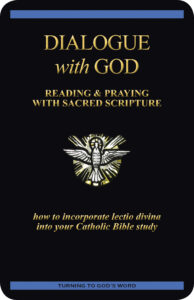 Vulgate Bible from Greek and Hebrew manuscripts, is famous for saying: “Ignorance of Scripture is ignorance of Christ.” In Aperuit Illis, Pope Francis calls attention to the sacramental nature of the Word of God, pointing to the unbreakable bond between Sacred Scripture and the Eucharist. In 2027, the Church will celebrate the Word of God on Sunday, January 24. We’ve posted a free digital version of Dialogue with God: Reading & Praying with Sacred Scripture, our guide to incorporating the Church’s traditional practice of lectio divina (sacred reading) into regular Bible study.
ex libris—read more Church documents
Find links to magisterial documents referred to in Turning to God’s Word Catholic Bible  studies, including Aperuit Illis (Instituting the Sunday of the Word of God), at ex libris—magisterial documents. The page lists significant recent encyclicals as well as a number of historical Church documents.
a few reminders about Turning to God’s Word Bible studies
The most distinguishing feature of our Bible studies is that they’re Catholic. Each one has been granted an imprimatur, which means that a bishop has read the work and found nothing contrary to Church teaching on morals or faith. Note that the imprimatur makes no claim that a work is equivalent to Church teaching, simply that it isn’t opposed to what the Church teaches. Practically speaking, this means that you don’t have to accept Turning to God’s Word interpretations of Scripture, only that choosing to do so doesn’t amount to heresy. Choosing not to accept conclusions of a work that’s been granted an imprimatur doesn’t immediately plunge you into heretical territory, but choosing not to accept Church teaching related to those conclusions does.
read the Catechism—how to avoid heresy
The imprimatur reinforces and validates the claim that Turning to God’s Word Bible studies are Catholic. All participants have a right to expect that discussions about our Bible studies will focus on Catholic teaching. That doesn’t mean that someone won’t occasionally have a question about Church teaching. Not knowing what the Church teaches about a particular issue isn’t heretical. Asking a question about Church teaching isn’t heretical. Failing to understand Church teaching isn’t heretical. Insisting that Church teaching is wrong is.
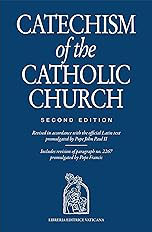 Most people who begin to study the psalms are caught off guard by how many challenging theological ideas are found in Scripture. There are a surprising number of things many Catholics believe to be Church teaching that actually are not. In this study, we attempt to present Scripture and Church teaching related to the psalms as unambiguously as possible. When in doubt, you can refer to the Catechism of the Catholic Church or talk with your parish priest about any doctrine that remains unclear.
If a Church teaching seems particularly unsettling even after studying the Catechism and speaking with someone who’s knowledgeable regarding Catholic doctrine, you might want to examine whether there’s a personal or emotional reason why you’re having difficulty. Pray for God’s guidance and be open to receiving a different answer than you anticipated, possibly at a later time than you expected or hoped.
be respectful of the others in your group
Keep in mind that most people in your discussion group are there for a Catholic interpretation of Scripture. People from other faith backgrounds are welcome, but the focus of any Turning to God’s Word study always is going to be Catholic in nature. The following opening prayer emphasizes maintaining mutual respect amid differences of opinion:
Heavenly Father, send forth your Spirit to enlighten our minds
and dispose our hearts to accept your truth.
Help us to listen to one another with openness and honesty,
eager to learn from the talents and intuitions that you have given each of us.
Never let differences of opinion diminish our mutual esteem and love.
May we leave this meeting with more knowledge and love for you and your Son.
In the unity of the Holy Spirit. Amen.
You can find other opening prayers on our website. We especially like the following:
Lord Jesus, you promised to send your Holy Spirit to teach us all things.
As we read and study your word today,
allow it to touch our hearts and change our lives. Amen.
watch an introductory video
Learn more about the goal of this Turning to God’s Word Catholic Bible study of the psalms and how regularly praying these ancient songs at Lauds and Vespers—or any time—can transform your days and deepen your relationship with God. We’ll look at the sample lesson from in this volume—”Set A Guard on My Mouth”—to get an idea of the elements included in the other lessons. Common problems often experienced when praying the psalms are addressed, and I share some of my favorite passages from the psalms.
the popes inspire us—the psalms aren’t just about the past
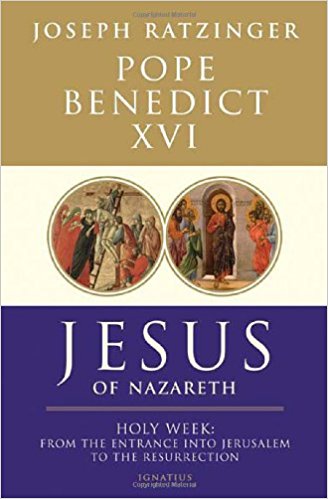 In the second volume of his excellent three-part series Jesus of Nazareth: Holy
  Week, Pope Benedict XVI examines Jesus’ last anguished words of prayer from the cross, recognized as Psalm 22:2: “My God, my God, why have you forsaken me?” (The Abbey Psalms and Canticles). The Holy Father explains that the psalms must be understood in the same context in which they originally were prayed. He writes: “To be sure, the psalms are deeply personal prayers, formed while wrestling with God, yet at the same time they are uttered in union with all who suffer unjustly, with the whole of Israel, indeed with the whole of struggling humanity, and so these psalms always span past, present, and future.” For more information about this and for excerpts from other books helpful in Catholic Bible study, visit ex libris—main bookshelf.
what do you think about interpreting Scripture?
 The Church encourages Catholics to read and interpret Scripture on our own as long as we follow these two rules:
1) Our interpretation can’t contradict anything else in Scripture.
2) Our interpretation can’t contradict Church teaching.
In order to comply, we need to know everything else that’s in the Bible as well as everything that the Church teaches. That’s a tall order, which is why each Turning to God’s Word Catholic Bible study is submitted to the Church for an imprimatur. The imprimatur for Sing a New Psalm: Communicating with God Through the Prayers of the Church—Volume I: Lauds & Vespers is a guarantee that the Church finds nothing objectionable in the work. You’re free to agree with interpretations in this Bible study, but it’s not essential that you do so. There are many different interpretations in other commentaries, but very few of them carry an imprimatur. This doesn’t mean that they necessarily pose any problems in regard to Catholic doctrine or moral teaching, but there’s no Church guarantee that they don’t.
When considering opinions that haven’t been granted an imprimatur, don’t be afraid to ask questions. Our Bible studies address some common interpretations, but there are innumerable opinions floating around about the meaning of different passages in the Bible—including in the psalms.
? Here’s the first question to ask about an opinion expressed in any commentary: How closely does it adhere to what we can read in the biblical text?
? Do viewpoints about the meaning of the Bible passages contradict anything else you already know from Scripture?
? Do they contradict anything from Church teaching? The Catechism of the Catholic Church addresses a large number of questions related to common Scripture interpretations.
Q&A—about the confusing numbering systems
Many people notice some major differences in the way that the psalms are numbered from one translation to another. This can frustrate anyone trying to communicate information about a particular psalm. There are reasons why these discrepancies exist.
Q: A participant in this study has asked why it is that we see two different numbers for most of the psalms in The Abbey Psalms and Canticles.
A: When the Bible was written, it originally wasn’t divided into chapters and verses. That came later. The psalms are an exception, however. Because they were composed as a collection of hymns to be used in the Jewish Temple, each hymn (psalm) was numbered. Confusion comes about because two different numbering systems arose. Most modern Bible translations follow the numbering used in the Hebrew Masoretic text, including The Abbey Psalms and Canticles and its initial translation, The Revised Grail Psalms. The Abbey Psalms and Canticles uses the Hebrew Masoretic numbers in large red titles for the psalms. In the page footers in the gutters of The Abbey Psalms and Canticles the Hebrew Masoretic numbers are listed first and Greek Septuagint numbers follow in parentheses. This Greek Septuagint numbering of the psalms is used in the Latin Vulgate and the Douay-Rheims translations.
We refer only to the Hebrew Masoretic system in our two-part study, Sing a New Psalm: Communicating with God Through the Prayers of the Church. This is consistent with the way that the United States Conference of Catholic Bishops (USCCB) treats the psalms. It’s expected that the Hebrew Masoretic numbering, which already is predominant in the Church, eventually will become the only system used in Catholic publications.
The New American Bible Revised Edition (NABRE) and the Revised Standard Version Catholic translations (RSVCE and RSV2C) follow the Hebrew Masoretic numbering system for the psalms, but some other translations follow Greek Septuagint numbering system. First editions of the printed study book Sing a New Psalm: Communicating with God Through the Prayers of the Church—Volume I: Lauds & Vespers are based on The Revised Grail Psalms, a translation that was available online at the time and originally was linked on our website. The Revised Grail Psalms has been replaced by The Abbey Psalms and Canticles as the translation upon which the study book Sing a New Psalm: Communicating with God Through the Prayers of the Church—Volume I: Lauds & Vespers now is based. The Abbey Psalms and Canticles translation currently isn’t available online, so our website links to the RSVCE translation for all of the psalms. The numbering of psalms verses linked on our online study pages occasionally will differ from numbering in the study book.
This differences in numbering arose because two Hebrew Masoretic psalms sometimes are combined as one in the Greek Septuagint system—and vice versa. The first numbering variance occurs when Hebrew Masoretic Psalm 9 and Psalm 10 are combined as Psalm 9. That causes the Greek Septuagint psalms to be one number behind the Hebrew psalms for most of the collection.
The next numbering shift occurs when Hebrew Psalm 114 and Psalm 115 are joined. This causes the numbering to be off by two, except that the next psalm—Hebrew Psalm 116—is divided into the two Greek Psalms 114 and 115. So the Greek psalms continue to be labeled one number behind the Hebrew psalms—until Hebrew Psalm 147, which is divided into the two Greek Psalms 146 and 147. This puts Hebrew and Greek numbering of the final three Psalms 148, 149, and 150—in lock-step through to the end of the psalms.
then there’s numbering of the verses …
Although most commonly used modern Catholic translations follow Hebrew Masoretic numbering to identify the psalms, the verses can be numbered differently within an individual psalm, depending on the translation. The Abbey Psalms and Canticles translation uses the same verse numbers as the New American Bible Revised Edition (NABRE), but the Revised Standard Version Catholic Editions (RSV2CE, which we reprint in our other Bible studies, and RSVCE, to which we link online unless otherwise indicated) follow a slightly different system. As long as you’re using The Abbey Psalms and Canticles or The Revised Grail Psalms for your lessons, you won’t run into discrepancies in any Turning to God’s Word study books. Because we link to the RSVCE on our website pages, it’s possible that you may encounter some instances where the verse numbers are off by one verse in some citations. We’ll try to identify these where they occur. These numbering differences happen because some translations include an explanatory note at the beginning of some of the psalms as the psalm’s first verse (for example: “A Psalm of David” introduces Psalm 141).
all of this affects translation differences
Because there currently is no online access to The Abbey Psalms and Canticles, Turning to God’s Word links to the RSVCE on our online pages. In some cases, particularly those involving translation differences between The Abbey Psalms and Canticles and The Revised Grail Psalms, the RSVCE translation numbers the verses or passages in question differently. Occasionally, the RSVCE translations may bear little resemblance to either The Abbey Psalms and Canticles or The Revised Grail Psalms.
the prayer of the Church
The psalms sing of faith in God. They enable people of all ages and cultures to pray in the words that Jesus himself used during his life on earth. In the psalms, the members of the assembly pray in the voice of Christ, who intercedes on their behalf before the Father. The psalms had a profound effect on the development of Christian worship. Obeying the call in the Letter of Paul to the Colossians 3:16—”Let the word of Christ dwell in you richly, as you teach and admonish one another in all wisdom, and as you sing psalms and hymns and spiritual songs,” the early Church chanted or sang psalms as part of the liturgy. After the Reformation, psalms were set to traditional melodies for congregational singing.
five books in one
The psalms are divided into five “books” (Psalms 1–41, 42–72, 73–89, 90–106, 107–150). Each “book” ends with a concluding doxology. “Book one” generally is thought to share a theme of Creation with the book of Genesis; “book two” corresponds to the book of Exodus and the redemption of Israel; book three” to the book of Leviticus and Temple worship; “book four” to the book of Numbers and humanity’s sojourn on earth; and “book five” to the book of Deuteronomy and offering suitable praise to God.
classifying the psalms
The classification of the psalms, though somewhat standardized, retains an arbitrary nature. Some psalms are classified according to form or type; such forms include the hymn, the lament, and the song of thanksgiving. Psalms also may be classified according to subject matter—royal psalms, for instance, portray the political king of the descendants of Jacob as both the representative of God to the community and the representative of the community to God—or they may be classified according to their use; scholars generally think that hymns exalting Zion were part of a ritual reenactment of the great deeds of God in maintaining Jerusalem as his home base.
is it Zion or Sion?
Sion, a variation of Zion, is the transliteration of a proper Hebrew place name. In The Revised Grail Psalms, the early version of The Abbey Psalms and Canticles, Zion is rendered as Sion. Early printings of Sing a New Psalm: Communicating with God Through the Prayers of the Church—Volume I: Lauds & Vespers reflect the spelling used in The Revised Grail Psalms. All future printings will follow the publishing style of The Abbey Psalms and Canticles and will refer to the more common use of Zion, as will all online study pages that accompany Turning to God’s Word Catholic Bible studies.
Both spellings identify a hill that was the site of the ancient Jebusite fortress David captured before he established that location as his capital of Jerusalem. Zion came to refer to the royal city and later to the descendants of Jacob. Mount Zion is the elevation upon which Solomon built his Temple, so in the psalms—including in Psalm 2:6 and Psalm 76:2—Zion has come to symbolize the dwelling place of God. Daughter Zion appears in Scripture as a metaphor for all of the children of Israel. Zion and Mount Zion also are used (primarily by the Old Testament prophets but also in the book of Revelation) to represent the eschatological city of God yet to come.
authorship of the psalms
Most of the psalms appear to have been written from the early monarchy of David to after the Exile, and their authorship is difficult for scholars to determine. They reflect varying stages of Israel’s history. Many psalms were composed for ritual life of the Temple of Solomon before the Babylonian Exile in the 6th century B.C.; the Psalter eventually became the hymnbook of the Second Temple in Jerusalem.
superscripts
Superscripts in the psalms derive from pre-Christian Jewish tradition, and they contain technical terms, many of them apparently liturgical, which are no longer known. The frequent use of such words as “maskil” and “miktam” confuses many readers. Scholars debate the liturgical significance of these words, whose meaning has been lost over centuries.
videos to help understand Old Testament liturgy (1:29:03; 2:10:18; 1:11:42)
 A few people in one of our psalms study groups expressed interest in learning more about ancient Hebrew worship practices. We recommend the following videos, which were recorded during conference talks by Turning to God’s Word author Matthew Phelps at our 2017 summer Bible study retreat at Conception Abbey. For talks from other previous retreats, check out our video page. Turning to God’s Word was forced to cancel these retreats in 2020 during COVID-19, and at this time there are no plans to resume them.
a video with potential to change the way you approach the Bible (40:44)
 Even if you’re a veteran of Catholic Bible studies, we encourage you to watch an explanation of the practical benefits of approaching The Bible as the Living Word of God. This 40-minute video is distilled from a talk that Turning to God’s Word author Matthew Phelps gave at a summer Bible study retreat at Conception Abbey in Conception, Missouri. In this video, Turning to God’s Word author Matthew Phelps looks at how viewing Scripture as a living document can help us to develop a more intimate relationship with Jesus Christ. There are benefits in setting aside what we think we know about Scripture to approach the Bible with the goal of learning what new things God is saying to us. Matthew examines the principles of lectio divina, the traditional Catholic approach to reading and praying with Scripture that’s foundational for all Turning to God’s Word Bible studies.
visual meditation is a form of prayer
If you like to draw, consider illustrating your prayers for Sing a New Psalm: Communicating with God 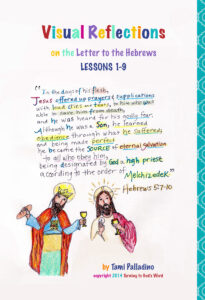 Through the Prayers of the Church—Volume I: Lauds & Vespers. Check out the
 drawings in this study and in the visual-meditation journal by Turning to God’s Word co-founder Tami Palladino to accompany The Letter to the Hebrews: An Explanation of the Mechanism of Our Salvation. Tami also illustrated The Revelation of Jesus Christ: The Faithful Witness, and some lessons in In the Beginning: The Book of Genesis and You Shall Have No Other Gods: The Book of Exodus.
the cursing psalms
A major difficulty for Christians who wish to incorporate the psalms into their prayer lives is that some of these ancient hymns include blatant curses asking the LORD to deal harshly with the Psalmist’s enemies. This is disturbing enough that the editors compiling Liturgy of the Hours books chose to leave out a few problematic verses from 20 psalms, as well as all of Psalm 58, Psalm 83, and Psalm 109. This Turning to God’s Word study addresses all of these omissions, which are pointed out when they occur in the lessons. The omissions may indeed pose what the general instructions for the Liturgy of the Hours refers to as “a certain psychological difficulty,” and in no way should be considered an endorsement of cursing.
Liturgy of the Hours verse omissions
Verses omitted from Liturgy of the Hours books but included in Volume I include: Psalms 5:11, 21:9–13, 63:10–12, 72:20, 110:6, 137:7–9, 139:19–22, 141:10, and 143:12. Verses omitted from Liturgy of the Hours books but included in Volume II include: Psalms 28:4–5, 31:18–19, 35:3–8, 35:20–21, 35:24–25, 40:15–16, 54:7, 55:16, 56:8, 59:6-9, 59:12–16, 69:23–29, 79:6–7, 79:12, and 140:10–12. In addition, all of Psalms 58, 83, and 109 are omitted from Liturgy of the Hours books but are included in Volume II of Sing a New Psalm: Communicating with God Through the Prayers of the Church.
the best Catholic commentary about Scripture
To find out more about how Church teaching is supported by passages in Sing a New Psalm: Communicating with God Through the Prayers of the Church—Volume I: Lauds & Vespers, check out the Index of Citations in the Catechism of the Catholic Church. Links to the primary Scripture passages in the lesson (Revised Standard Version Catholic Edition [RSVCE*]) and relevant paragraphs in the Catechism are provided here. Not every passage in the biblical text for this study is referenced in a Catechism paragraph, however.
don’t forget about our indexes & extra online material
If you’re trying to locate information about a specific Scripture passage, you can look it up in the index at the back of the study book. If you want to find a particular commentary, you can look up its title in the topics index. To learn more about another book of the Bible for which there’s a Turning to God’s Word study, visit the online study directories to read the commentaries and watch any accompanying videos. Finally, if you have a question or would like to make a comment about any of our studies, you can use one of the “ask us your question” or “what do you think” buttons to email our authors.
ex libris—Church documents & books about religious topics
Link to magisterial documents referred to in our Bible studies at ex libris—magisterial documents. This listing includes significant recent encyclicals as well as a number of historical Church documents. Recommended books related to Scripture study can be found at ex libris—main bookshelf.
wondering how to pronounce some words in the psalms?
Each online page provides links to readings from the New International Version (NIV) Bible. To listen, open one of the links and click on the audio icon above the printed text. Although not taken from the translations used in our study materials, the NIV readings provide an audio guide to pronunciation of many words in this lesson’s primary biblical texts. A close online version of the translation of the Bible currently used in Catholic liturgy in the United States as well as an audio guide for daily Mass readings for the current month can be found on the website of the United States Conference of Catholic Bishops (USCCB).
 close with a psalms-based prayer
Many of our Catholic study groups like to conclude their discussions with a prayer based on the scriptural focus of their lesson. If you’re uncomfortable composing your own Bible-based prayers, you can follow our four easy steps. If you prefer, you can pray any of the psalms in the lesson your group has been discussing. Amen.
Lesson 1 Set a Guard on My Mouth, Sunday First Vespers (Week I)—Psalm 141, Psalm 142, and Psalm 119:105–112
you also may like Volume II of our psalms study
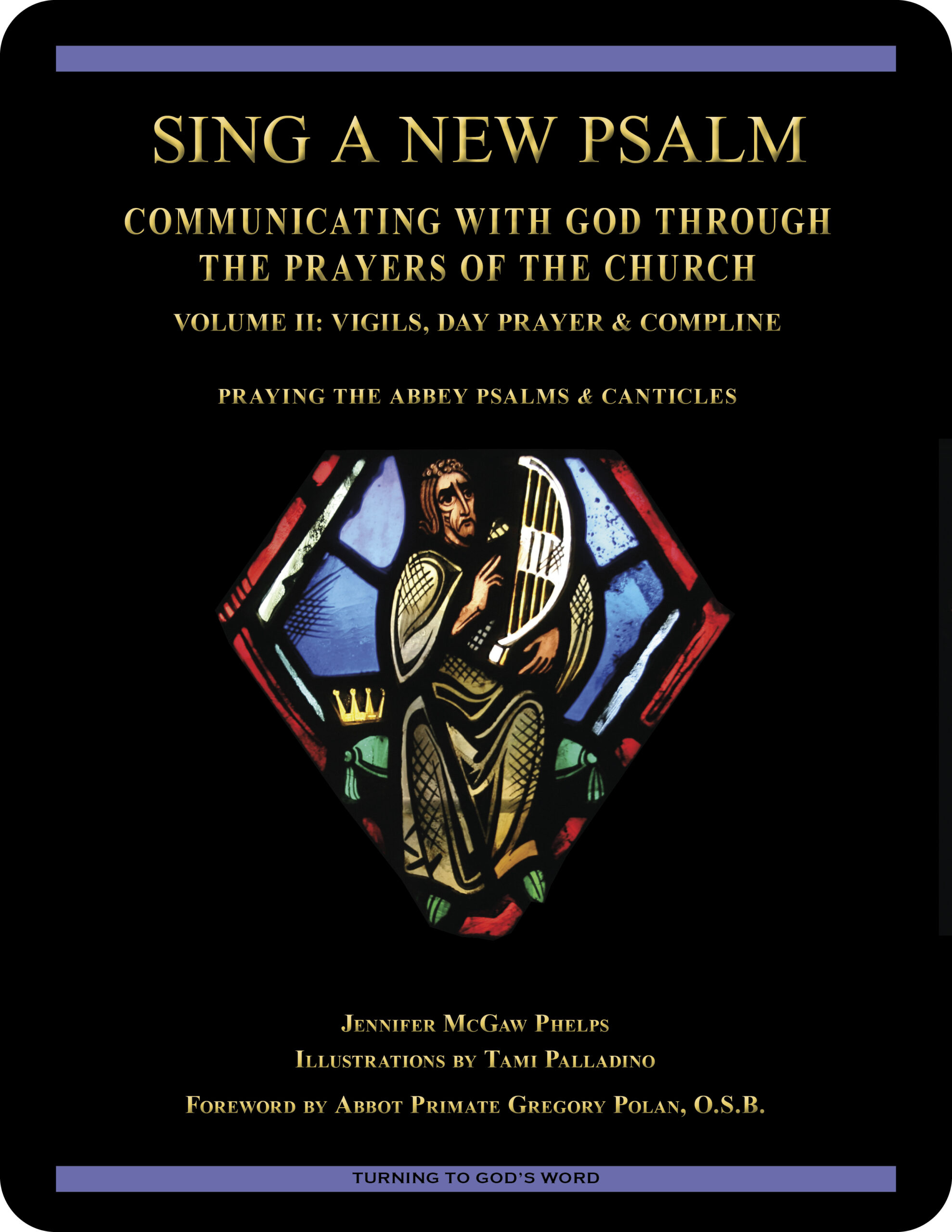 Sing a New Psalm: Communicating with God Through the Prayers of the Church—Volume II: Vigils, Day Prayer & Compline provides an in-depth look at psalms prayed by Catholics in early morning, mid-day, and evening liturgies. Volume II includes 29 lessons based on The Abbey Psalms and Canticles, a translation prepared by the Benedictine monks of Conception Abbey and endorsed by the United States Conference of Catholic Bishops (USCCB) for liturgical use. Click here to view a sample of the Introduction and Lesson 1.
start a Turning to God’s Word Bible study
Thank you for your interest in Sing a New Psalm: Communicating with God Through the Prayers of the Church—Volume I: Lauds & Vespers. 
 More information about beginning a Turning to God’s Word Bible study can be found on this website at start a Bible study, and Tami, Matthew, and I are available to answer questions or discuss concerns. Contact us to start this or one of our other studies or to have your schedule listed with other TtGW study groups on our website. —Jennifer
*There are seven deuterocanonical books in the Old Testament—Baruch, Judith, Sirach, Tobit, Wisdom, and First and Second Maccabees—and there are some deuterocanonical passages in the Books of Daniel and Esther. Protestants usually refer to these works as “apocryphal,” a word that means “outside the (Protestant) canon” because they’re excluded from most Protestant Bibles. Deuterocanonical means “second canon”; Catholics use that word to refer to any section of the Catholic Old Testament for which there are no extant, or existing, Hebrew manuscripts. All of the deuterocanonical books appear in the Septuagint, the earliest remaining versions of which date to the 1st century B.C. This Greek translation of the Old Testament was in common use by Jews at the time of Jesus. Learn more by reading How Do Catholic & Protestant Bibles Differ?
Turning to God’s Word printed Bible studies use the 2006 Revised Standard Version Second Catholic Edition (RSV2CE) translation for all Scripture references except those to the psalms, which are taken from The Abbey Psalms and Canticles, prepared by the Benedictine monks of Conception Abbey and published in 2020 by the United States Conference of Catholic Bishops (USCCB). All Scripture links for the online study pages for Sing a New Psalm: Communicating with God Through the Prayers of the Church—Volume I: Lauds & Vespers are to the 1966 Revised Standard Version Catholic Edition (RSVCE) translation. The New International Version (NIV) audio recordings follow the same chapter and verse numbering as the RSV Catholic translations, but the NIV translation doesn’t include the deuterocanonical books and passages.
The 1966 RSVCE uses archaic pronouns and verb forms such as “thee,” “thou,” and “didst” in the psalms and in direct quotations attributed to God. The 2006 RSV2CE replaces these with more accessible English. The few significant translation changes in the RSV2CE include rendering almah as “virgin” in the Book of Isaiah 7:14 and restoring the term “begotten” in the Gospel According to John 3:16.
Numbering varies for some passages in this Bible study. Turning to God’s Word studies (print and digital) follow the numbering in the Revised Standard Version Catholic translations (RSV2CE and RSVCE). Discrepancies in the New American Bible Revised Edition (NABRE) are noted in the Index of Scripture Citations in the study book.