 Sing a New Psalm:
Communicating with God Through
the Prayers of the Church
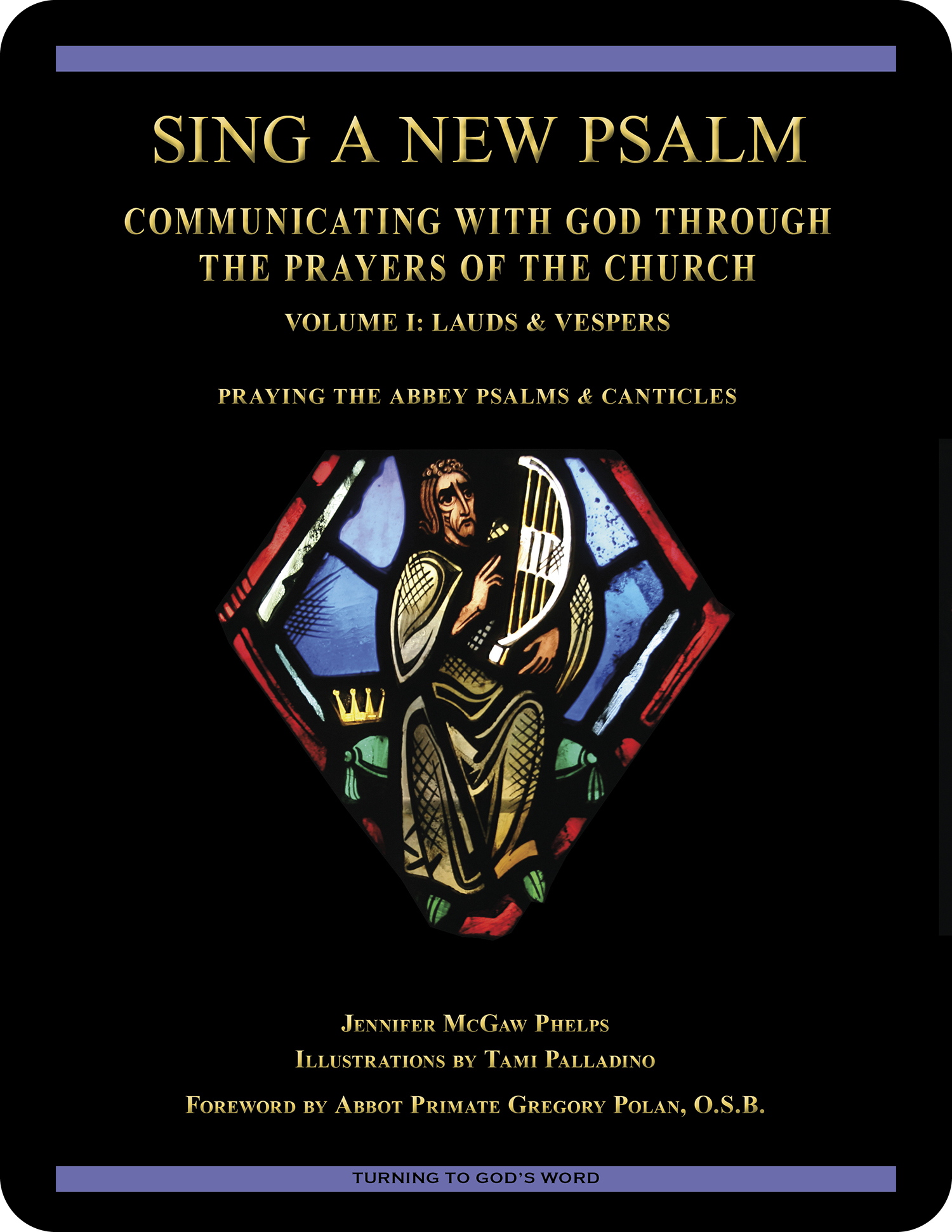
Volume I: Lauds & Vespers
Lesson 7 One Thing I Ask of the LORD
Psalm 27 and Psalm 33
Tuesday Vespers (Week I)
Revised Standard Version Catholic Edition (RSVCE)*
New American Bible Revised Edition (NABRE)*
Catechism of the Catholic Church
ex libris (in our library)
next lesson: Seeing in God’s Light
This material coordinates with Lesson 7, “One Thing I Ask of the LORD,” on pages 32–35 in Sing a New  Psalm: Communicating with God Through the Prayers of the Church—Volume I: Lauds & Vespers. Our Catholic Bible study is based on The Abbey Psalms and Canticles, a psalms translation prepared by the monks at Conception Abbey in 2010 and first published as The Revised Grail Psalms. The Abbey Psalms and Canticles is a revision of that work, finished in 2020 and now owned by the United States Conference of Catholic Bishops (USCCB). Wording and numbering of some psalms in other translations may differ. This translation is being added to all English-language Liturgy of the Hours books used in the United States.
“Unlike other prayers in sacred Scripture, the prayers contained in the psalms are not inserted into a narrative story that specifies their meaning and function. Instead, the psalms are given to the believer precisely as a text of prayer. Since they are the Word of God, the believer who prays the psalms speaks to God using the very words that God himself has given to us. Thus, in praying the psalms we learn to pray. The psalms are a school of prayer.”—Pope Benedict XVI
welcome to our in-depth study of the psalms
We invite groups and individuals to check out the sample Introduction and Lesson 1 from this 28- lesson Turning to
  God’s Word Catholic Bible study. Our online study pages include additional questions, commentary, and prayers based on the psalm texts. Sing a New Psalm: Communicating with God Through the Prayers of the Church—Volume I: Lauds & Vespers has been granted an imprimatur. A digital version of can be purchased from our website shop. Volume II covers psalms prayed at Vigils, Day Prayer, and Compline. If you have a Bible-related question or comment, click on one of the “ask us your question” or “what do you think” buttons on any online study page.
open with prayer
It’s always wise to begin any Bible study with prayer, whether reading the Scriptures alone or meeting with others in a discussion study group. You can pray using your own words, pray one of the psalms in this lesson, or use one of the opening prayers on our website. We especially like the following:
Lord Jesus, you promised to send your Holy Spirit
to teach us all things.
As we read and study your word today,
allow it to touch our hearts and change our lives. Amen.
 about the psalms in this lesson**
During Ordinary Time, the monks at Conception Abbey pray the following psalms for Tuesday Vespers Week I: Psalm 27, an individual of personal lament by David, and Psalm 33, a hymn with an unknown author.
vespers—praying at the end of the day
“One Thing I Ask of the LORD” examines David’s desire to dwell in the house of the LORD all the days of his life. This illustration by Turning to God’s Word co-founder Tami Palladino 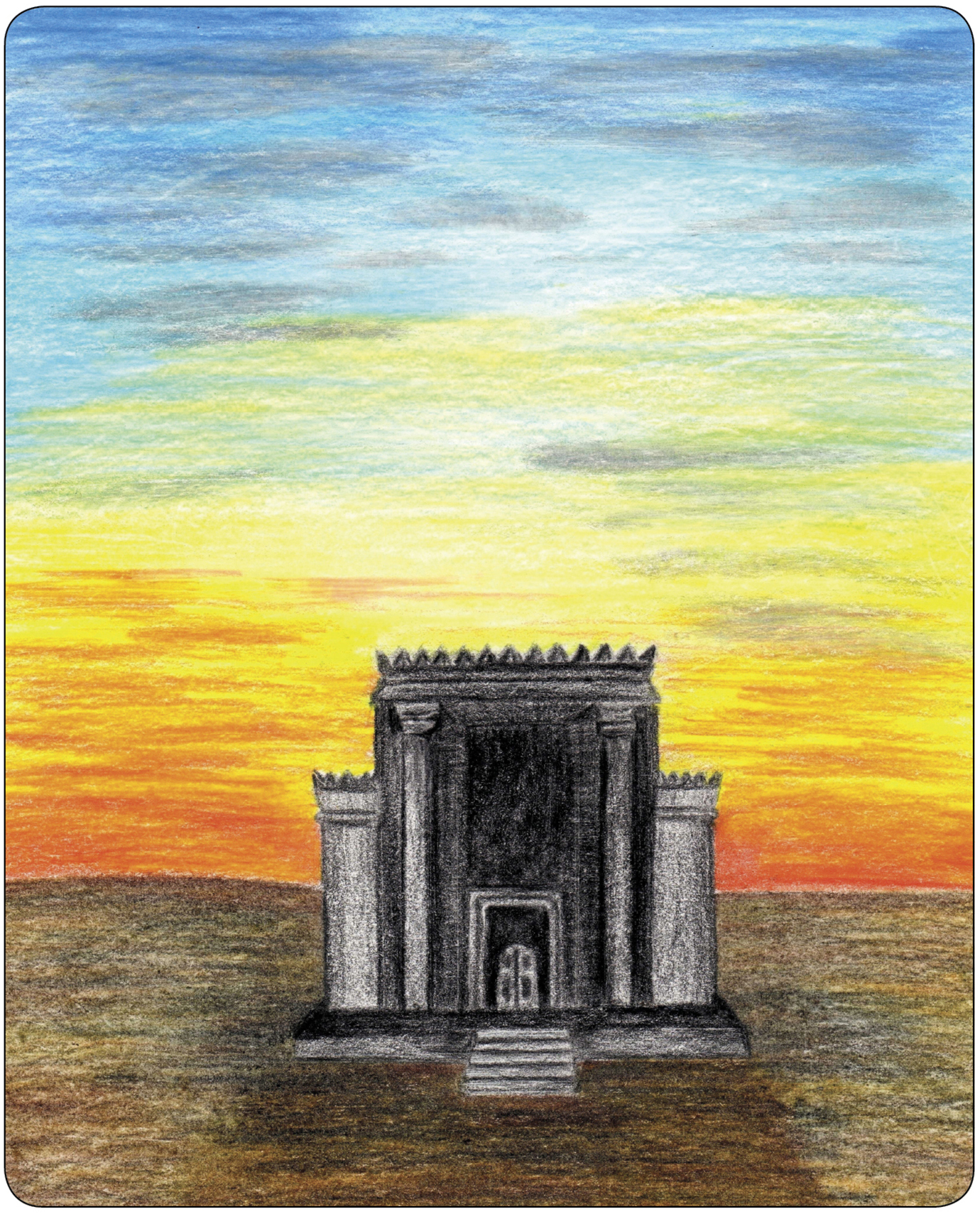 shows God’s Temple glowing in the light of sunset. The end of the day is an excellent time to pray. For most of us, the primary duties of the day are over. We can thank God for the help he provided throughout the day and ask for protection when we sleep. Evening also is a good time to consider our spiritual accomplishments of the day and to make a mental note of spiritual goals we wish to focus on using during the gift of time we expect to be given the next day. We can re-establish that we wish for God to be the focus of everything we plan to do, and we can ask God to remain with us through the darkness of the night and through any other darkness in our lives. Click on Tami’s illustration to enlarge it. The illustration also is printed on page 33 in Sing a New Psalm: Communicating with God Through the Prayers of the Church—Volume I: Lauds & Vespers.
what the one thing you want from the LORD?
In Psalm 27, David seems certain about what it is that he most wants from God—to live in the house of the LORD all the days of his life.
 ? What are some other things that David might have considered asking of the LORD?
? What does David’s choice indicate about the kind of relationship he wants with God?
? What does it indicate about the kind of relationship he already has with God?
? What’s on your list of things that you desire from the LORD?
? What’s the most important thing on your list?
? What does your choice indicate about the kind of relationship that you want with God?
? What does it indicate about the kind of relationship that you already have with God?
tabernacle—you could look it up in our archives
 When God’s people wandered in the wilderness, God dwelt with them in a tent. Tabernacle comes from the Latin word for “tent” and is used in Scripture as a verb as well as a noun. It indicates that God has chosen a humble place to dwell with his people. To learn more, read Lost in Translation, an online column in which Turning to God’s Word author Matthew Phelps helps readers connect with ideas in the original languages of the Scriptures. New Lost in Translation entries are posted on Mondays, and past entries are archived on our website. Contact us if you’d like to receive Lost in Translation by email every week.
read the Catechism—where God dwells today
In the Old Testament, the Temple replaced the tent or tabernacle as God’s dwelling.  For Christians the Church replaces the Temple, but this idea carries a deeper meaning than that of merely substituting one building for another, as paragraph 1267 in the Catechism of the Catholic Church teaches.
1267 Baptism makes us members of the Body of Christ: “Therefore … we are members of one another.” Baptism incorporates us into the Church. From the baptismal fonts is born the one people of God of the New Covenant, which transcends all the natural or human limits of nations, cultures, races, and sexes: “For by one Spirit we were all baptized into one body.”
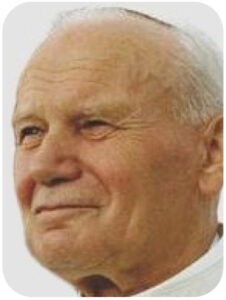 the popes inspire us—words of encouragement in time of trial
“The LORD is Light & Salvation” on page 33 in Sing a New Psalm: Communicating with God Through the Prayers of the Church—Volume I: Lauds & Vespers is from an audience with Pope St. John Paul II. The Holy Father addresses a problem faced by all men and women of faith—being treated with contempt and hostility by the secular world. You can read the entire excerpt to learn how Christians can preserve inner calm in the face of extreme ostracism.
Q&A—land of the living
Some participants in this Bible study are wondering what’s meant by the phrase “land of the living.” Question 5 on page 34 in Sing a New Psalm: Communicating with God Through the Prayers of the Church—Volume I: Lauds & Vespers asks where David thinks he’ll be when he sees the goodness of the LORD. The phrase “land of the living” appears in Psalm 27:13: “I believe that I shall see the goodness of the LORD in the land of the living.” It also appears in Psalm 116 and Psalm 142. We’re including Question 5 for readers without access to a print or digital copy of Sing a New Psalm: Communicating with God Through the Prayers of the Church—Volume I: Lauds & Vespers.
Question 5 Read Psalm 27:11–14. What specific troubles plague David? Consider why he wants instruction from the LORD in order to stay on an even path. What might explain David’s steadfast faith that the LORD will come to his assistance? Where does David believe he will be when he witnesses the LORD’s goodness?
Q: My discussion group is wondering how to interpret “land of the living.” Was David referring to Jerusalem or was he thinking heaven? Our answers were all over the board.
A: Both ideas are valid. One reason your group might be coming up with a variety of responses regarding the location of the “land of the living” is because this term changes meaning depending on whether we’re looking at Old or New Testament interpretation. In the Old Testament, David pretty much had to be thinking of the here and now—life on earth. It’s worth noting that people in your group associated this earthly life with being in Jerusalem, the city established by David as the fixed location for the LORD’s home base here on earth. When Christians encounter the phrase “land of the living” in the psalms and interpret it in light of faith in Jesus, “land of the living” refers to heaven or eternal life.
Trying to describe the change in view of the afterlife from the Old Testament to the New is challenging. We don’t hear much teaching about it, and most of what we’re exposed to can’t be supported when put to the test of continuity in Scripture and consistency with Church teaching. This view of heaven as a place open to human souls after physical death is foundational to Christianity, however. None of the Old Testament apocalyptic visions of heaven include any evidence of human souls having taken up residence there. The vision of heaven in the book of Revelation closely follows the Old Testament visions with one significant exception—the book of Revelation describes any number of human souls firmly entrenched in heaven. This is in keeping with Church teaching  that heaven wasn’t open to men and women until after the Passion, death, and Resurrection of Jesus. Learn more about the Christian view of heaven in our in-depth Catholic Bible study The Revelation of Jesus Christ: The Faithful Witness.
It’s easy for us to think that ancient people had the same idea of salvation and eternal life that we have in the present day, but reading the Old Testament doesn’t support that viewpoint. Although the Old Testament sees God as ruler over all the earth and understands heaven to be where God hangs out, people living at the time that the psalms were written didn’t expect to go to heaven themselves. They didn’t really think beyond life on earth. Their primary idea of salvation dealt with being made safe from enemies on earth, in the “land of the living.” They understood there to be a parallel “abode of the dead,” usually referred to by its Greek name “Hades” but also often referred to by the Hebrew word “Sheol.” This abode of the dead was the place all souls went after dying—regardless of how they might have behaved while alive. For more information about Sheol, see the vocabulary box “Pit” on page 31 in Lesson 6 A Soul Athirst for the Living God.
Jesus offers convincing evidence of this kind of thinking in the sixteenth chapter in the Gospel According to Luke, which includes the parable of Lazarus and the rich man. On earth, these two men lived dramatically different lives. Both die and go to Hades, but they’re assigned to different neighborhoods once there. The rich man is in torment, while Lazarus reclines in the bosom of Abraham. They’re able to observe each other, but neither can leave their own area. Hades isn’t heaven and it isn’t hell. It’s simply the “abode of the dead.” In the Old Testament, this is the place where all souls go after death.
In the Gospels, Jesus expends an enormous amount of time and energy attempting to explain that the kingdom of heaven is at hand. The idea of anyone on earth going there was a new concept. You can learn more about Jesus and his most important teachings in our in-depth Catholic Bible study The Gospel According to John: An Encounter with Grace & Truth. Only a few Old Testament prophets were granted a glimpse of heaven during what amounted to a day pass. The Old Testament hope for salvation was much more limited than the eternal life that we hope for as  Christians. The Old Testament Psalmists’ prayers nevertheless apply to Christianity, even though Christianity didn’t exist when the psalms were written.
We can interpret the psalms in terms of our present-day understanding, which has been revealed to us by God through Scripture and the Church. It’s important to know what the Psalmists are thinking, but if we try to restrict our own thinking about the psalms to what these prayers meant at the time of the Old Testament, we’re missing the reason that they’ve endured for thousands of years as Scripture and remain part of liturgy. We’re also making it much harder to relate to them in our own lives.
what does ‘land of the living’ mean to you?
This difference in understanding about the location of the “land of the living” suggests another interesting idea. Less important than whether David’s Old Testament audience understood eternal life as we do is the question of whether we as Christians believe that we only will see the LORD’s goodness after we die.
? What does the term “land of the living” mean in connection with your own life?
? What evidence from Jesus’ teaching in the New Testament can you cite to back up your thinking?
what’s the big deal about a vertical posture?
Consider what it means to be “upright.” In Psalm 33, think about whether the anonymous author is commenting on maintaining a standing position. To learn how standing up is related to other themes in Psalm 33, read “Upright” on page 35 in Sing a New Psalm: Communicating with God Through the Prayers of the Church—Volume I: Lauds & Vespers.
a translation difference: from vs. for
In The Abbey Psalms and Canticles translation of Psalm 33:1, an unidentified Psalmist announces that praise is fitting “from” the upright. The Revised Grail Psalms translates the same passage to indicate that praise is fitting “for” the upright. Most readers would understand both translations to mean that it is fitting for the upright to praise the LORD, although using the preposition “from” is a more precise way to communicate that idea. (Note that it is not possible to link to either The Abbey Psalms and Canticles or The Revised Grail Psalms; all links on the online pages are to the Revised Standard Version Catholic Edition [RSVCE]).
another translation difference: upright vs. faithful
In The Abbey Psalms and Canticles translation of Psalm 33:4, the word of the LORD is described as “upright.” The same passage in The Revised Grail Psalms describes the word of the LORD as “faithful.” A common misconception speakers of English make is assuming that the word “faith” only describes a belief system. This occurs because the word “faith” in English is not used as a verb. It is impossible to “faith” something in English, and “belief” has become the go-to word for translators looking for an English verb. The word “trust” probably more nearly matches what the original biblical authors meant by using their word for “faith” as a verb. Confusion about “faith” as something one believes or thinks as opposed to something one does may be behind this translation change. Which translation of Psalm 33:4 do you prefer?
yet another translation difference: the whole human race vs. all the children of men
In The Abbey Psalms and Canticles translation of Psalm 33:13, the unidentified Psalmist announces that the LORD sees the “the whole human race.” The Revised Grail Psalms translates the same passage as the LORD sees “all the children of men.” Think about why editors at the United States Conference of Catholic Bishops (USCCB) might have wanted to make this change.
the best Catholic commentary about Scripture
To find out more about how Church teaching is supported by passages in Sing a New Psalm: Communicating with God Through the Prayers of the Church—Volume I: Lauds & Vespers, check out the Index of Citations in the Catechism of the Catholic Church. Links to the primary Scripture passages in the lesson (Revised Standard Version Catholic Edition [RSVCE*]) and relevant paragraphs in the Catechism are provided here. Not every passage in the biblical text for this study is referenced in a Catechism paragraph, however.
Psalm 27:8—paragraph 2730
Psalm 27:10—paragraph 239
Psalm 33:6—paragraphs 292, 703
don’t forget about our indexes & extra online material
If you’re trying to locate information about a specific Scripture passage, you can look it up in the index at the back of the study book. If you want to find a particular commentary, you can look up its title in the topics index. To learn more about another book of the Bible for which there’s a Turning to God’s Word study, visit the online study directories to read the commentaries and watch any accompanying videos. Finally, if you have a question or would like to make a comment about any of our studies, you can use one of the “ask us your question” or “what do you think” buttons to email our authors.
ex libris—Church documents & books about religious topics
Link to magisterial documents referred to in our Bible studies at ex libris—magisterial documents.  This listing includes significant recent encyclicals as well as a number of historical Church documents. Recommended books related to Scripture study can be found at ex libris—main bookshelf.
wondering how to pronounce some of these words?
The following links are to readings from the New International Version (NIV) Bible. To listen, open one of the links and click on the audio icon above the printed text. Although not taken from the translations used in our study materials, the NIV readings provide an audio guide to pronunciation of many words in this lesson’s primary biblical texts. A close online version of the translation of the Bible used in Catholic liturgy in the United States as well as an audio guide for daily Mass readings for the current month can be found on the website of the United States Conference of Catholic Bishops (USCCB).
 close with a psalms-based prayer for Tuesday Vespers Week I
Many of our Catholic study groups like to conclude their discussions with a prayer based on the scriptural focus of their lesson. If you’re uncomfortable composing your own Bible-based prayers, you can follow our four easy steps. If you prefer, you can pray any of the psalms in this lesson, or you can use the following short prayer.
O generous and loving God,
you teach us to make wise choices
in regard to the things we desire in this life.
Guide our decisions and help us
to value spiritual goods above material ones—
and to value our relationship with you above all else.
We ask this in the name of your Son, Jesus Christ,
who is one with you and the Holy Spirit. Amen.
Lesson 8 Seeing in God’s Light, Wednesday Lauds (Week I)—Psalm 36, Psalm 47, and Psalm 48
Lesson 6 A Soul Athirst for the Living God, Tuesday Lauds (Week I)—Psalm 30, Psalm 42, and Psalm 43
you also may like our study of the Letter to the Hebrews (digital only)
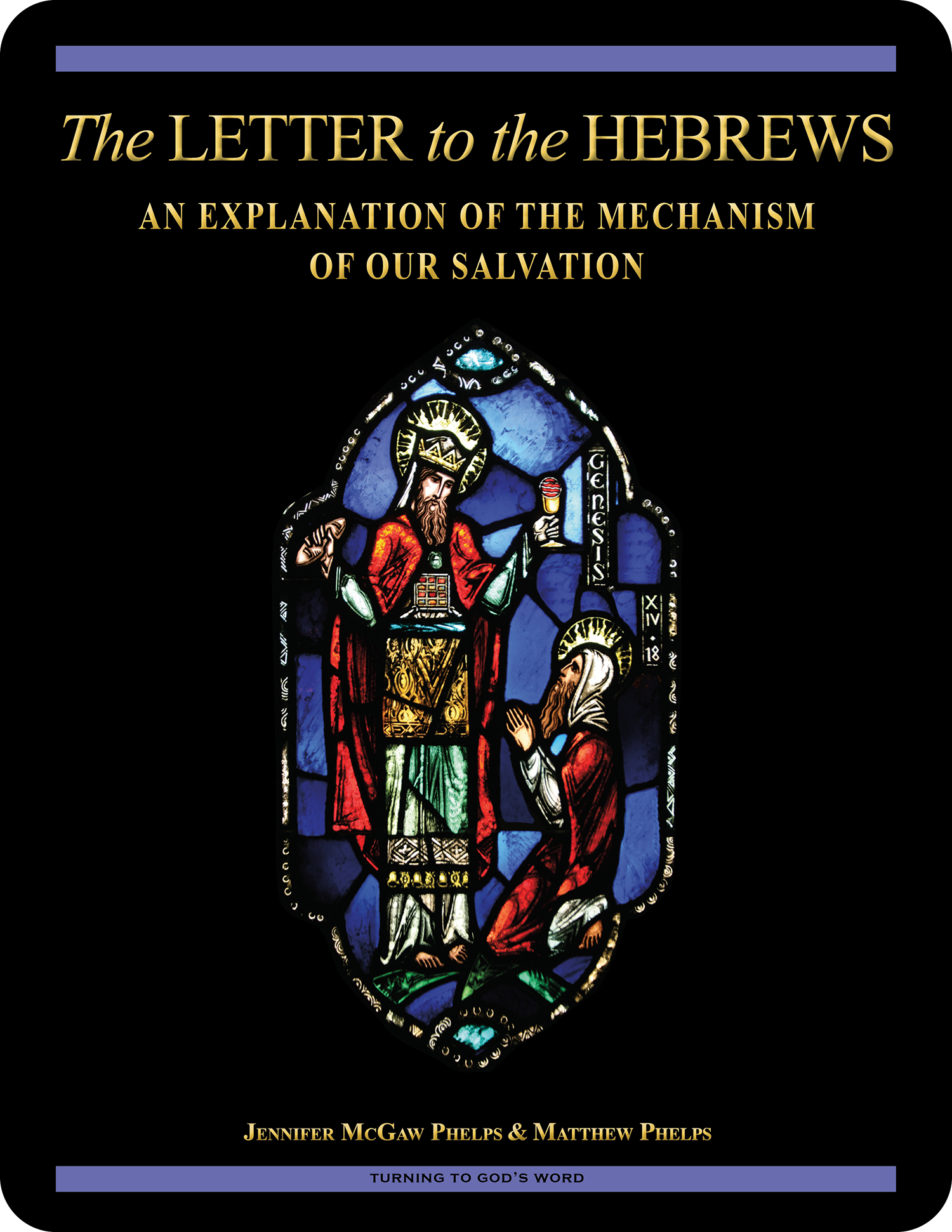 Many Christians struggle to understand one of the central mysteries of our faith: how Jesus can be both human and divine at the same time. The Letter to the Hebrews: An Explanation of the Mechanism of Our Salvation, an 18-lesson Catholic Bible study with an imprimatur, offers an in-depth look at the way in which Jesus’ dual nature allows for the salvation of humanity. The Letter to the Hebrews is designed to provide information that will encourage Christians to remain faithful. Click here to view a sample of the first lesson.
start a Turning to God’s Word Bible study
Thank you for your interest in Sing a New Psalm: Communicating with God Through the Prayers of the Church—Volume I: Lauds & Vespers. 
 More information about beginning a Turning to God’s Word Bible study can be found on this website at start a Bible study, and Tami, Matthew, and I are available to answer questions or discuss concerns. Contact us to start this or one of our other studies or to have your schedule listed with other TtGW study groups on our website. —Jennifer
*There are seven deuterocanonical books in the Old Testament—Baruch, Judith, Sirach, Tobit, Wisdom, and First and Second Maccabees—and there are some deuterocanonical passages in the Books of Daniel and Esther. Protestants usually refer to these works as “apocryphal,” a word that means “outside the (Protestant) canon” because they’re excluded from most Protestant Bibles. Deuterocanonical means “second canon”; Catholics use that word to refer to any section of the Catholic Old Testament for which there are no extant, or existing, Hebrew manuscripts. All of the deuterocanonical books appear in the Septuagint, the earliest remaining versions of which date to the 1st century B.C. This Greek translation of the Old Testament was in common use by Jews at the time of Jesus. Learn more by reading How Do Catholic & Protestant Bibles Differ?
**You can learn more about the psalms by viewing a sample lesson from the Turning to God’s Word Catholic Bible study Sing a New Psalm: Communicating with God Through the Prayers of the Church. The first volume covers psalms prayed at Lauds and Vespers; the second covers psalms prayed at Vigils, Day Prayer, and Compline. Numbering of psalms and verses may vary in different translations.
Turning to God’s Word printed Bible studies use the 2006 Revised Standard Version Second Catholic Edition (RSV2CE) translation for all Scripture references except those to the psalms, which are taken from The Abbey Psalms and Canticles, prepared by the Benedictine monks of Conception Abbey and published in 2020 by the United States Conference of Catholic Bishops (USCCB). All Scripture links for the online study pages for Sing a New Psalm: Communicating with God Through the Prayers of the Church—Volume I: Lauds & Vespers are to the 1966 Revised Standard Version Catholic Edition (RSVCE) translation. The New International Version (NIV) audio recordings follow the same chapter and verse numbering as the RSV Catholic translations, but the NIV translation doesn’t include the deuterocanonical books and passages.
The 1966 RSVCE uses archaic pronouns and verb forms such as “thee,” “thou,” and “didst” in the psalms and in direct quotations attributed to God. The 2006 RSV2CE replaces these with more accessible English. The few significant translation changes in the RSV2CE include rendering almah as “virgin” in the Book of Isaiah 7:14 and restoring the term “begotten” in the Gospel According to John 3:16.
Numbering varies for some passages in this Bible study. Turning to God’s Word studies (print and digital) follow the numbering in the Revised Standard Version Catholic translations (RSV2CE and RSVCE). Discrepancies in the New American Bible Revised Edition (NABRE) are noted in the Index of Scripture Citations in the study book.