 Sing a New Psalm:
Communicating with God Through
the Prayers of the Church
Volume I: Lauds & Vespers
Lesson 9 An Overflowing Heart
Psalm 32, Psalm 45, and Psalm 62
Wednesday Vespers (Week I)
Revised Standard Version Catholic Edition (RSVCE)*
New American Bible Revised Edition (NABRE)*
Catechism of the Catholic Church
Rosarium Virginis Mariae (Rosary of the Virgin Mary)
ex libris (in our library)
next lesson: Awake, My Soul!
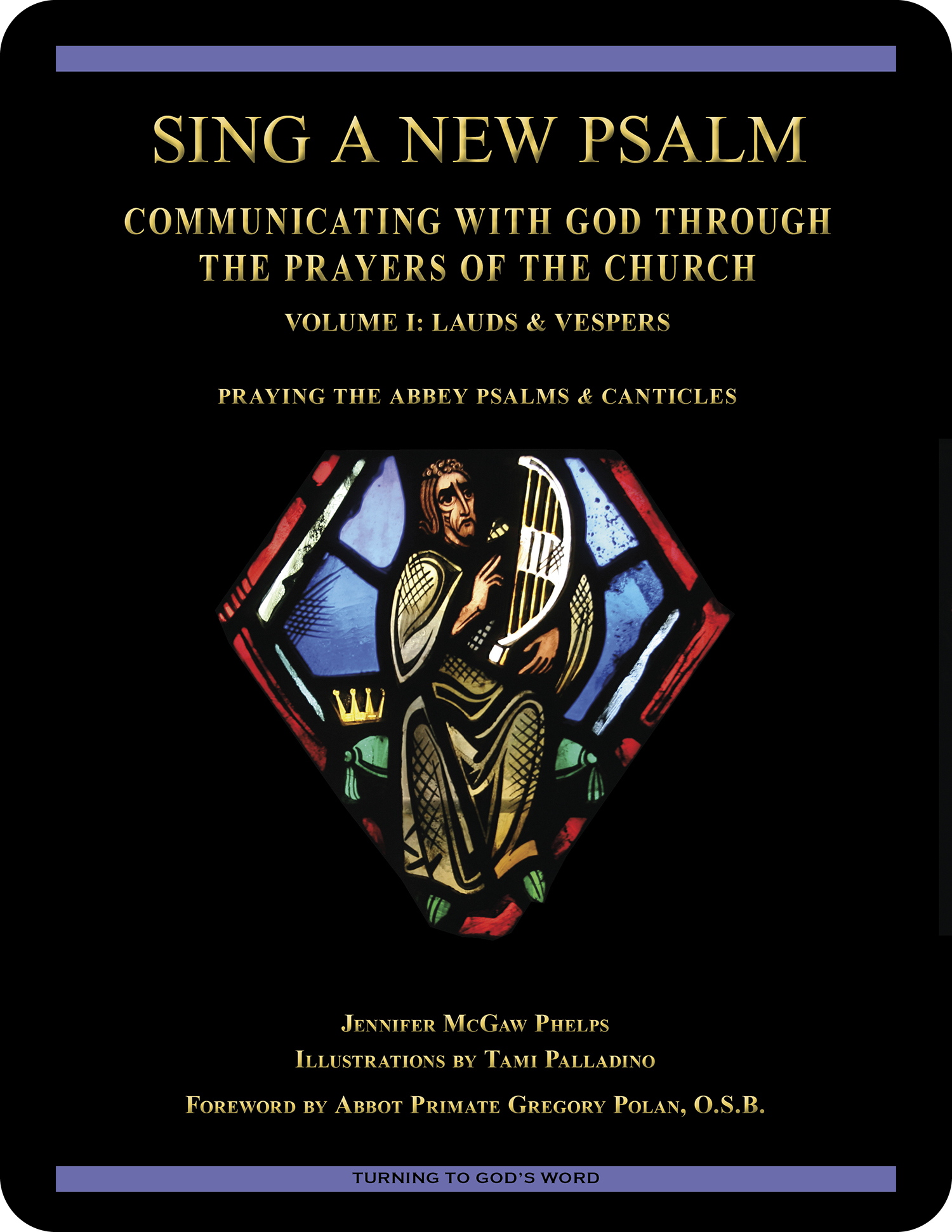
This material coordinates with Lesson 9, “An Overflowing Heart,” on pages 40–43 in>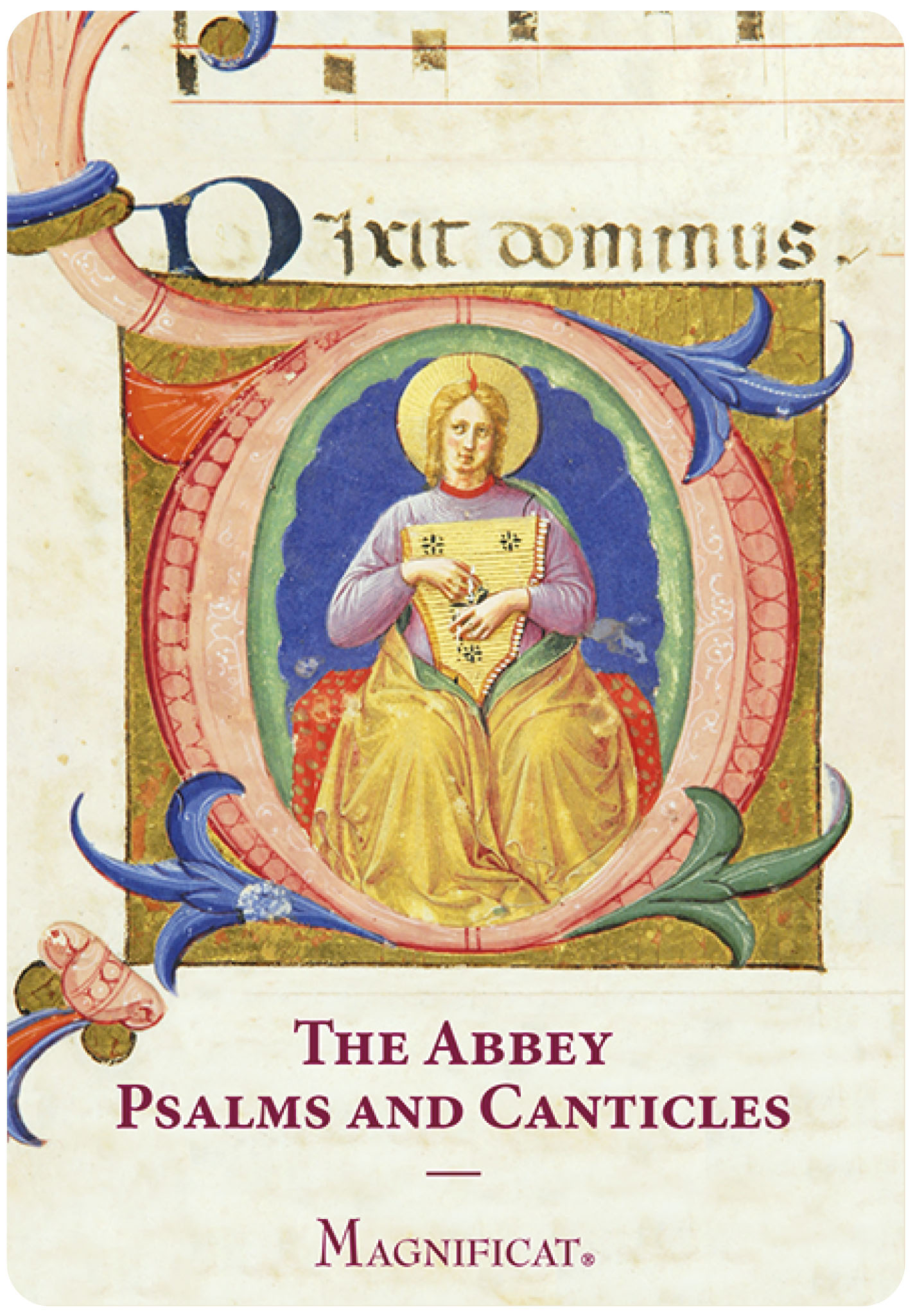 Sing a New Psalm: Communicating with God Through the Prayers of the Church—Volume I: Lauds & Vespers. Our Catholic Bible study is based on The Abbey Psalms and Canticles, a psalms translation prepared by the monks at Conception Abbey in 2010 and first published as The Revised Grail Psalms. The Abbey Psalms and Canticles is a revision of that work, finished in 2020 and now owned by the United States Conference of Catholic Bishops (USCCB). Wording and numbering of some psalms in other translations may differ. This translation is being added to all English-language Liturgy of the Hours books used in the United States.
“Unlike other prayers in sacred Scripture, the prayers contained in the psalms are not inserted into a narrative story that specifies their meaning and function. Instead, the psalms are given to the believer precisely as a text of prayer. Since they are the Word of God, the believer who prays the psalms speaks to God using the very words that God himself has given to us. Thus, in praying the psalms we learn to pray. The psalms are a school of prayer.”—Pope Benedict XVI
welcome to our in-depth study of the psalms
We invite groups and individuals to check out the sample Introduction and Lesson 1 from this 28- lesson Turning to
  God’s Word Catholic Bible study. Our online study pages include additional questions, commentary, and prayers based on the psalm texts. Sing a New Psalm: Communicating with God Through the Prayers of the Church—Volume I: Lauds & Vespers has been granted an imprimatur. A digital version of can be purchased from our website shop. Volume II covers psalms prayed at Vigils, Day Prayer, and Compline. If you have a Bible-related question or comment, click on one of the “ask us your question” or “what do you think” buttons on any online study page.
open with prayer
It’s always wise to begin any Bible study with prayer, whether reading the Scriptures alone or meeting with others in a discussion study group. You can pray using your own words, pray one of the psalms in this lesson, or use one of the opening prayers on our website. We especially like the following:
Lord Jesus, you promised to send your Holy Spirit
to teach us all things.
As we read and study your word today,
allow it to touch our hearts and change our lives. Amen.
about the psalms in this lesson**
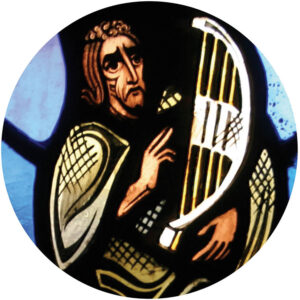 During Ordinary Time, the monks at Conception Abbey pray the following psalms for Wednesday Vespers Week I: Psalm 32, a hymn of thanksgiving written by David; Psalm 45, a royal psalm written by one or more descendants of Korah (the sixteenth chapter in the book of Numbers records that the Levite Korah was killed by God for leading an unsuccessful revolt against Moses and Aaron; his sons, who did not participate in the revolt, were spared); and Psalm 62, a hymn of trust attributed to David.
who are the sons of Korah?
The superscript to Psalm 45 associates the sons of Korah with the authorship of this psalm. The book of Exodus 6:24 lists the names of Korah’s sons as Assir, Elkanah, and Abiasaph, indicating that they followed Moses‘ command to depart from their father’s tent to avoid being destroyed because of Korah’s sin, which was challenging the authority of Moses and Aaron—and ultimately of God. This event is described in the book of Numbers 16:20–26. Various psalms mention the “sons of Korah” as their composers; the term refers to descendants of Korah and not to his literal children. In addition to Psalm 45 in this lesson, other psalms in Volume I attributed to descendants of Korah include Psalm 42 (in Lesson 6 A Soul Athirst for the Living God), Psalm 47 and Psalm 48 (both in Lesson 8 Seeing in God’s Light), Psalm 49 (in Lesson 11 God Will Ransom My Soul), Psalm 84 and Psalm 85 (both in Lesson 20 The LORD God Is a Sun & a Shield), and Psalm 87 (in Lesson 18 What God Is As Great As Our God?). In addition, Psalm 44, Psalm 46 and Psalm 88 are covered in Volume II and also are attributed to descendants of Korah.
who is Jeduthun in the superscript to Psalm 62?
Jeduthun appears in the Old Testament as one of three principal leaders of liturgical music during the reign of David. (The other two music leaders appointed by David are Asaph and Heman.) Jeduthun is named in The Abbey Psalms and Canticles translations of Psalm 62:1 in this lesson, and in Psalm 39:1 in Lesson 4 I Wash My Hands in Innocence in Volume II and Psalm 77:1 in Lesson 18 What God Is As Great As Our God? in this volume. These superscripts associate Jeduthun in some way with those three psalms. (David is considered the composer of Psalm 39 and Psalm 62, while Psalm 77 is attributed to Asaph.) A few scholars suggest that Jeduthun and Ethan may have been the same person (Ethan is named in the superscript to Psalm 89 and is considered the composer of that psalm; Psalm 89 is covered in Lesson 13 Praise the LORD Who Rides on the Heavens in Volume II.)
a heart too full to contain the Psalmist’s joy
The title of this lesson—”An Overflowing Heart”—is based on the announcement in Psalm 45 that the 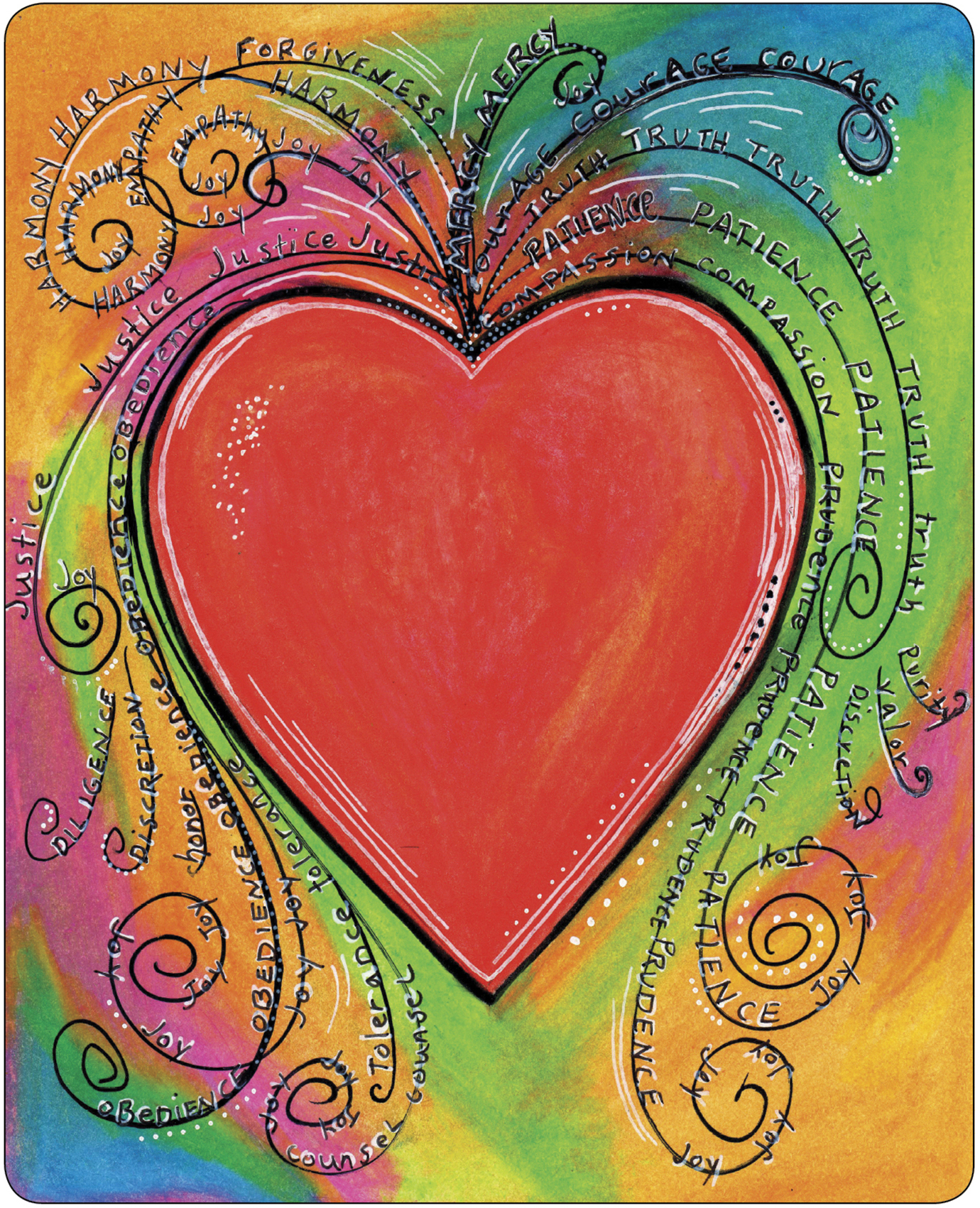 Psalmist’s heart is overflowing with noble words. The Psalmist is identified as one or more of the sons of Korah. He’s unable to contain his joy. This contrasts with the feelings expressed in Psalm 32, in which this unnamed son of Korah acknowledges in vivid detail the physical effects that have occurred whenever he’s attempted to keep his sins a secret. The illustration for this lesson was created by Turning to God’s Word co-founder Tami Palladino and shows a heart spilling over with character traits associated with Christian life. If you examine this illustration, you’ll see a list of the noble words with which the Psalmist’s heart is overflowing. How do these qualities contribute to overall well-being? How are they incompatible with sin? How many of these traits do you think others might use to describe you? Are there any other words that you’d include if you were making such a drawing of your own heart? Click on Tami’s illustration to enlarge it. The illustration also is printed on page 41 in Sing a New Psalm: Communicating with God Through the Prayers of the Church—Volume I: Lauds & Vespers.
 rest—you could look it up
In the Gospel According to Matthew 11:28–30, Jesus makes a promise that seems to build on the rest described by David in Psalm 62. To learn about the kind of rest that Jesus has promised his followers and how it’s related to the Hebrew concept of the sabbath, read Lost in Translation, an online column in which Turning to God’s Word author Matthew Phelps helps readers connect with ideas expressed in the original languages of the Scriptures. New Lost in Translation entries are posted on Mondays, and past entries are archived on our website. Contact us if you’d like to receive Lost in Translation by email every week. You can learn more about God’s  establishment of the sabbath on the seventh day of Creation in Lesson 1 And God Said, Let There Be Light in the Turning to God’s Word Catholic Bible study In the Beginning: The Book of Genesis.
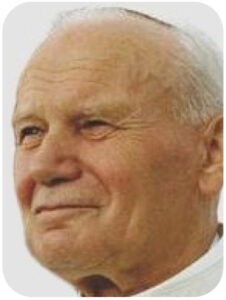 the popes inspire us—what attracts us to Christ
Two of many attractive attributes ascribed to God are beauty and justice. (How many more can you name?) “Beauty Combined with Justice” on page 42 in Sing a New Psalm: Communicating with God Through the Prayers of the Church—Volume I: Lauds & Vespers, is a reflection by Pope St. John Paul II. The bridegroom in Psalm 45 is seen as a person who possesses beauty and holiness of life. It’s this picture that leads Christians to see in the bridegroom an image of Jesus Christ in the form of a perfect and attractive man.
read the Catechism—how well do you know your faith?
Can you answer the following questions without looking at the Catechism of the Catholic Church?
 ? Why is contrition important? To learn what the Church teaches about this and other related questions concerning the sacrament of Reconciliation (also called the sacrament of Confession or the sacrament of Penance), refer to paragraph 1451 in the Catechism of the Catholic Church.
? Why are Christians anointed at Baptism? Although there’s a separate sacrament of Anointing of the Sick, the Church also uses anointing in the sacrament of Baptism. Refer to paragraph 1241 in the Catechism of the Catholic Church.
a translation difference: uprightness vs. justice
In The Abbey Psalms and Canticles translation of Psalm 45:5 (Psalm 45:4 in Revised Standard Version Catholic editions), the  mighty one is described as triumphant in “right“; in Psalm 45:8 (Psalm 45:7 in Revised Standard Version Catholic editions) he is described as having a love for “uprightness.” The Revised Grail Psalms translates the same passages substituting the word “justice” for the words “right” and “uprightness.” It appears that editors at the United States Conference of Catholic Bishops (USCCB) decided to substitute “upright” or some variation of that word most—but not all—of the time that the original translators of The Revised Grail Psalms chose “justice” or some similar word. Why do you think that might be? (Note that it is not possible to link to either The Abbey Psalms and Canticles or The Revised Grail Psalms; all links on the online pages are to the Revised Standard Version Catholic Edition [RSVCE]).
who might be a person of prominence?
In The Abbey Psalms and Canticles translation of Psalm 62:5 (Psalm 62:4 in Revised Standard Version Catholic editions), the evildoers plan to bring down “someone of prominence.” The Revised Grail Psalms translation of the same passage completely deletes “someone of prominence”—perhaps to retain the meter when Psalm 62 is chanted. Which translation do you prefer, and why?
yet another translation difference:
children of Adam & children of wealth vs. children of men
The Abbey Psalms and Canticles translation of Psalm 62:10 (Psalm 62:9 in Revised Standard Version Catholic editions) refers to “children of Adam” and “children of wealth.” The Revised Grail Psalms translates both passages to refer to “children of men.” What do you think might have been behind the thinking of the USCCB editors? Which translation do you prefer?
the best Catholic commentary about Scripture
To find out more about how Church teaching is supported by passages in Sing a New Psalm: Communicating with God Through the Prayers of the Church—Volume I: Lauds & Vespers, check out the Index of Citations in the Catechism of the Catholic Church. Links to the primary Scripture passages in the lesson (Revised Standard Version Catholic Edition [RSVCE*]) and relevant paragraphs in the Catechism are provided here. Not every passage in the biblical text for this study is referenced in a Catechism paragraph, however, including Psalm 45, and Psalm 62 in this lesson.
Psalm 32:1–11—paragraph 304
Psalm 32:5—paragraph 1502
don’t forget about our indexes & extra online material
If you’re trying to locate information about a specific Scripture passage, you can look it up in the index at the back of the study book. If you want to find a particular commentary, you can look up its title in the topics index. To learn more about another book of the Bible for which there’s a Turning to God’s Word study, visit the online study directories to read the commentaries and watch any accompanying videos. Finally, if you have a question or would like to make a comment about any of our studies, you can use one of the “ask us your question” or “what do you think” buttons to email our authors.
ex libris—Church documents & books about religious topics
Link to magisterial documents referred to in our Bible studies at ex libris—magisterial documents.  This listing includes significant recent encyclicals as well as a number of historical Church documents. Recommended books related to Scripture study can be found at ex libris—main bookshelf.
wondering how to pronounce some of these words?
The following links are to readings from the New International Version (NIV) Bible. To listen, open one of the links and click on the audio icon above the printed text. Although not taken from the translations used in our study materials, the NIV readings provide an audio guide to pronunciation of many words in this lesson’s primary biblical texts. A close online version of the translation of the Bible used in Catholic liturgy in the United States as well as an audio guide for daily Mass readings for the current month can be found on the website of the United States Conference of Catholic Bishops (USCCB).
Psalm 32 (NIV)
Psalm 45 (NIV)
Psalm 62 (NIV)
 close with a psalms-based prayer for Wednesday Vespers Week I
Many of our Catholic study groups like to conclude their discussions with a prayer based on the scriptural focus of their lesson. If you’re uncomfortable composing your own Bible-based prayers, you can follow our four easy steps. If you prefer, you can pray any of the psalms in this lesson, or you can use the following short prayer.
O God of merciful love,
mold our hearts to reflect Christian virtues
in more perfect likeness of your Son, Jesus Christ,
whose own Sacred Heart burns with love for humanity
and who models the way in which we should love others. Amen.
Lesson 10 Awake, My Soul! Thursday Lauds (Week I)—Psalm 57, Psalm 80, and Psalm 81
Lesson 8 Seeing in God’s Light, Wednesday Lauds (Week I)—Psalm 36, Psalm 47, and Psalm 48
you also may like our free year-long study of Scripture & the Rosary (digital only)
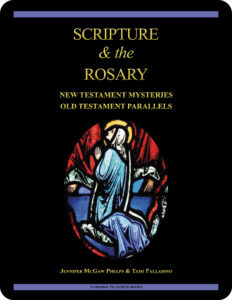 Scripture & the Rosary: New Testament Mysteries, Old Testament Parallels, a 26-lesson Catholic Bible study with an imprimatur, looks at the biblical foundations of the Rosary. The study includes lessons on Pope St. John Paul II’s Rosarium Virginis Mariae (Rosary of the Virgin Mary), the Apostles’ Creed, and the Luminous Mysteries as well as the original 15 Mysteries of the Rosary. Color photographs of stained glass windows depict key scenes in the lives of Jesus and Mary. In lieu of a sample, check out our free digital lessons.
start a Turning to God’s Word Bible study
Thank you for your interest in Sing a New Psalm: Communicating with God Through the Prayers of the Church—Volume I: Lauds & Vespers. 
 More information about beginning a Turning to God’s Word Bible study can be found on this website at start a Bible study, and Tami, Matthew, and I are available to answer questions or discuss concerns. Contact us to start this or one of our other studies or to have your schedule listed with other TtGW study groups on our website. —Jennifer
*There are seven deuterocanonical books in the Old Testament—Baruch, Judith, Sirach, Tobit, Wisdom, and First and Second Maccabees—and there are some deuterocanonical passages in the Books of Daniel and Esther. Protestants usually refer to these works as “apocryphal,” a word that means “outside the (Protestant) canon” because they’re excluded from most Protestant Bibles. Deuterocanonical means “second canon”; Catholics use that word to refer to any section of the Catholic Old Testament for which there are no extant, or existing, Hebrew manuscripts. All of the deuterocanonical books appear in the Septuagint, the earliest remaining versions of which date to the 1st century B.C. This Greek translation of the Old Testament was in common use by Jews at the time of Jesus. Learn more by reading How Do Catholic & Protestant Bibles Differ?
**You can learn more about the psalms by viewing a sample lesson from the Turning to God’s Word Catholic Bible study Sing a New Psalm: Communicating with God Through the Prayers of the Church. The first volume covers psalms prayed at Lauds and Vespers; the second covers psalms prayed at Vigils, Day Prayer, and Compline. Numbering of psalms and verses may vary in different translations.
Turning to God’s Word printed Bible studies use the 2006 Revised Standard Version Second Catholic Edition (RSV2CE) translation for all Scripture references except those to the psalms, which are taken from The Abbey Psalms and Canticles, prepared by the Benedictine monks of Conception Abbey and published in 2020 by the United States Conference of Catholic Bishops (USCCB). All Scripture links for the online study pages for Sing a New Psalm: Communicating with God Through the Prayers of the Church—Volume I: Lauds & Vespers are to the 1966 Revised Standard Version Catholic Edition (RSVCE) translation. The New International Version (NIV) audio recordings follow the same chapter and verse numbering as the RSV Catholic translations, but the NIV translation doesn’t include the deuterocanonical books and passages.
The 1966 RSVCE uses archaic pronouns and verb forms such as “thee,” “thou,” and “didst” in the psalms and in direct quotations attributed to God. The 2006 RSV2CE replaces these with more accessible English. The few significant translation changes in the RSV2CE include rendering almah as “virgin” in the Book of Isaiah 7:14 and restoring the term “begotten” in the Gospel According to John 3:16.
Numbering varies for some passages in this Bible study. Turning to God’s Word studies (print and digital) follow the numbering in the Revised Standard Version Catholic translations (RSV2CE and RSVCE). Discrepancies in the New American Bible Revised Edition (NABRE) are noted in the Index of Scripture Citations in the study book.