
 The Gospel According to Mark:
A Look at the Son of God
Lesson 15 Jesus Is Betrayed & Condemned
the Gospel According to Mark 14:32–72
Revised Standard Version Catholic Edition (RSVCE)*
New American Bible Revised Edition (NABRE)*
Catechism of the Catholic Church
ex libris (in our library)
glossary for the Gospel According to Mark
cross references in the Gospel According to Mark
next lesson: The Crucifixion
This material coordinates with Lesson 15, “Jesus Is Betrayed & Condemned,” on pages 69–72 in The Gospel According to Mark: A Look at the Son of God.
Now after John was arrested, Jesus came into Galilee, preaching the gospel of God, and saying,
“The time is fulfilled, and the kingdom of God is at hand; repent, and believe in the gospel.”
—the Gospel According to Mark 1:14–15
welcome to our in-depth study of the Gospel According to Mark
We invite interested groups and individuals to check out the sample introduction and first lesson from this 17- lesson Turning to
  God’s Word Catholic Bible study based on Scripture that is the source of most of the Sunday Gospel readings for Liturgical Year B. These online study pages link to an online glossary and cross references in the biblical text. Other study aids include maps, additional commentary, and prayers based on the primary Scripture in each lesson. The Gospel According to Mark: A Look at the Son of God and the other two synoptic studies are being submitted for imprimaturs. This study will be available from our website shop about three months before the start of liturgical Year B in 2026. If you have a Bible-related question or comment, click on one of the “ask us your question” or “what do you think” buttons on any online study page.
open with prayer
It’s always wise to begin any Bible study with prayer, whether reading the Scriptures alone or meeting with others in a discussion study group. You can pray using your own words or use one of the opening prayers on our website. We especially like the following:
Lord Jesus, you promised to send your Holy Spirit to teach us all things.
As we read and study your word today,
allow it to touch our hearts and change our lives. Amen.
let’s review—the Gospel According to Mark 14:1–31
Lesson 14 The Institution of the Eucharist describes Jesus introducing the sacrament of his Body and Blood at a meal that all of the synoptic writers consider a Passover feast, but the Gospel According to John, which contains an account of Jesus and his disciples celebrating a meal together just prior to Jesus’ Passion, doesn’t include Jesus’ institution of the Eucharist or call that meal a Passover. The fourteenth chapter in the Gospel According to Mark also includes a description of an unnamed woman anointing Jesus with costly nard, and the Gospel According to Mark also recounts Judas Iscariot betraying Jesus to the Jewish religious authorities in Jerusalem. Jesus reinforces that idea when he announces at supper that one of those eating with him is going to betray him. In the Gospel According to Mark, Jesus also announces that he will not drink wine with his disciples again until he drinks it “new in the kingdom of God.” The group moves to the Mount of Olives, and Peter vows that he’s willing to die with Jesus rather than deny him. The other disciples agree that they feel the same way. Jesus predicts that Peter is going to deny him three times before the cock crows twice.
 from Matthew—about Jesus’ prayer in Gethsemane
Turning to God’s Word author Matthew Phelps points out that the Gospel According to Mark 14:33 doesn’t provide a lot of information about Jesus’ motives when he goes to pray in the Garden of Gethsemane.
“It’s interesting that Jesus goes off to pray separately instead of with all of his disciples and that he chooses to take a couple of them along with him. He’s not treating all of his followers equally, and different people in relationship with Jesus are called to different things. That doesn’t mean Jesus doesn’t love all of them equally. Maybe some of them wouldn’t have totally blown it either. Did Jesus pick these three guys specifically because they wouldn’t respond well because he wanted to prove a point or did he want his closer friends around? His motives are not clear, but it’s a fascinating thing to think about.
“It’s also possible that Jesus didn’t want people to see him in this state. This version of Jesus conflicts with how we tend to think about him. He’s not just calmly accepting what he’s been deliberately marching toward. This still is hard for him.”
 more from Matthew—Jesus’ two wills
Matthew discusses the difference between what Jesus wills and what he wants in the Gospel According to Mark 14:36.
“As noted in the study book, Jesus has two wills. He wants what God wants—and he wants to not have to do what he’s about to do. He also defers to God over himself. Will is an interesting thing, however; it’s not what we want, but what we choose. Jesus only ever acts with one will—he chooses what God wants. His conflict is more of mismatched desires. He wants different things; he wills one thing.
“We can do the same thing as Jesus. It’s fine to acknowledge that we don’t always want to do what is good, and that’s not sinful. What matters is what we then do about it. When trying to go against our own desires, it’s important to stay rooted in prayer and conversation with God, which Jesus demonstrates here.
“Meanwhile, the disciples are happy to do what they want rather than what Jesus wants. They don’t even seem interested in being there for their friend in a time of his need. This is their last relational interaction with Jesus—at least in this life—and they blow him off.”
more from Matthew—Jesus is aware of what’s going to happen
Matthew also points out that the Gospel According to Mark 14:42 indicates that Jesus is instrumental in setting up the events that lead to his Crucifixion.
“This is obvious, but Jesus wasn’t taken by surprise in the Garden of Gethsemane. He easily could have avoided being caught, which makes his suffering and death more complex. Jesus didn’t cause it, but he could have avoided it.”
 witness & testimony—you could look it up in our archives
The Gospel According to Mark 14:56 records that there were many false witnesses testifying against Jesus, and their witness didn’t agree. To learn how the witness of Christ forms the foundation of Christianity, read Lost in Translation, a weekly online column in which Turning to God’s Word author Matthew Phelps helps readers connect with ideas expressed in the original languages of the Scriptures. New Lost in Translation entries are posted on Mondays, and past entries are archived on our website. Contact us if you’d like to receive Lost in Translation by email every week.
more from Matthew—let’s see what’s going on with Peter
Matthew observes that the Evangelist Mark presents a somewhat different view of Peter than is commonly considered.
“When Jesus is arrested in the Garden of Gethsemane, Peter fled with everyone else—but he still followed to see where Jesus was being taken. Peter gets some points for being brave. One has to wonder how much Peter is motivated by sleeping in the garden. How much are Jesus’s words about Peter’s denial motivating Peter’s behavior now? Peter gets flack for denying Jesus, but where was everyone else? No one else had the opportunity to deny Jesus because they were too busy running away and hiding.” [The Gospel According to John 18:15 states that “another disciple,” whom scholars believe to have been John, also was present when Jesus was taken before the Jewish religious leaders. The Fourth Gospel also records that Jesus was taken to Annas and Caiaphas, while only the synoptic Gospel According to Luke mentions that Annas, the father-in-law of Caiaphas, had any role in Jesus’ trial.]
ex libris—pesky discrepancies about the Passion
The Gospel According to Mark and the other two synoptic Gospels—the Gospel According to Matthew and the 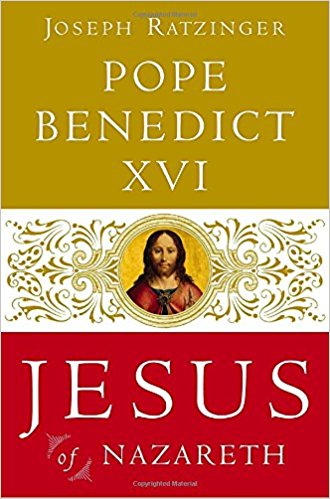
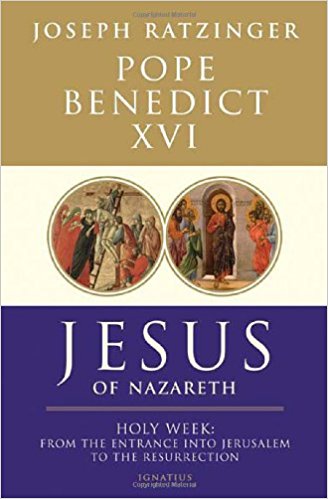 Gospel According to Luke—mostly agree about the basic events that took place in connection with Jesus’ Crucifixion. The Gospel According to John, however, differs in regard to several important details. The late Pope Benedict XVI examines these differences in the Holy Week volume of his three part series Jesus of Nazareth. The late Pope offers an explanation for the timing discrepancies, and he avoids the issue concerning Annas by referring to Jesus’ Passion and death taking place during “the high priesthood of Annas and Caiaphas.” You can read excerpts and learn more about the Jesus of Nazareth trilogy as well as about other works related to Bible study at ex libris—main bookshelf.
more from Matthew—about that trial
Matthew observes that Jesus was doomed before his trial by the Jewish religious leaders even started.
“The Gospel According to Mark 14:55 indicates as much. This isn’t how a trial should work. What about innocent until proven guilty? The religious leaders are trying to work backwards from a foregone conclusion for reasons not justified by the evidence.
“The Gospel According to Mark 14:61–64 suggests that once again, Jesus had an out and refuses to take it. The members of the religious council weren’t managing to find anything persuasive enough to kill Jesus, so Jesus intentionally helps them. He could have again avoided being killed if he’d continued to keep his mouth shut.
more from Matthew—the key word is blasphemy
Matthew notes that the chief priest [whom the Evangelist Mark never names] uses Jesus’ confession that he’s indeed the Christ, the long-awaited Messiah, as evidence of blasphemy. Blasphemy was considered such a strong offense against God that it was punishable by death.
“It’s not blasphemy, however, if it’s true. Considering the things that Jesus has done, this is a bold and dangerous thing to put forward. The Jewish religious leaders aren’t even entertaining the idea that Jesus might be telling the truth. Such a position would be at odds with their view of what or who the Messiah should be.
“This isn’t real religious outrage; it’s theater in service of the conclusion the chief priests were working toward. It’s deeply ironic, because that itself is a blasphemous act. The high priest is denying the divinity or divine authority of God while saying that blasphemy is a capital offense. He condemns himself in trying to condemn Jesus. It seems like this is why Jesus waited for this opening—specifically for this irony.”
Christian Connection—would you have wanted to be there?
Although many people are sure that they would have been supportive of Jesus had they been in Jerusalem at the time of his Passion and death, the evidence in Scripture suggests this might not have been true in all cases.
 ? If you were writing one of the Gospel accounts of Jesus’ life, think about whether you’d want to include negative information about Jesus’ disciples betraying and denying him.
? Consider what effect such information might have on how people unfamiliar with Jesus eventually would come to view him.
? How many of Jesus’ disciples stood by him during the final events leading to his death?
? Why do you think that all four Gospel writers include negative information about Jesus’ disciples betraying and denying him?
? What do you think is the most important fact about Jesus that should be included in all of Gospel accounts of his life?
the best Catholic commentary about Scripture
To find out more about how Church teaching is supported by passages in the Gospel According to Mark, check out the Index of Citations in the Catechism of the Catholic Church. Links to each lesson’s primary Scripture passages (from the Revised Standard Version Catholic Edition [RSVCE*]) that are cited in relevant paragraphs in the Catechism are provided here. Not every passage in the Gospel According to Mark is referenced in a Catechism paragraph.
the Gospel According to Mark 14:33–34—paragraph 1009
the Gospel According to Mark 14:36—paragraphs 473, 2701
the Gospel According to Mark 14:39—paragraph 2849
the Gospel According to Mark 14:57–58—paragraph 585
the Gospel According to Mark 14:61—paragraph 443
ways our glossary might prove helpful
In addition to providing extra information about geographical locations, our glossary also points out  persons or places mentioned in the biblical text under more than one name or more than one spelling. If you can remember a name but aren’t sure in which lesson it shows up, you can find it in the glossary, which lists every proper noun that appears in the biblical text for every lesson in The Gospel According to Mark: A Look at the Son of God. A few general terms also are included that may be unfamiliar or whose meaning may be unclear to readers.
to learn more, read more Scripture
If you’re having difficulty with a passage of Scripture, it can be helpful to read the relevant  cross references—but looking these up can take time. To make that easier, we’ve compiled the cross references from the Revised Standard Version Second Catholic Edition (RSV2CE)—the translation that we reprint in our study books. A link to these cross references can be found at the top of every online study page; the list includes each of the cross references in the primary biblical text for The Gospel According to Mark: A Look at the Son of God.
don’t forget about our indexes & extra online material
If you’re trying to locate information about a specific Scripture passage, you can look it up in the index at the back of the study book. If you want to find a particular commentary, you can look up its title in the topics index. (If you don’t have access to the study book, both indexes are in the sample.) To learn more about another book of the Bible for which there’s a Turning to God’s Word study, visit the online study directories to read the commentaries and watch any accompanying videos. Finally, if you have a question or would like to make a comment about any of our studies, you can use one of the “ask us your question” or “what do you think” buttons to email our authors.
ex libris—Church documents & books about religious topics
Link to magisterial documents referred to in our Bible studies at ex libris—magisterial documents.  This listing includes significant recent encyclicals as well as a number of historical Church documents. Recommended books related to Scripture study can be found at ex libris—main bookshelf.
wondering how to pronounce some of these words?
The following link is to a reading from the New International Version (NIV) Bible. To listen, open the link and click on the loudspeaker icon above the printed text. Although not taken from translations used in our study materials, the NIV reading provides an audio guide to pronunciation of many words in this lesson’s primary biblical text. A close online version of the translation of the Bible used in Catholic liturgy in the United States and an audio guide for daily Mass readings for the current month can be found on the website of the United States Conference of Catholic Bishops (USCCB).
the Gospel According to Mark 14:32–72 (NIV)
close with Bible-based prayer related to this lesson
Many of our Catholic study groups like to conclude their discussions with a prayer based on the scriptural focus of their lesson, and some participants include Scripture-specific prayer in their individual study. If you’re uncomfortable composing your own Bible-based prayers, you can follow our four easy steps. If you prefer, you can use the following prayer based on this lesson’s text from the Gospel According to Mark.
O God, Peter vowed that he would rather die with Jesus than deny him,
yet he did deny Jesus three times.
And the Evangelist Mark describes how the disciple Judas Iscariot betrayed Jesus.
Grant that we may recognize our all-too-human failings
and take care to neither deny or betray Jesus—
and give us the grace to repent and not lose hope
if we ever fail in our resolve
and give in to our flawed human nature. Amen.
Lesson 16 The Crucifixion—the Gospel According to Mark 15:1–47
Lesson 14 The Institution of the Eucharist—the Gospel According to Mark 14:1–31
you also may like our study of the Letter to the Hebrews (digital only)
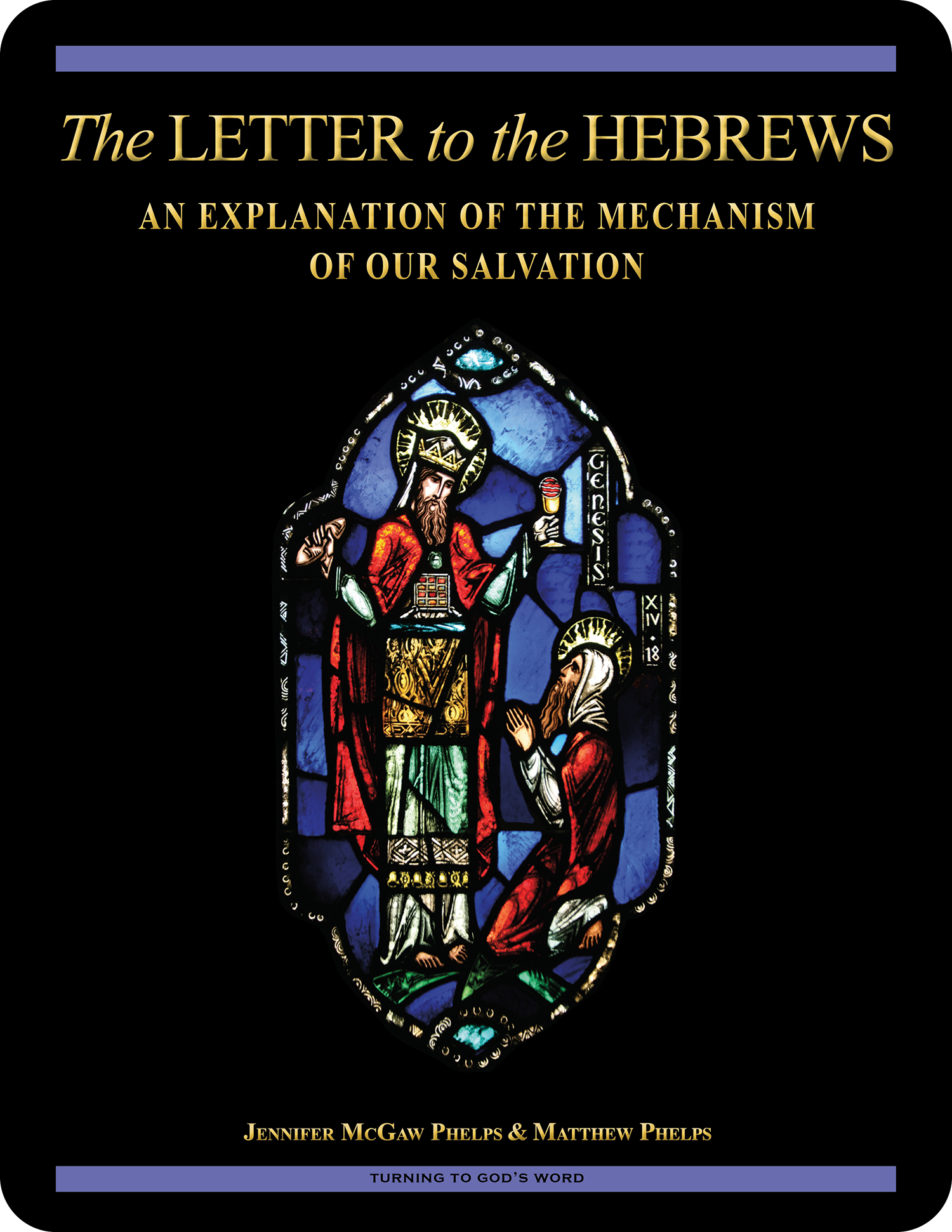 Many Christians struggle to understand one of the central mysteries of our faith: how Jesus can be both human and divine at the same time. The Letter to the Hebrews: An Explanation of the Mechanism of Our Salvation, an 18-lesson Catholic Bible study with an imprimatur, offers an in-depth look at the way in which Jesus’ dual nature allows for the salvation of humanity. The Letter to the Hebrews is designed to provide information that will encourage Christians to remain faithful. Click here to view a sample of the first lesson.
start a Turning to God’s Word Bible study
 Thank you for your interest in our three-part study of the synoptic Gospels.
  More information about beginning a Turning to God’s Word Bible study can be found at start a Bible study, and Tami, Matthew, and I are available to answer questions or discuss concerns. Contact us to start this or one of our other studies or to have your schedule listed with other TtGW study groups on our website. —Jennifer
*There are seven deuterocanonical books in the Old Testament—Baruch, Judith, Sirach, Tobit, Wisdom, and First and Second Maccabees—and there are some deuterocanonical passages in the Books of Daniel and Esther. Protestants usually refer to these works as “apocryphal,” a word that means “outside the (Protestant) canon” because they’re excluded from most Protestant Bibles. Deuterocanonical means “second canon”; Catholics use that word to refer to any section of the Catholic Old Testament for which there are no extant, or existing, Hebrew manuscripts. All of the deuterocanonical books appear in the Septuagint, the earliest remaining versions of which date to the 1st century B.C. This Greek translation of the Old Testament was in common use by Jews at the time of Jesus. Learn more by reading How Do Catholic & Protestant Bibles Differ?
Turning to God’s Word printed Bible studies use the 2006 Revised Standard Version Second Catholic Edition (RSV2CE) translation for all Scripture references except those to the Psalms, which are taken from The Abbey Psalms and Canticles, prepared by the Benedictine monks of Conception Abbey and published in 2020 by the United States Conference of Catholic Bishops (USCCB). All Scripture links for the online study pages for The Gospel According to Mark: A Look at the Son of God are to the 1966 Revised Standard Version Catholic Edition (RSVCE) translation. The New International Version (NIV) audio recordings follow the same chapter and verse numbering as the RSV Catholic translations.
The 1966 RSVCE uses archaic pronouns and verb forms such as “thee,” “thou,” and “didst” in the Psalms and in direct quotations attributed to God. The 2006 RSV2CE replaces these with more accessible English. The few significant translation changes in the RSV2CE include rendering almah as “virgin” in the Book of Isaiah 7:14 and restoring the term “begotten” in the Gospel According to John 3:16.
Numbering varies for some passages in this Bible study. Turning to God’s Word studies (print and digital) follow the numbering in the Revised Standard Version Catholic translations (RSV2CE and RSVCE). Discrepancies in the New American Bible Revised Edition (NABRE) are noted in the Index of Scripture Citations in the study book or toward the end of the sample.
 You can learn more about the biblical Psalms by viewing a sample lesson from the Turning to God’s Word Catholic Bible study Sing a New Psalm: Communicating with God Through the Prayers of the Church. The first volume covers Psalms prayed at Lauds and Vespers; the second volume covers Psalms prayed at Vigils, Day Prayer, and Compline. Numbering of Psalms and verses may vary in different translations.