
Glossary
the Gospel According to Mark
The following proper nouns name people and places mentioned in the biblical text for the Turning to God’s Word Catholic Bible study The Gospel According to Mark: A Look at the Son of God. A few potentially uncler words and phrases also are included. The Gospel According to Mark is the primary source of the Sunday readings for liturgical Year B.
—A—
 Abiathar—A high priest in David’s time is named Abiathar, but there is confusion about the Abiathar mentioned in the second chapter of the Gospel According to Mark. Some scholars suggest that citation refers to a son of Ahimelech with the name Abiathar. It is Ahimelech who is credited in the First Book of Samuel 21:1–6 with permitting David and his men to eat the showbread in the house of the Lord at Nob. The name “Abiathar” means “father of abundance”; the name “Ahimelech” means “brother of the king.” See showbread. The Gospel According to Mark 2:26 in Lesson 2.
Abraham—Abraham was the Old Testament patriarch whom Jews and Christians both consider to be the father of faith, and it is with Abraham that God enters into covenant. Abraham’s birth name was “Abram,” which means “exalted father.” Abram was renamed Abraham by God; the name “Abraham” means “father of a multitude.” All descendants of Jacob also are descendants of Abraham. The Gospel According to Mark 12:26 in Lesson 12.
Alexander—Alexander was one of two sons of Simon of Cyrene; the other was named Rufus. Simon of Cyrene was conscripted by the Romans to carry Jesus’ cross. The name “Alexander” means “defender of men.” The Gospel According to Mark 15:21 in Lesson 16.
Alphaeus—Alphaeus was the name of the father of Jesus’ follower named Levi; Levi also is thought to be the disciple Matthew. Scripture records a man named Alphaeus as the father of Jesus’ follower James (the Lesser), but scholars are uncertain whether the Alphaeus in the second chapter of the Gospel According to Mark is the same person mentioned in the third chapter. The name “Alphaeus” means “changing.” The Gospel According to Mark 2:14 in Lesson 2; the Gospel According to Mark 3:18 in Lesson 3.
Andrew—Andrew was the name of one of Jesus’ disciples; he was a brother of Simon. (It was this Simon who was renamed Peter by Jesus). The name “Andrew” derives from the Greek name “Andreas” and means “manly” or “courageous.” The Gospel According to Mark 1:16 and 1:29 in Lesson 1; the Gospel According to Mark 3:18 in Lesson 3; the Gospel According to Mark 13:3 in Lesson 13.
angel—Angels are supernatural beings, usually sent to earth to deliver a message from God. The Gospel According to Mark 1:13 in Lesson 1; the Gospel According to Mark 8:38 in Lesson 8; the Gospel According to Mark 12:25 in Lesson 12; the Gospel According to Mark 13:27 and 13:32 in Lesson 13.
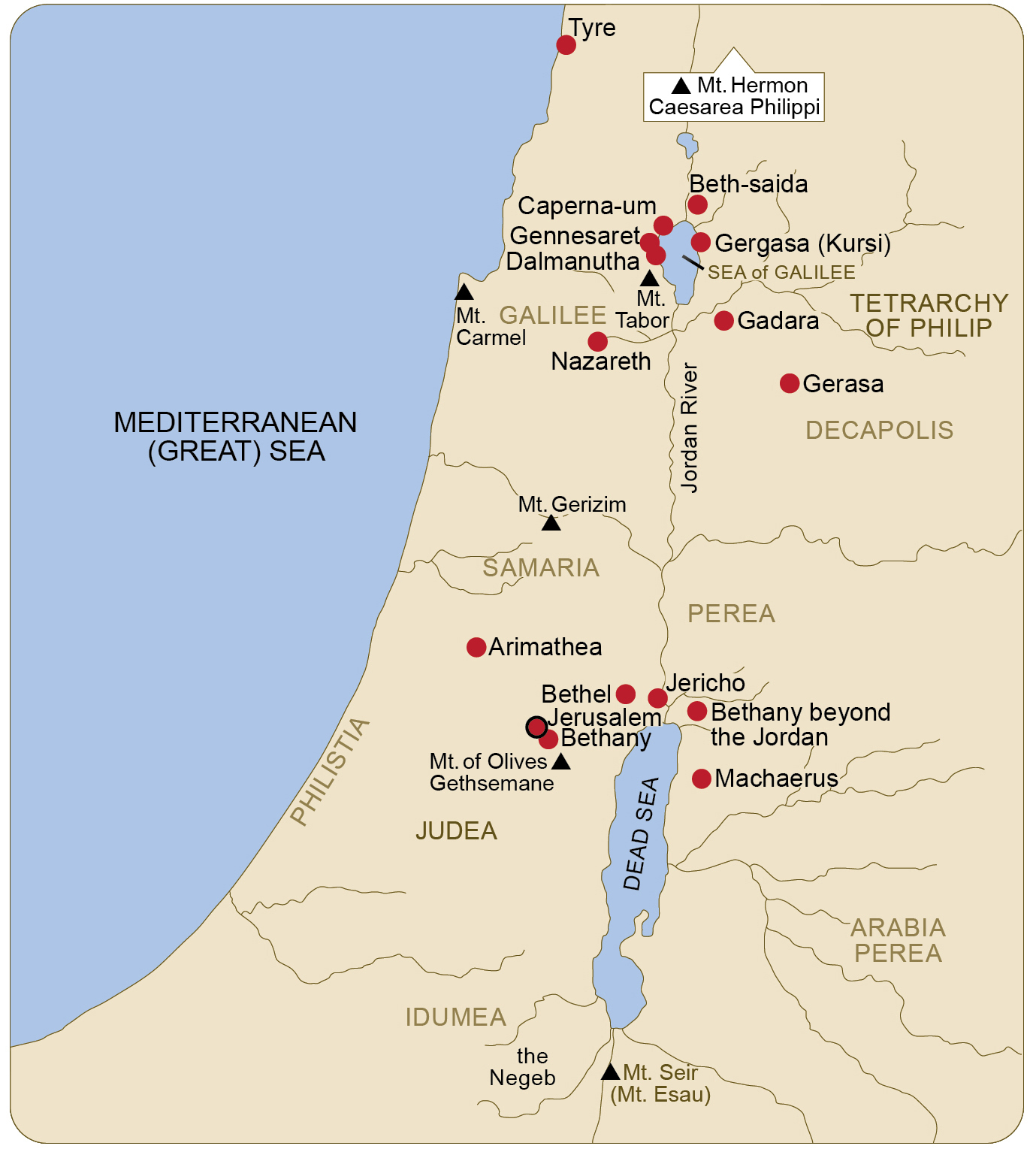
Arimathea—Scholars are uncertain about the exact location of the town of Arimathea; most agree that it was located in northern Judea. The word “Arimathea” is thought to mean “heights” or “a high place.” The town was the home of Joseph of Arimathea, who asked Pontius Pilate for permission to bury Jesus’ body. See Joseph of Arimathea. The Gospel According to Mark 15:43 in Lesson 16.
apostle—The word “apostle” means “one who is sent”; it is used in the synoptic Gospels to indicate a follower of Jesus who has been given authority to be sent out to preach and heal. Although the words “disciple” and “apostle: are used somewhat interchangeably, a disciple generally is restricted to those followers of Jesus who are classified as “students” and “learners” and have not be tasked with being sent out to preach and heal. See disciple. The Gospel According to Mark 6:30 in Lesson 6.
—B—
Baptist—The word “baptize” means “to be submerged in water.” It was essential that the water used in any baptism be “living” water, that is, water that was flowing. (Some translations—including the Revised Standard Version Catholic Edition [RSVCE] that preceded the Revised Standard Version Second Catholic Edition [RSV2CE]—generally refer to John as the Baptizer instead of as the Baptist. The Turning to God’s Word website links to the RSVCE, while Turning to God’s Word study books reprint the newer RSV2CE translation, which is not available free online.) See John the Baptist. The Gospel According to Mark 1:4 in Lesson 1; the Gospel According to Mark 6:14 and 6:24–25 in Lesson 6; the Gospel According to Mark 8:28 in Lesson 8.
Barabbas—Barabbas was a notorious murderer and rebel released by Pontius Pilate instead of Jesus during the eight-day religious celebration called Passover. The name “Barabbas” means “son of the father.” The Gospel According to Mark 15:7, 15:11, and 15:15 in Lesson 16.
Bartholomew—Bartholomew was one of Jesus’ disciples. He also is called Nathanael (often spelled Nathaniel). The name “Bartholomew” means “rich in land”; the name “Nathanael” means “God has given.” The Gospel According to Mark 3:18 in Lesson 3.
Bartimaeus—Bartimaeus was a blind beggar whom Jesus encountered on the road outside of Jericho. Scripture records that Bartimaeus was the son of a man named Timaeus. Jesus restored the man’s sight. The name “Bartimaeus” means “son of honor” or “son of the unclean.” The Gospel According to Mark 10:46 in Lesson 10.
Be-elzebul—”Be-elzebul” is a word that means “lord of the high place” or “lord of the sky”; over time, it came to refer to Satan. The word “Be-elzebub” often is substituted for the word “Be-elzebul” and means “lord of the flies.” Many high places in the ancient world were the sites of altars constructed to false gods, a practice that God denounces throughout the Old Testament. See Satan. The Gospel According to Mark 3:22 in Lesson 3.
Bethany—There are several towns named Bethany referred to in Scripture. The one most often mentioned in the synoptic Gospels is near Jerusalem on the eastern slope of the Mount of Olives. The word “Bethany” means “house of affliction.” The Gospel According to Mark 11:1 and 11:11–12 in Lesson 11; the Gospel According to Mark 14:3 in Lesson 14.
Bethphage—Bethphage is a village located at the foot of the Mount of Olives on the road connecting Jerusalem and Jericho. The word “Bethphage” means “house of unripe figs.” The Gospel According to Mark 11:1 in Lesson 11.
Beth-saida—Beth-saida is a small fishing village in the district of Galilee on the northern shore of the Sea of Galilee. The word “Beth-saida: means “house of fish.” The Gospel According to Mark 6:45 in Lesson 6; the Gospel According to Mark 8:22 in Lesson 8.
beyond the Jordan—The territory to the east of the Jordan River often is referred to in Scripture as “beyond the Jordan.” See Jordan (River). The Gospel According to Mark 3:8 in Lesson 3; the Gospel According to Mark 10:1 in Lesson 10.
Boanerges—Boanerges is name that was given by Jesus to his disciples James and John, the sons of Zebedee. The word “Boanerges” means “sons of thunder.” The Gospel According to Mark 3:17 in Lesson 3.
—C—
Caesar—Caesar is a title given to ancient rulers of Rome; a caesar’s power and duties are roughly equivalent to those of kings and emperors. The word “caesar” means “hair.” The Gospel According to Mark 12:14 and 12:16–17 in Lesson 12.
Caesarea Philippi—Caesaea Philippi is a region north of the Sea of Galilee near the source of the Jordan River. The area was founded by Philip the Tetrarch, a son of Herod the Great. Its name honors both Caesar and Philip. The Gospel According to Mark 8:27 in Lesson 8.
Caperna-um—Caperna-um is a town located on the northern shore of the Sea of Galilee; Jesus made his home in Caperna-um after he moved from Nazareth. The word “Caperna-um” means “village of comfort” or “village of nahum.” The Gospel According to Mark 1:21 in Lesson 1; the Gospel According to Mark 2:1 in Lesson 2; the Gospel According to Mark 9:33 in Lesson 9.
centurion—A centurion is an officer in the ancient Roman army. The word “centurion” is derived from the word “century,” which means “100”; a centurion was responsible for about 80 soldiers. The Gospel According to Mark 15:39 and 15:44–45 in Lesson 16.
Christ—Christ is a title derived from the Greek word Christos and corresponds to the Hebrew word for Messiah. “Christ” means “Anointed One.” Saying that Jesus is the Christ (or calling him Jesus Christ) is the same as identifying Jesus as God’s Anointed. Because the former kings of Israel and Judah traditionally were anointed, people awaiting the promised Messiah at the time of Jesus were expecting a king. In the history of the ancestors of the Jews, however, priests and prophets also were anointed. In the present day, Christians are anointed priests, prophets, and kings as part of the sacrament of Baptism. See Jesus/Jesus Christ.
Corban—The Jewish practice of dedicating resources to God is known as Corban. Jesus condemns Corban because it provides a loophole allowing people to avoid God-given responsibilities to care for their parents. The Gospel According to Mark 7:11 in Lesson 7.
Cyrene—Cyrene is a Greek city in northern Africa where one-hundred thousand Judean Jews were forced to settle in 323–285 B.C. during the reign of the Ptolemies—a dynasty founded by the Macedonian kings of Egypt after the death of Alexander the Great. In the Gospels, a man named Simon who carried Jesus’ cross to Golgatha is from Cyrene. See Simon of Cyrene. The Gospel According to Mark 15:21 in Lesson 16.
—D—
Dalmanutha—This village on the western shore of the Sea of Galilee often is associated with Magdala (sometimes called Magadan), the home of Mary Magdalene. The word “dalmanutha” means “harbor.” The Gospel According to Mark 8:10 in Lesson 8.
David—David is a member of the tribe of Judah; his father is Jesse. David in turn is the father of Solomon, whose mother is Bathsheba, the wife of Uriah the Hittite. David is known for having been chosen by God to replace Saul as king over all of the descendants of Jacob. God’s promise of a Messiah (Anointed One) is made to David. David also is listed as an ancestor of Joseph, Jesus’ earthly father. The name David means “beloved” or “friend.” The Gospel According to Mark 2:25 in Lesson 2; the Gospel According to Mark 11:10 in Lesson 11; the Gospel According to Mark 12:36–37 in Lesson 12.
day of Preparation—The day of Preparation is the day when unblemished lambs are slaughtered in preparation for the Passover meal, which is eaten after sundown on the first day of the eight-day religious celebration. The term “day of Preparation” also can refer to the time before sundown that marks the beginning of any regular sabbath. The eight-day religious observance that begins on the Passover does not always fall on a sabbath. That means that a regular sabbath always will fall sometime within the eight days as well. This explains what appears to be a timing difference between the synoptic Gospels and the Gospel According to John. See feast of Unleavened Bread and Passover. The Gospel According to Mark 15:42 in Lesson 16.
Decapolis—Territory located east of the Sea of Galilee and the Jordan River at the time of Jesus is called the Decapolis. Although the name Decapolis refers to 10 cities, in reality the number varied. The Gospel According to Mark 5:20 in Lesson 5; the Gospel According to Mark 7:31 in Lesson 7.
demon/demoniac—A demon is a fallen angel that often manifests as an unclean spirit causing physical and mental anguish; the word “demoniac” describes a person who has been possessed by a demon. The word “demon” developed from the Greek “daimon,” which referred to a benevolent spirit.The association between the word “demon” and evil spirits came later. The Gospel According to Mark 1:32, 1:34, and 1:39 in Lesson 1; the Gospel According to Mark 3:15 and 3:22 in Lesson 3; the Gospel According to Mark 5:15–16 and 5:18 in Lesson 5; the Gospel According to Mark 6:13 in Lesson 6; the Gospel According to Mark 7:26 and 7:29–30 in Lesson 7; the Gospel According to Mark 9:38 in Lesson 9; the Gospel According to Mark 16:9 and 16:17 in Lesson 18.
disciple—The word “disciple” means “student” or “learner”; it implies becoming like a particular teacher. Although the words “disciple” and “apostle” are used somewhat interchangeably, an apostle describes a disciple who also is sent out with the authority to preach and heal. See apostle. The Gospel According to Mark 2:15–16, 2:18, and 2:23 in Lesson 2; the Gospel According to Mark 3:7 and 3:9 in Lesson 3; the Gospel According to Mark 5:31 in Lesson 5; the Gospel According to Mark 6:1; 6:29, 6:35, 6:41, and 6:45 in Lesson 6; the Gospel According to Mark 7:2 and 7:5 in Lesson 7; the Gospel According to Mark 8:1, 8:4, 8:6, 8:10, 8:27, and 8:33-34 in Lesson 8; the Gospel According to Mark 9:14, 9:18, 9:28, and 9:31 in Lesson 9; the Gospel According to Mark 10:13, 10:23–24, and 10:46 in Lesson 10; the Gospel According to Mark 11:1 and 11:14 in Lesson 11; the Gospel According to Mark 12:43 in Lesson 12; the Gospel According to Mark 13:1 in Lesson 13; the Gospel According to Mark 14:12–14 and 14:16 in Lesson 14; the Gospel According to Mark 14:32 in Lesson 15; the Gospel According to Mark 16:7 in Lesson 18.
dumb—Some translations of the synoptic Gospels—including the Revised Standard Version Catholic Edition (RSVCE) that preceded the Revised Standard Version Second Catholic Edition (RSV2CE)—use the word “dumb” to mean “unable to speak.” The RSV2CE and other recent translations substitute the politically correct “mute” or “silent.” (Turning to God’s Word study books reprint the RSV2CE translation while the Turning to God’s Word website links to the RSVCE.)
—E—
Eleven—Eleven is the number of the original 12 disciples remaining after the death of Judas Iscariot. See Twelve. The Gospel According to Mark 16:14 in Lesson 18.
Elijah—Elijah is a prophet who was sent by God to the northern kingdom of Israel. He had repeated encounters with the northern rulers Ahab and Jezebel, whom he chastised for flaunting religious law. Elijah frequently appears in Scripture as an iconic representation of all the prophets—often with Moses, who symbolizes the Law. Jewish tradition held that before the coming of the Messiah, both Elijah and Moses would reappear. The name “Elijah” means “my God is the LORD.” The Gospel According to Mark 6:15 in Lesson 6; the Gospel According to Mark 8:28 in Lesson 8; the Gospel According to Mark 9:4–5 and 9:11–13 in Lesson 9; the Gospel According to Mark 15:35–36 in Lesson 16.
Eloi, Eloi, lama sabach-thani?—This question is among the last recorded words that Jesus utters from the cross. Scripture translates the phrase as: “My God, my God, why have you forsaken me?” Bystanders at the time interpreted this to mean Jesus calling for Elijah. The Gospel According to Mark 15:34 in Lesson 16.
Ephphatha—Jesus speaks this word when he cures a deaf man with a speech impediment. Scripture explains that the meaning of the word “ephphatha” is “be opened.” The Gospel According to Mark 7:34 in Lesson 7.
—F—
Father—When Jesus uses the term “Father” in the Gospels, it always is capitalized and always refers to God, his heavenly father. The Gospel According to Mark 8:38 in Lesson 8; the Gospel According to Mark 11:25 in Lesson 11; the Gospel According to Mark 13:32 in Lesson 13; the Gospel According to Mark 14:36 in Lesson 15.
feast of Unleavened Bread—The feast of Unleavened Bread occurs after sundown at the end of the first day of an eight-day religious celebration; the feast itself is called the Passover, but the entire eight-day celebration also may be referred to as the Passover. It is at the end of the first day that the Passover lambs are eaten. That day commemorates the angel of death sparing the Israelites in Egypt; the remaining seven days commemorate God’s care for his people during the 40 years they spent in the wilderness. The eight-day religious observance begins with the Passover, which does not always fall on a sabbath each year and means that a regular sabbath will fall within the eight days as well. This helps to explain what appears to be a timing difference between the synoptic Gospels and the Gospel According to John. See Unleavened Bread, Passover, and day of Preparation. The Gospel According to Mark 14:1 in Lesson 14.
—G—
Galilee/Galilean—Galilee is the region located north of Judea and Samaria and including the Sea of Galilee (sometimes called the Sea of Tiberias). It was part of the northern kingdom of Israel prior to that kingdom’s fall to Assyria in 722–721 B.C., which led to the relocation of what later came to be referred to as the “lost tribes of Israel.” That relocation sometimes is called the Dispersion. Inhabitants of the region are known as Galileans. Gentiles lived in the region after the Dispersion, many in territory originally allotted to descendants of the tribes of Zebulun and Naphtali. The area sometimes is called “Galilee of the Gentiles.” The Gospels indicate that Jesus spent the bulk of his ministry in the region of Galilee. The word “Galilee” means “district.” The Gospel According to Mark 1:9, 1:14, 1:28, and 1:39 in Lesson 1; the Gospel According to Mark 3:7 in Lesson 3; the Gospel According to Mark 6:21 in Lesson 6; the Gospel According to Mark 9:30 in Lesson 9; the Gospel According to Mark 14:28 in Lesson 14; the Gospel According to Mark14:70 in Lesson 15; the Gospel According to Mark 15:41 in Lesson 16; the Gospel According to Mark 16:7 in Lesson 17.
Gennesaret—Gennesaret is the name given to a crescent-shaped tract of land three to four miles long on the western shore of the Sea of Galilee. Some scholars believe that the name “Gennesaret” is a corruption of Chinnereth, an ancient city in the same region; it sometimes is referred to as Gennesaret. The word “Gennesaret” means “garden of riches.” The Gospel According to Mark 6:53 in Lesson 6.
Gentiles—People who don’t worship the Hebrew monotheistic God of Abraham, Isaac, and Jacob are referred to as Gentiles. The Gospel According to Mark 10:33 and 10:42 in Lesson 10.
Gerasenes—It’s difficult for scholars to determine exactly where events took place that are described in the Gospel According to Mark 5:1–20. The Gerasenes sometimes are called Gadarenes or Gergesenes. As potential sites, two locations in the region of the Decapolis—Gerasa and Gadara—plus another town known as Gergasa on the eastern shore of the Sea of Galilee, tend to be favored by scholars. The meaning of the names of each of these three potential sites is uncertain. The Gospel According to Mark 5:1 in Lesson 5.
Gethsemane—Gethsemane is the garden where Jesus was arrested; it is located near Jerusalem at the foot of the western slope of the Mount of Olives. The word “Gethsemane” means “oil press.” The Gospel According to Mark 14:32 in Lesson 15.
God—When capitalized, God is the primary title used for the divinity worshiped in the Old and New Testaments. Lowercase, the word “god” may refer to any of a number of false deities. The Hebrew word “elohim,” which means “mighty one,” usually is translated as God when it appears in ancient manuscripts. The word “God” appears many times throughout the Gospel According to Mark. See Lord/Lord.
Golgatha—The location where Jesus was crucified just outside of Jerusalem was called “Golgatha,” which the Gospel According to Mark defines as “the place of a skull.” Also known as Calvary, since the 4th century the traditional site of Golgatha is believed to be inside the boundaries of Old Jerusalem in the Church of the Holy Sepulchre, although there is scholarly support for other sites located outside of the ancient city walls. The Gospel According to Mark 15:22 in Lesson 16.
Good Teacher—When a man approached Jesus wanting to know how to inherit eternal life, he addresses Jesus as “Good Teacher”; Jesus upbraids the man for calling him “good.” See Teacher. The Gospel According to Mark 10:17 in Lesson 10.
gospel—Lowercase, the word “gospel” refers to the teaching of Jesus—or to any position claiming to be based on truth; capitalized, the word “Gospel” refers to any of the first four books in the Bible. The Gospel According to Mark, the Gospel According to Matthew, and the Gospel According to Luke are known as synoptic Gospels. These three accounts of Jesus’ life and teaching are similar, but the Gospel According to John takes a decidedly different approach. See synoptic. The Gospel According to Mark 1:1 and 1:14–15 in Lesson 1; the Gospel According to Mark 8:35 in Lesson 8; the Gospel According to Mark 10:29 in Lesson 10; the Gospel According to Mark 13:10 in Lesson 13; the Gospel According to Mark 14:9 in Lesson 14; the Gospel According to Mark 16:15 in Lesson 17.
Greek—The word “Greek” can refer to an inhabitant of Greece or it can be used to describe the culture of that region. Alexander the Great (who was from Macedonia) spread Greek language and culture throughout the known world, making it prevalent in Judea at the time of Jesus. The Gospel According to Mark 7:26 in Lesson 7.
—H—
heaven/heavens—Heaven refers to the dwelling place of God, which the ancient Hebrews believed to be in or above the sky; the word “heaven” means “the skies.” The Gospel According to Mark 6:41 in Lesson 6; the Gospel According to Mark 7:34 in Lesson 7; the Gospel According to Mark 8:11 in Lesson 8; the Gospel According to Mark 10:21 in Lesson 10; the Gospel According to Mark 11:25 and 11:30–31 in Lesson 11; the Gospel According to Mark 12:25 in Lesson 12; the Gospel According to Mark 13:25, 13:27, and 13:31–32 in Lesson 13; the Gospel According to Mark 14:62 in Lesson 15; the Gospel According to Mark 16:19 in Lesson 18.
Herod—The name “Herod” is used in the New Testament Gospels to refer either to Herod the Great or Herod Antipas. “Herod” means “heroic” or “exalted one.” See Herod Antipas, Herod the Great.
Herod Antipas—Herod Antipas was a son of Herod the Great and the Rome-appointed tetrarch over Galilee and Perea. As the ruler responsible for the beheading of John the Baptist and for ruling Galilee at the time of Jesus’ Crucifixion, he is the only Herod mentioned in the Gospel According to Mark. Both Herod Antipas and his father Herod the Great were Edomites, descendants of Jacob’s twin brother Esau (also called Edom) and not descendants of Jacob (also called Israel). The name “Herod” means “heroic” or “exalted one.” See Herod (the Great), tetrarch. The Gospel According to Mark 6:14, 6:17–18, and 6:20–22 in Lesson 6; the Gospel According to Mark 8:15 in Lesson 8.
Herod (the Great)—The king of Judea at the time of Jesus’ birth was Herod the Great. He orchestrated what is known as the “massacre of the innocents,” described in the Gospel According to Matthew 2:16–18. Herod Antipas is his son. Either sometimes is called simply “Herod,” and both figure in the Gospels. It is Herod Antipas who is referred to in the Gospel According to Mark. Herod the Great also was the father of Herod Archelaus and Philip. Most scholars don’t think this is the Philip who was the first husband of Herodi-as. Members of the family of Herod the Great were Edomites. The name “Herod” means “heroic” or “exalted one.” See Herod Antipas, tetrarch.
Herodians—Members of a sect of Hellenistic Jews combined traditional Judaism with aspects of Greek culture and identified as Herodians. They supported the Rome-backed dynasty of Herod and his family and often clashed with the Pharisees—though the Herodians aligned with the Pharisees in opposition to Jesus. The Gospel According to Mark 3:6 in Lesson 3; the Gospel According to Mark 12:13 in Lesson 12.
Herodi-as—Herodi-as is the wife of Herod Antipas; she formerly was married to his brother, but there is academic confusion over who this was. Scripture identifies Herodi-as’ first husband by the name of Philip, but most scholars think this refers to the half brother of Herod Antipas, Herod I, whom some writers refer to as Herod Philip I. It is not generally thought that Philip the tetrarch, whom some writers call Herod Philip II, ever was married to Herodi-as. Herodi-as was behind the successful plot to behead John the Baptist. The name Herodi-as means “song of the hero” or “protector of the legend.” The Gospel According to Mark 6:17, 6:19, and 6:22 in Lesson 6.
Holy One of God—This title for Jesus recognizes his close relationship with God the Father. It is of interest that evil spirits in the Gospel According to Mark recognize Jesus’ holiness while the religious leaders of the time fail to do so. The Gospel According to Mark 1:24 in Lesson 1.
Holy Spirit—The third person of the Most Holy Trinity, the Holy Spirit also is referred to as “Spirit” and “Spirit of God.” The word “spirit” suggests a relationship to the word “inspiration.” The term Holy Spirit appears throughout the New Testament, Although the term is harder to locate in the Old Testament, it shows up in the beginning of the book of Genesis as the “Spirit of God” present at Creation.
Hosanna—The word “Hosanna” expresses adoration or praise. Crowds greet Jesus with loud Hosannas when he rides into Jerusalem on what now is called Palm Sunday. The Gospel According to Mark 11:9–10 in Lesson 11.
hypocrite, hypocrisy—A hypocrite is a person who pretends to have values or beliefs they don’t actually possess or whose actions don’t match their words. Hypocrisy is engaging in such pretense. The Gospel According to Mark 7:5 in Lesson 7; the Gospel According to Mark 12:15 in Lesson 12.
—I—
Idumea—The Greek name for Edom is Idumea; it referred to territory settled by descendants of Jacob’s twin brother Esau. Located south of Judea, Idumea originally took in the mountainous region of Mount Seir (also called Mount Esau); later the Edomites were pushed into southern Judea. Edom means “red.” The Gospel According to Mark 3:8 in Lesson 3.
Isaac—Isaac was the son of Abraham and the father of Jacob. Abraham, Isaac, and Jacob are considered the greatest of the Old Testament patriarchs; the name “Isaac” means “one who laughs.” The Gospel According to Mark 12:26 in Lesson 12.
Isaiah—Isaiah is the Old Testament prophet with whom Jesus’ relative John (often referred to as John “the Baptist”) chooses to identify by claiming to be a voice crying in the wilderness. Because of its vast historical scope and certain stylistic changes, most scholars agree that the Book of Isaiah was written by at least three people. Proto-Isaiah (First Isaiah) focuses on the first 39 chapters and deals with the situation in Judah prior to the fall of Jerusalem in 587 B.C. Proto-Isaiah sometimes is called “Isaiah of Jerusalem.” Deutero- and Trito-Isaiah (Second and Third Isaiah, respectively) are believed to have been written by anonymous authors who held similar points of view to Proto-Isaiah. All of the Old Testament Isaian prophecies focus on God’s people restoring a proper relationship with God. Deutero-Isaiah (Second Isaiah) consists of the fortieth through fifty-fifth chapters of the Book of Isaiah; the remaining fifty-sixth through sixty-sixth chapters are attributed to Trito-Isaiah (Third Isaiah). The name “Isaiah” means “the Lord is my salvation.” The words in the first chapter of the Gospel According to Mark are taken from the Book of Isaiah 40:3–5. The words in the seventh chapter of the Gospel According to Mark are taken from the Book of Isaiah 29:13. The Gospel According to Mark 1:2 in Lesson 1; the Gospel According to Mark 7:6 in Lesson 7.
Israel—The name “Israel” means “he who struggles with God.” Depending on context, the term “Israel” may describe several different things; it always is connected in some way to the patriarch Jacob, who was renamed Israel by God. In the Gospels, “Israel” usually refers to all of Jacob’s descendants. In the Old Testament especially, the word “Israel” often is used to refer to the northern kingdom, which includes all of the tribes except Judah and Benjamin. The Gospel According to Mark 12:29 in Lesson 12.
—J—
Jacob—Jacob, a major patriarch in Hebrew religious history, is the son of the patriarch Isaac and grandson of the patriarch Abraham. Jacob is renamed “Israel” by God, and is the father of 12 sons whose descendants make up the 12 tribes of Israel. The name “Jacob” means “supplanter,” while the name “Israel” means “he who struggles with God.” See Israel. The Gospel According to Mark 12:26 in Lesson 12.
Jairus—Jairus is a religious leader from a synagogue, most likely in Caperna-um, who seeks Jesus to cure his young daughter; the girl is at the point of death. Jesus complies. The name “Jairus” means “God who enlightens.” The Gospel According to Mark 5:22 in Lesson 5.
James (possible half-brother of Jesus)—A person named James is thought by people in Galilee to be a brother of Jesus. The Church teaches that Jesus’ mother remained a virgin throughout her life, and the siblings of Jesus referred to in Scripture are children that her husband Joseph had from a previous marriage. There is scholarly mystery over the identity of this particular James. The name “James” means “supplanter” and is an English variation of the Hebrew name Jacob. The Gospel According to Mark 6:3 in Lesson 6.
James (the son of Alphaeus)—This disciple of Jesus occasionally usually is referred to as James the Lesser or as James the Younger; he sometimes may be called James the Minor or James the Little. Although little is known about James the son of Alphaeus, scholars agree that he isn’t the same person as James the son of Zebedee. The name “James” means “supplanter” and is an English variation of the Hebrew name “Jacob.” See Alphaeus. The Gospel According to Mark 3:18 in Lesson 3.
James (the son of Zebedee)—James is the name of Jesus’ disciple who also is the brother of the disciple John. The name “James” means “supplanter” and is an English variation of the Hebrew name “Jacob.” See Boanerges. The Gospel According to Mark 1:19 and 1:29 in Lesson 1; the Gospel According to Mark 3:17 in Lesson 3; the Gospel According to Mark 5:37 in Lesson 5; the Gospel According to Mark 9:2 in Lesson 9; the Gospel According to Mark 10:35 and 10:41 in Lesson 10; the Gospel According to Mark 13:3 in Lesson 13; the Gospel According to Mark 14:33 in Lesson 15.
Jericho—Jericho is a city located just north of the Dead Sea near where the Israelites first crossed into the Promised Land of Canaan. The word “Jericho” means “moon” or “fragrance.” The Gospel According to Mark 10:46 in Lesson 10.Jerusalem—Originally a Jebusite stronghold, Jerusalem was conquered by David, who made it his capital city. It is located in territory settled by the tribe of Judah. After the united kingdom split, Jerusalem continued as capital of the southern kingdom, and it also became the site of the Temple. By the time of Jesus, it is the city to which practicing Jews traveled three times a year for mandatory religious festivals. The word Jerusalem means “city of peace.” The Gospel According to Mark 1:5 in Lesson 1; the Gospel According to Mark 3:8 and 3:22 in Lesson 3; the Gospel According to Mark 7:1 in Lesson 7; the Gospel According to Mark 10:32–33 in Lesson 10; the Gospel According to Mark 11:1, 11:11, 11:15, and 11:27 in Lesson 11; the Gospel According to Mark 15:41 in Lesson 16.
Jesus/Jesus Christ—The name “Jesus” is a derivation of the Hebrew name Yeshua or Joshua; it means “God saves.” The title “Christ” means “Anointed One” and indicates that Jesus is the long-awaited Messiah promised by God to be born into the line of David in the tribe of Judah and to rule over an eternal kingdom. God’s promise establishes the relationship between the human and the divine. Jesus, Christ, and Jesus Christ are names or titles that appear many times throughout the Gospels. See Christ, God, Lord/lord.
Jews—Practitioners of the law-based religion of Judaism founded on traditional Hebrew worship of the monotheistic God of Abraham are called Jews. Judaism developed after the fall of Jerusalem to Babylon beginning in 587 B.C. The term “Judahite” describes a member of the tribe of Judah. Descendants of Jacob before the Babylonian Exile who worshiped the God of Abraham are properly identified as Hebrews (descendants of Eber) or after Jacob as Israelites (descendants of Jacob/Israel). In the Gospels, the word “Jews” refers almost exclusively to the Jewish religious leaders of the time—but it is significant that Jesus is a practicing Jew. The word “Jewish” is a modifier. The Gospel According to Mark 7:3 in Lesson 7.
John (the Baptist)—The man sent from God to testify and bear witness to Jesus as God’s Word also is a relative of Jesus. John the Baptist is the son of Zechariah, a priest, and Zechariah’s wife Elizabeth, a descendant of Aaron. His lineage makes him eligible for the hereditary priesthood. John the Baptist occasionally is referred to simply as John, a name that means “God is gracious.” The Gospel According to John—traditionally attributed to the disciple John—focuses on Jesus’ relative John as a witness to Jesus’ arrival; only the synoptic Gospels refer to him as “the Baptist.” See Baptist. (Some translations—including the Revised Standard Version Catholic Edition [RSVCE] that preceded the Revised Standard Version Second Catholic Edition [RSV2CE]—refer to “John the Baptizer” instead of John the Baptist. The Turning to God’s Word website links to the RSVCE, while Turning to God’s Word study books reprint the RSV2CE.) The Gospel According to John (written by a different John) focuses on Jesus’ relative as a witness to Jesus’ arrival; only the synoptic Gospels refer to him as “the Baptist.” See Baptist. The Gospel According to Mark 1:4, 1:6, 1:9, and 1:14 in Lesson 1; the Gospel According to Mark 2:18 in Lesson 2; the Gospel According to Mark 6:14, 6:16–18, 6:20, and 6:24–25 in Lesson 6; the Gospel According to Mark 8:28 in Lesson 8; the Gospel According to Mark 11:30 and 11:32 in Lesson 11.
John (son of Zebedee)—John is the name of one of the disciples of Jesus; this disciple John also is the brother of the disciple James. The name “John” means “God is gracious.” See Boanerges. The Gospel According to Mark 1:19 and 1:29 in Lesson 1; the Gospel According to Mark 3:17 in Lesson 3; the Gospel According to Mark 5:37 in Lesson 5; the Gospel According to Mark 9:2 and 9:38 in Lesson 9; the Gospel According to Mark 10:35 and 10:41 in Lesson 10; the Gospel According to Mark 13:3 in Lesson 13; the Gospel According to Mark 14:33 in Lesson 15.Jordan (River)—The Jordan is a river has its source north of the Sea of Galilee and flows south into the Dead Sea. Because the descendants of Jacob crossed the Jordan River when they entered the land of Canaan, the term “crossing the Jordan” sometimes is used as an image of dying and entering the Promised Land of heaven. It can be referred to as either the “river Jordan” or the “Jordan River” and frequently is called simply the “Jordan.” The word “Jordan” means “to flow down” or “to descend.” See beyond the Jordan. The Gospel According to Mark 1:5 and 1:9 in Lesson 1.
Joseph of Arimathea—A wealthy follower of Jesus named Joseph arranged for Jesus’ body to be buried. The name “Joseph” means “he will add.” He occasionally is referred to simply as “Joseph,” but scholars do not associate him with the husband of Jesus’ mother. See Arimathea. The Gospel According to Mark 15:43 and 15:45 in Lesson 16.
Joses (possible half-brother of Jesus)—Joses was the name of a person believed by people in Galilee to be a brother of Jesus. The Catholic Church teaches that Jesus’ mother remained a virgin throughout her life, and the siblings of Jesus referred to in Scripture are thought to be children that her husband Joseph had from a previous marriage. The name “Joses” is a variation on the name “Joseph” and means “God will add.” His mother is identified by the name Mary and also is described as the mother of James (the Younger, also known as James the son of Alphaeus). The Gospel According to Mark 6:3 in Lesson 6; the Gospel According to Mark 15:40 in Lesson 16.
Judas—See Judas Iscariot, Judas (the son of James).
Judas (possible half-brother of Jesus)—Judas was the name of a person believed by people in Galilee to be a brother of Jesus. The Catholic Church teaches that Jesus’ mother remained a virgin throughout her life, and the siblings of Jesus referred to in Scripture are children that her husband Joseph had from a previous marriage. Judas’ mother is identified by the name Mary and also is described as the mother of James (the Younger, also known as James the son of Alphaeus). Scholars do not believe this person named Judas had any connection to Jesus’ betrayer, who sometimes is identified in Scripture simply as “Judas.” The name “Judas” means “praise” or “thanksgiving,” but association with Jesus’ betrayer has led to its meaning being associated with treachery. See Judas Iscariot. The Gospel According to Mark 6:3 in Lesson 6.
Judas Iscariot—The disciple who betrays Jesus was named Judas Iscariot, but sometimes is referred to simply as Judas. The name “Judas” originally meant “praise” or “thanksgiving,” but association with Jesus’ betrayer has led to its meaning now being associated with treachery; the name “Iscariot” is believed to mean “man from Kerioth.” See Judas. The Gospel According to Mark 3:19 in Lesson 3; the Gospel According to Mark 14:10 in Lesson 14; the Gospel According to Mark 14:43 in Lesson 15.
Judas (the son of James)—Judas was the name of two of the disciples of Jesus. One is the brother of the disciple John; the other often is called Thaddeus or Jude. Scholars do not believe this Judas has any connection to Jesus’ betrayer, who sometimes is identified in Scripture simply as “Judas.” The name “Judas” means “praise” or “thanksgiving.” See Judas Iscariot, Judas (possible half-brother of Jesus).
Judea—The Roman name by which the former southern kingdom of Judah was known after the Babylonian Exile; it sometimes is spelled Judaea. “Judea” means the same as the Hebrew name “Judah,” that is, “praise.” See Judah. The Gospel According to Mark 1:5 in Lesson 1; the Gospel According to Mark 3:7 in Lesson 3; the Gospel According to Mark 10:1 in Lesson 10; the Gospel According to Mark 13:14 in Lesson 13.
—K—
kingdom—The Greek word for “kingdom” is basileia and stresses royal reign over geography. It occasionally is used without “of God” of “of heaven” as a way of describing the rule of Jesus in terms that men and women might better understand. It also is used to describe earthly kingdoms. The Gospel According to Mark 3:24 in Lesson 3; the Gospel According to Mark 6:23 in Lesson 6; the Gospel According to Mark 11:10 in Lesson 6; the Gospel According to Mark 13:8 in Lesson 13.
kingdom of God—The Greek word for “kingdom” is basileia, which stresses royal reign over geography. The term “kingdom of God” is used multiple times in the Gospels to emphasize that God is more important than the territory over which he reigns. Both “kingdom of God” and “kingdom of heaven” are used to describe the universal and all-encompassing rule of God; the author of the Gospel According to Mark appears to prefer “kingdom of God.” The Gospel According to Mark 1:15 in Lesson 1; the Gospel According to Mark 4:11, 4:26, and 4:30 in Lesson 4; the Gospel According to Mark 9:1 and 9:47 in Lesson 9; the Gospel According to Mark 10:14–15 and 10:23–25 in Lesson 10; the Gospel According to Mark 12:34 in Lesson 12; the Gospel According to Mark 14:25 in Lesson 14; the Gospel According to Mark 15:43 in Lesson 16.
King Herod—See Herod Antipas. The Gospel According to Mark 6:14 in Lesson 6.
King of Israel—The title “King of Israel” suggests a ruler over all of the descendants of Jacob, as opposed to King of the Jews, “which limits the king’s dominion to those who practice Judaism—originally descendants of Judah and Benjamin. See Israel. The Gospel According to Mark 15:32 in Lesson 16.
King of the Jews—The title “King of the Jews” indicates the desire of Jews for God to fulfill the promise of a Messiah by sending a strong political leader who would free Judea from Roman rule.See Jews. The Gospel According to Mark 15:2, 15:9, 15:12, 15:18, and 15:26 in Lesson 16.
—L—
Legion—Legion is a name claimed by the unclean spirits inhabiting the Gerasene demoniac. The word “legion” referred to a Roman army unit of about 6,000 soldiers, but it also can be used to represent a great multitude. See Gerasenes. The Gospel According to Mark 5:9 in Lesson 5.
Levi—This son of Alphaeus is named “Levi,” a Hebrew name that means “joined in harmony.” Levi is described sitting at a tax office when called by Jesus. The author of the Gospel According to Matthew uses Levi’s Greek name of Matthew in all references to the disciple; “Matthew” means “gift of God.” The author of the Gospel According to Mark, however, never directly connects Levi with the disciple Matthew. Some scholars speculate that Levi may have taken the name Matthew at the time he became a follower of Jesus, and there also is speculation that Jesus may have been responsible for renaming the disciple. See Matthew. The Gospel According to Mark 2:14 in Lesson 2.
Lord/lord—The Greek word kyrie usually is translated as “Lord” and often refers to either the first or second person of the Most Holy Trinity. It originally meant “master” but in the New Testament it frequently is used as a title for Jesus, the second person of the Most Holy Trinity. The word “LORD” also appears in small capital letters in print in the Old Testament to indicate God the Father, the first person of the Most Holy Trinity (on the Turning to God’s Word website and elsewhere on the Internet, small capital letters appear as all capital letters); when the word “Lord” appears in the New Testament without small capital letters it may indicate either the first or second person of the Most Holy Trinity, or it may be used to refer to any person in authority. The same word enters the Catholic Mass in the phrase “Kyrie eleison” or “Lord, have mercy.” See God and Jesus/Jesus Christ.
—M—
Machaerus—The hilltop fortress of Herod Antipas, where John the Baptist is believed to have been beheaded. Today only a few ruins of the original castle exist, but the views from the site, located east of the Dead Sea in present-day Jordan, are considered spectacular.
Mary—While the name “Mary” has a number of contradictory meaning, when applied to Jesus’ Mother it takes on the positive meanings of “wished-for child,” “beloved,” or “star of the sea.” Mary usually is called the Blessed Virgin Mary in the Catholic Church. See son of Mary. The Gospel According to Mark 6:3 in Lesson 6.
Mary Magdalene—Perhaps the best-known woman follower of Jesus—in addition to his Mother—is Mary Magdalene. Not only is she recorded as present at the Crucifixion, Mary Magdalene was the first to see Jesus after his Resurrection. Mary Magdalene also is identified as one of three women who went to the tomb early on Sunday morning to anoint Jesus’ body. The name “Mary” has a number of contradictory meanings, but in Scripture it usually means “wished-for child” or “beloved.” The name “Magdalene” refers to “Magdala,” a fishing town on the western shore of the Sea of Galilee that was the home of Mary Magdalene. Magdala sometimes is The Gospel According to Mark 15:40 and 15:47 in Lesson 16; the Gospel According to Mark 16:1 and 16:9 in Lesson 17.
Mary the mother of James (the Younger)—One of the women present at Jesus’ Crucifixion and who, along with Mary Magdalene, went to Jesus’ tomb early on Sunday morning to anoint Jesus’ body. Her son James often is referred to as James the Lesser, and he may be called James the Minor or James the Little. See Mary (the mother of Joses). The Gospel According to Mark 15:40 in Lesson 16; the Gospel According to Mark 16:1 in Lesson 17.
Mary the mother of Joses—The Gospel According to Mark indicates that this is the same Mary who is identified as the mother of James (the Younger). Mary the mother of Joses was with Mary Magdalene when the two women see Jesus’ body placed in a tomb. She later is identified as one of three women who go to the tomb early on Sunday morning to anoint Jesus’ body. See Mary the mother of James (the Younger). The Gospel According to Mark 15:40 and 15:47 in Lesson 16; the Gospel According to Mark 16:1 in Lesson 17.
Master—One of the titles Jesus’ disciples use to address him; the same title also is used by some others who approach Jesus, and by Judas Iscariot when he betrays Jesus. The Gospel According to Mark 9:5 in Lesson 9; the Gospel According to Mark 10:51 in Lesson 10; the Gospel According to Mark 11:21 in Lesson 11; the Gospel According to Mark 14:45 in Lesson 15.
Matthew—One of the 12 disciples of Jesus. The other two synoptic Gospels connect Matthew with the tax collector Levi. See Levi. The Gospel According to Mark 3:18 in Lesson 3.
Moses—Moses is a major figure in the Old Testament who was responsible for leading God’s people out of slavery in Egypt. He was revered by the Jews for receiving God’s law on Mount Sinai and then transmitting it to the people. Jewish tradition held that before the coming of the Messiah, a prophet similar to Moses would appear. The name Moses means “drawn out” or “pulled from the water.” The Gospel According to Mark 1:44 in Lesson 1; the Gospel According to Mark 7:10 in Lesson 7; the Gospel According to Mark 9:4–5 in Lesson 9; the Gospel According to Mark 10:3–4 in Lesson 10; the Gospel According to Mark 12:19 and 12:26 in Lesson 12.
Mount Herman—One of two locations scholars think may have been where Jesus’ Transfiguration took place. The other is Mount Tabor. Neither location is identified in any of the synoptic Gospels as the site of the Transfiguration; the Gospel According to John does not include an account of the Transfiguration. Mount Herman is located north of the Sea of Galilee about two-thirds of the way to Damascus. It sometimes is known as “the eyes of Israel” because of its spectacular views, and it has geographical and historical importance as the northernmost boundary of the Promised Land. Today, Mount Hermon is on the border of Syria and Lebanon and its ownership is shared by Israel and Syria.
Mount of Olives—One of three hills located on a long ridge just to the east of Jerusalem. It sometimes is referred to as Olivet, a world that also means “olive grove” and can be used to suggest peace. The Gospel According to Mark 11:1 in Lesson 11; the Gospel According to Mark 13:3 in Lesson 13; the Gospel According to Mark 14:26 in Lesson 14.
Mount Tabor—One of two locations scholars think may have been where Jesus’ Transfiguration took place. The other is Mount Herman. Neither location is identified in any of the four Gospels as the site of the Transfiguration; the Gospel According to John does not include an account of the Transfiguration. Mount Tabor is a dome-shaped hill located about 11 miles west of the Sea of Galilee and five miles east of Nazareth toward the eastern end of the Jezreel Valley.
—N—
Nazareth/Nazarene—Nazareth was a small town located in lower Galilee in the northern part of the northern kingdom of ancient Israel. About 15 miles southwest of the Sea of Galilee, Nazareth was the boyhood home of Jesus. Inhabitants of Nazareth are called Nazarenes The Gospel According to Mark 1:9 and 1:24 in Lesson 1; the Gospel According to Mark 10:47 in Lesson 10; the Gospel According to Mark 14:67 in Lesson 14; the Gospel According to Mark 16:6 in Lesson 17.
Nathaniel—See Bartholomew.
—O—
—P—
parable—The synoptic Gospels are the source of many parables told by Jesus to illustrate a moral. The Gospel According to Mark 3:23 in Lesson 3; the Gospel According to Mark 4:2, 4:10–11, 4:13, 4:30, and 4:33–34 in Lesson 4; the Gospel According to Mark 7:17 in Lesson 7; the Gospel According to Mark 12:1 and 12:12 in Lesson 12.
Passover—The first day of an eight-day religious celebration commemorating when the angel of death spared the Israelites in Egypt. The remaining seven days commemorate God’s care for his people during the 40 years they spent in the wilderness prior to entering the Promised Land of Canaan. The feast of Passover, also called the feast of Unleavened Bread, occurs after sundown at the end of the first day and the beginning of the second. It is at this time that the Passover lambs are eaten. The entire eight days frequently are referred to as the Passover. See feast of Unleavened Bread and Unleavened Bread. The Gospel According to Mark 14:1, 14:12, 14:14, and 14:16 in Lesson 14.
Peter—Peter was one of Jesus’ disciples and the brother of the disciple Andrew. The name Peter is derived from Petros, a Greek word meaning “rock,” and was conferred on Simon by Jesus. Peter sometimes is referred to as Simon or Simon Peter. See Simon/Simon Peter. The Gospel According to Mark 3:16 in Lesson 3; the Gospel According to Mark 5:37 in Lesson 5; the Gospel According to Mark 8:29 and 8:32–33 in Lesson 8; the Gospel According to Mark 9:2 and 9:5 in Lesson 9; the Gospel According to Mark 10:28 in Lesson 10; the Gospel According to Mark 11:21 in Lesson 11; the Gospel According to Mark 13:3 in Lesson 13; the Gospel According to Mark 14:29 in Lesson 14; the Gospel According to Mark 14:33, 14:37, 14:54, 14:66–67, 14:70, and 14:72 in Lesson 15; the Gospel According to Mark 16:7 in Lesson 17.
Pharisees—Pharisees were Jewish religious leaders who promoted strict adherence to the Law of Moses and to additional regulations that over time had arisen out of interpretations of various passages in the first five books of the Old Testament (also called the Pentateuch or the Torah). Along with the Sadducees, the Pharisees can be thought of as somewhat similar to present-day political parties. Most rabbis were Pharisees, and most priests were Sadducees. While their opinions differed about some religious matters, both groups opposed Jesus. The name “Pharisee” likely comes from a Hebrew word meaning “separated one.” See Sadducees. The Gospel According to Mark 2:16, 2:18, and 2:24 in Lesson 2; the Gospel According to Mark 3:6 in Lesson 3; the Gospel According to Mark 7:1, 7:3, and 7:5 in Lesson 7; the Gospel According to Mark 8:11 and 8:15 in Lesson 8; the Gospel According to Mark 10:2 in Lesson 10; the Gospel According to Mark 12:13 in Lesson 12.
Philip—Philip was one of the 12 disciples of Jesus. His name means “friend of horses.” The Gospel According to Mark 3:18 in Lesson 3.
Philip (the brother of Herod)—Many translations refer to the first husband of Herodi-as as a brother of Herod Antipas named Philip, but scholars are in disagreement about who this might have been. The name Philip means “friend of horses.” The name Herod means “heroic” or “exalted one,” and the name Antipas means “like the father.” See Herodi-as. The Gospel According to Mark 6:17 in Lesson 6.
Pilate—The Roman prefect serving as governor of the province of Judea at the time of Jesus’ Passion, death, and Resurrection was named Pontius Pilate. He often is referred to simply as Pilate. The name Pilate means “armed with javelins.” The name “Pontius” is a surname and can mean either “fifth” or “bridge.” The Gospel According to Mark 15:1–2, 15:4, 15:8, 15:12, 15:14–15, and 15:43–44 in Lesson 16.
Power—Jesus personified the word “Power” and capitalized it to refer to God the Father when being questioned by the high priest. The word “Power” suggests that God operates from an abundance of “authority,” “control,” and “strength.” The Gospel According to Mark 14:62 in Lesson 15.
Preparation—See day of Preparation.
—Q—
—R—
Rufus—Rufus was one of two sons of Simon of Cyrene; the other son was named Alexander. Simon of Cyrene was conscripted by the Romans to carry Jesus’ cross. The name Rufus means “red-haired.” The Gospel According to Mark 15:21 in Lesson 16.
—S—
Sadducees—Sadducees traditionally traced their lineage to establishment of the priesthood in the book of Exodus 40:12–15. The Sadducees accepted only the first five books of the Old Testament (the Pentateuch or Torah), and rejected oral law and any religious teaching that wasn’t included in the Pentateuch. The Pharisees and Sadducees can be thought of as somewhat similar to present-day political parties. Most rabbis were Pharisees, and most priests were Sadducees. While their opinions differed about some religious matters, both groups opposed Jesus. See Pharisees. The Gospel According to Mark 12:18 in Lesson 12.
Salome—Salome is one of the women present at Jesus’ Crucifixion. She also is identified as one of the three women who go to the tomb early on Sunday morning to anoint Jesus’ body. Because all of Scripture probably was written without punctuation, the comma in the two verses in the Gospel According to Mark that pertain to Salome must have been added in later editing, so there is historical uncertainty about the relationship of Salome to James the younger; he may or may not have been her brother, and she may or may not have been a half-sister of Jesus. Although the daughter of Herodi-as whose dancing before Herod Antipas led to the beheading of John the Baptist is not named in Scripture, the Jewish historian Josephus identifies her by the name of Salome. Scholars do not believe that this is the same Salome who went to his tomb early on the first Easter to anoint Jesus’ body. The name Salome is derived from the word “shalom” and means “peace.” The Gospel According to Mark 15:40 in Lesson 16; the Gospel According to Mark 16:1 in Lesson 17.
Satan—Satan was the name traditionally reserved for the devil or the primary evil spirit opposed to God. The word “Satan” literally means “adversary.” See Be-elzebul. The Gospel According to Mark 1:13 in Lesson 1; the Gospel According to Mark 3:23 and 3:26 in Lesson 3; the Gospel According to Mark 4:15 in Lesson 4; the Gospel According to Mark 8:33 in Lesson 8.
scribe—Scribe describes a person who writes. The word “scribe” is related to the word “inscribe.” Because few people were able to read and write in ancient times, the scribes gained power as experts in religious law. Most scribes in Jesus’ time aligned with the Pharisees. See Pharisees, Sadducees. The Gospel According to Mark 1:22 in Lesson 1; Gospel According to Mark 2:6 and 2:16 in Lesson 2; the Gospel According to Mark 3:22 in Lesson 3; the Gospel According to Mark 7:1 and 7:5 in Lesson 7; the Gospel According to Mark 8:31 in Lesson 8; the Gospel According to Mark 9:11 and 9:14 in Lesson 9; the Gospel According to Mark 11:18 and 11:27 in Lesson 11; the Gospel According to Mark 12:28, 12:32, 12:35, and 12:38 in Lesson 12; the Gospel According to Mark 14:1 in Lesson 14; the Gospel According to Mark 14:43 and 14:53 in Lesson 15; the Gospel According to Mark 15:1 and 15:30 in Lesson 16.
Scripture—In the Gospel According to Mark, all references to Scripture are to the Old Testament; the New Testament was not written until after Jesus. The Gospel According to Mark 12:10 and 12:24 in Lesson 12; the Gospel According to Mark 14:49 in Lesson 15.
Sea of Galilee—Sea of Galilee is the traditional name for the body of water located north of Jerusalem in a region that once was part of the former northern kingdom of Israel. In other Gospels, the Sea of Galilee sometimes is referred to by its Roman name, the Sea of Tiberias; occasionally it is called the Sea of Tiberias and may be referred to as a lake instead of a sea. All references to any sea in the Gospel According to Mark are to the Sea of Galilee. The Gospel According to Mark 1:16 in Lesson 1; the Gospel According to Mark 7:31 in Lesson 7.
showbread—According to the book of Exodus 25:30, bread was required to be kept in the presence of God—first in the tabernacle in the wilderness and later in the Temple at Jerusalem. This bread is called showbread; it sometimes is referred to as “bread of the Presence.” The Gospel According to Mark 2:26 in Lesson 2.Sidon—Sidon was a wealthy port on the Mediterranean Sea that in ancient times was a Phoenician city-state. Located north of territory settled by the descendants of Jacob, Sidon often is mentioned in connection with Tyre, another city-state that was located 20–25 miles south of Tyre. By the time of Jesus, both had come under Roman rule. The word Sidon means “fishing place.” See Tyre. The Gospel According to Mark 3:8 in Lesson 3; the Gospel According to Mark 7:24 and 7:31 in Lesson 7.
Simon (possible half-brother of Jesus)—Simon was a person believed by people in Galilee to be a close relative of Jesus; the name “Simon” means “he has heard” or “listening.” Scholars do not think that this Simon was the same person who became a disciple and whom Jesus renamed Peter. The Catholic Church teaches that Jesus’ mother remained a virgin throughout her life, and that the siblings of Jesus referred to in Scripture are children that her husband Joseph had from a previous marriage. See Simon/Simon Peter. The Gospel According to Mark 6:3 in Lesson 6.
Simon/Simon Peter—One of the two first disciples called by Jesus; Simon or Simon Peter was the brother of the disciple Andrew. Simon was renamed Peter by Jesus. The name “Simon” means “he has heard” or “listening.” The name “Peter” means “rock.” See Peter. The Gospel According to Mark 1:16, 1:29, and 1:36 in Lesson 1; the Gospel According to Mark 3:16 in Lesson 3; the Gospel According to Mark 14:37 in Lesson 15.
Simon’s mother-in-law—In the Gospel According to Mark, Jesus healed the unnamed mother of the wife of Jesus’ disciple Simon. Jesus later renamed the disciple “Peter.” See Simon/Simon Peter. The Gospel According to Mark 1:30 in Lesson 1.
Simon (of Cyrene)—Simon (of Cyrene) was a man conscripted by the Romans to help Jesus carry his cross. He is identified in Scripture as the father of Alexander and Rufus. The name “Simon” means “he has heard” or “listening.” See Cyrene and Simon/Simon Peter. The Gospel According to Mark 15:21 in Lesson 16.
Simon (the Cananaean)—Also sometimes called Simon the Zealot, Simon the Cananaean is among the most obscure of Jesus’ disciples. The name Simon means “he has heard” or “listening.” The word Canaanean is thought to have meant “zealot” in Aramaic. See Simon/Simon Peter. The Gospel According to Mark 3:18 in Lesson 3.
Simon (the leper)—Simon (the leper) was an acquaintance of Jesus who lived in Bethany near Jerusalem. The name “Simon” means “he has heard” or “listening.” See Simon/Simon Peter. The Gospel According to Mark 14:3 in Lesson 14.
Son—When capitalized, Son always refers to Jesus, the Son of God the Father. In the Gospel According to Mark, God himself refers to Jesus as his Son. The Gospel According to Mark 1:11 in Lesson 1; the Gospel According to Mark 9:7 in Lesson 9; the Gospel According to Mark 13:32 in Lesson 13.
Son of David—When Son is capitalized, the term Son of David is used to refer to Jesus as the long-awaited Messiah-king promised to be born into the line of David. See David. The Gospel According to Mark 10:47–48 in Lesson 10; the Gospel According to Mark 12:35 in Lesson 12.
Son of God—The title Son of God signified Jesus’ divine nature and unique relationship with God the Father. It’s a key point that the author of the Gospel According to Mark states in the first verse of the first chapter of what is believed by scholars to be the first Gospel account of the earthly life of Jesus. In the Old Testament, the term “son of God” was used to describe such figures as angels, the nation of Israel, and the Davidic king, as well as used more generally to describe faithful Israelites or people favored by God. See God. The Gospel According to Mark 1:1 in Lesson 1; the Gospel According to Mark 3:11 in Lesson 3; the Gospel According to Mark 15:39 in Lesson 16.
Son of man—Son of man is a title taken from the apocalyptic Old Testament Book of Daniel. Jesus often applies this title to himself, emphasizing both his humanity and his divinity. The word “son” traditionally is capitalized in “Son of man” when the title refers to Jesus. The Gospel According to Mark 2:10 and 2:28 in Lesson 2; the Gospel According to Mark 8:31 and 8:38 in Lesson 8; the Gospel According to Mark 9:9, 9:12, and 9:31 in Lesson 9; the Gospel According to Mark 10:33 and 10:45 in Lesson 10; the Gospel According to Mark 13:26 in Lesson 13; the Gospel According to Mark 14:21 in Lesson 14; the Gospel According to Mark 14:41, and 14:62 in Lesson 15.
son of Mary—Identifying Jesus as the “son of Mary” allowed people in the region of Galilee to disregard the idea that God might be behind the miracles that Jesus had been performing. This is the only clear mention of Jesus’ mother by name in the Gospel According to Mark. See Mary. The Gospel According to Mark 6:3 in Lesson 6.
Son of the Blessed—The title Son of the Blessed was based on the idea that Jesus had been begotten by God. It’s a term used in the Gospel According to Mark by the high priest, who links it with the idea of Jesus as the Messiah. The Gospel According to Mark 14:61 in Lesson 15.
Son of the Most High God—This title for Jesus also is based on the idea that he was begotten by God. In the Gospel According to Mark a demoniac refers to Jesus as Son of the Most High God. The Gospel According to Mark 5:7 in Lesson 5.
Spirit—See Holy Spirit.
Spirit of God—See Holy Spirit.
synagogue—The word “synagogue” comes from a Greek word for “assembly” or “gathering.” A synagogue frequently served as a community center, social gathering place, and school as well as a place of worship. The Gospel According to Mark 1:21, 1:23, 1:29, and 1:39 in Lesson 1; the Gospel According to Mark 3:1 in Lesson 3; the Gospel According to Mark 5:22, 5:36, and 5:38 in Lesson 5; the Gospel According to Mark 6:2 in Lesson 6; the Gospel According to Mark 12:39 in Lesson 12; the Gospel According to Mark 13:9 in Lesson 13.
Syrophoenician—Syrophoenician referred to inhabitants of the ancient Roman province of Syrophoenicia, which included the coastal regions of what now is Lebanon, Syria, and Israel. The area formerly was known as Phoenicia; main cities in the region were Tyre and Sidon. The Gospel According to Mark 7:26 in Lesson 7.
synoptic—The Greek word “synoptic” means “with the same eye.” Three of the four Gospels are identified as synoptic Gospels—the Gospel According to Matthew, the Gospel According to Mark, and the Gospel According to Luke. At Sunday Masses, the Church devotes one liturgical year to reading through each of the synoptic Gospels—Year A, Year B, and Year C, respectively. The Gospel According to John is interspersed throughout all three years, especially on major Christian solemnities. The Gospel According to Mark is featured during liturgical Year B, which begins with Advent in 2026 and repeats with the start of Advent in 2029 and every third year thereafter. See gospel.
—T—
Talitha cumi—”Talitha cumi” was the phrase spoken by Jesus when he healed the ailing daughter of Jairus, a synagogue official in Galilee. It translates as “Little girl, I say to you, arise.” The Gospel According to Mark 5:41 in Lesson 5.
Teacher—Jesus often was addressed as Teacher, especially by his disciples. Some translations substitute the word “rabbi” for the word “teacher.” At the time of Jesus, most rabbis were Pharisees. The Gospel According to Mark 4:38 in Lesson 4; the Gospel According to Mark 5:35 in Lesson 5; the Gospel According to Mark 9:17 and 9:38 in Lesson 9; the Gospel According to Mark 10:17, 10:20, and 10:35 in Lesson 10; the Gospel According to Mark 12:14, 12:19, and 12:32 in Lesson 12; the Gospel According to Mark 13:1 in Lesson 13; the Gospel According to Mark 14:14 in Lesson 14.
tetrarch—A tetrarch is a ruler who governs a quarter of a larger territory under authority of an emperor. The word eventually came to mean a petty, subordinate ruler, lower in rank than a king, who manages local affairs but owes allegiance elsewhere.
Thaddeus—Thaddeus was one of Jesus’ disciples who also sometimes is known as Jude or Judas. He is not the same person as Judas Iscariot. Thaddeus is believed to have written The Letter of Jude in the New Testament. The name “Thaddeus” means “heart” or “praise.” The Gospel According to Mark 3:18 in Lesson 3.
Thomas—One of Jesus’ disciples, Thomas also is known as the Twin. The reason remains something of a mystery, but the name “Thomas” appears to be derived from a Hebrew word meaning “twin.” The Gospel According to Mark 3:18 in Lesson 3.
Timaeus—Timeaus was the father of the blind beggar Bartimaeus. Jesus met Bartimaeus on the road near Jericho and restored his sight. The Gospel According to Mark 10:46 in Lesson 10.
Twelve—The Twelve, when capitalized, refers to the original 12 disciples of Jesus 12. The Gospel According to Mark 4:10 in Lesson 4; the Gospel According to Mark 6:7 in Lesson 6; the Gospel According to Mark 9:35 in Lesson 9; the Gospel According to Mark 10:32 in Lesson 10; the Gospel According to Mark 11:11 in Lesson 11; the Gospel According to Mark 14:10, 14:17, and 14:20 in Lesson 14; the Gospel According to Mark 14:43 in Lesson 15.
Tyre—Tyre was a wealthy port on the Mediterranean Sea that in ancient times was a Phoenician city-state. Located just north of territory settled by the descendants of Jacob, Tyre often is mentioned in connection with Sidon, another city-state that was located even farther north in the region. By the time of Jesus, both had come under Roman rule. The word Tyre means “rock” or “fortress.” See Sidon. The Gospel According to Mark 3:8 in Lesson 3; the Gospel According to Mark 7:24 and 7:31 in Lesson 7.
—U—
Unleavened Bread—Unleavened Bread is the name given to the eight-day religious celebration commemorating God’s care for his people during the 40 years they spent in the wilderness prior to entering the Promised Land of Canaan. The first day (Passover) commemorates the angel of death sparing the Israelites in Egypt. The entire eight days frequently is referred to as the Passover. The feast of Passover, sometimes called the feast of Unleavened Bread, occurs after sundown at the end of the first day and the beginning of the second. It is at this time that the Passover lambs are eaten. See Passover and feast of Unleavened Bread. The Gospel According to Mark 14:12 in Lesson 14.
—V—
—W—
—X—
—Y—
—Z—
Zebedee—The father of Jesus’ disciples James and John was named Zebedee. The name “Zebedee” means “he has bestowed.” The Gospel According to Mark 1:19–20 in Lesson 1; the Gospel According to Mark 3:17 in Lesson 3; the Gospel According to Mark 10:35 in Lesson 10.